Reblochon, Mont d’Or and 2 Other Soft Alpine Cheeses You Need
Reblochon doesn’t smell or taste like Époisses or Munster, even though all three are washed rind cheeses, and the reason is the mountains. The soft washed rind cheeses of Savoie, Haute-Savoie and the Haut-Doubs are made from the milk of cows and goats grazing high pastures, rubbed mostly with salted water rather than beer or spirits, and aged for a few weeks rather than months, so they come out gentler, creamier and more milky than their lowland cousins.
Reblochon is the one everyone knows, and Mont d’Or the one everyone waits for each autumn, so they come first. After them come three cheeses that are much harder to find: a winter vacherin from the Chablais, a cheese made by monks above Albertville, and a small farmhouse goat cheese that’s the only one of the five not made with cow’s milk. Once you’ve tasted them side by side, you’ll know which one goes on the board, which one goes in the oven and which one you can only buy for part of the year. If you’d like the basics of washed rind cheese first, my soft washed rind cheese guide explains how they’re made.
Table of Contents
Reblochon
Made in
Haute-Savoie, mostly east of Annecy, plus a few communes in Savoie (Val d’Arly), in the French Alps
Milk
Raw whole cow’s milk (Abondance, Montbéliarde and Tarine cows)
Aged
At least 15 days
AOP/PDO Status
Yes (AOC since 1958)
Fat content
At least 45% fat in the dry matter
Best Time
All year, at its best from summer to autumn, from mountain pasture milk
Where it comes from
The name comes from an old Savoyard practice, according to its appellation file. Farmers renting high pastures paid the landowner according to how much milk their cows gave, so on the day it was measured they didn’t milk the cows completely, then went back afterwards for a second, secret milking (the reblâche). That last milk was the richest, and it went into small cheeses kept for the family. The cheese is documented from the 13th century, though the colourful story is best taken with a pinch of salt.
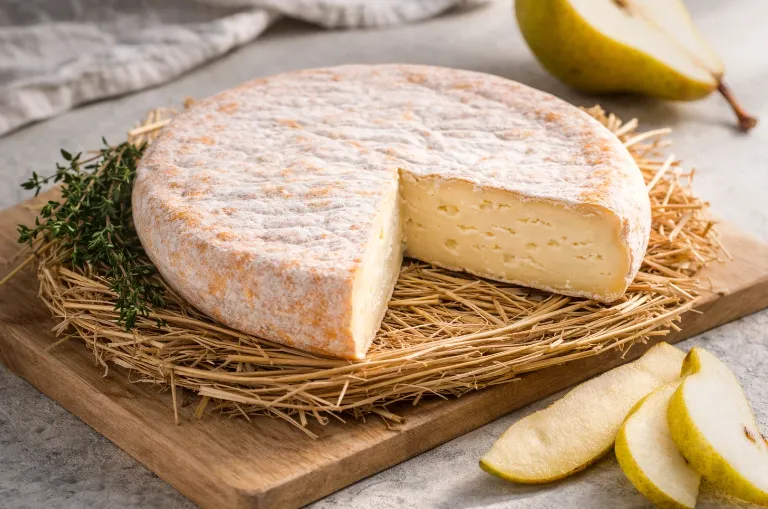
A full Reblochon is a flat disc of about 14 cm (5½ in) across, weighing 450 to 550 g, and there’s also a petit Reblochon of about 9 cm (3½ in). Look at the small round casein disc on the rind: green means fermier, made on the farm with the farm’s own milk, and red means laitier, made in a dairy.
What it tastes like
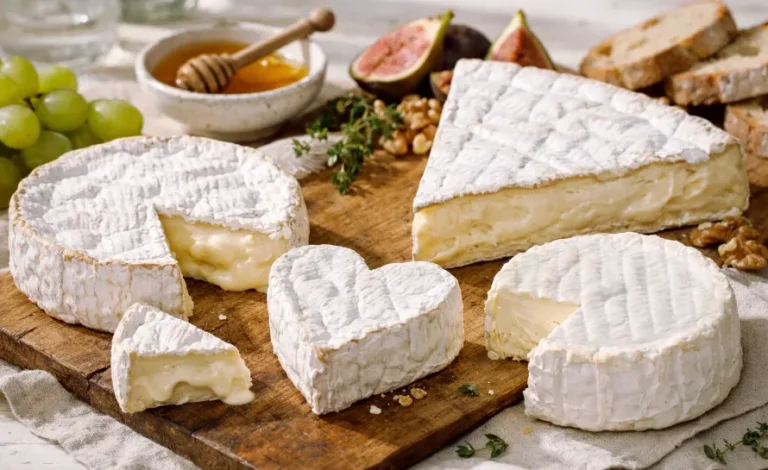
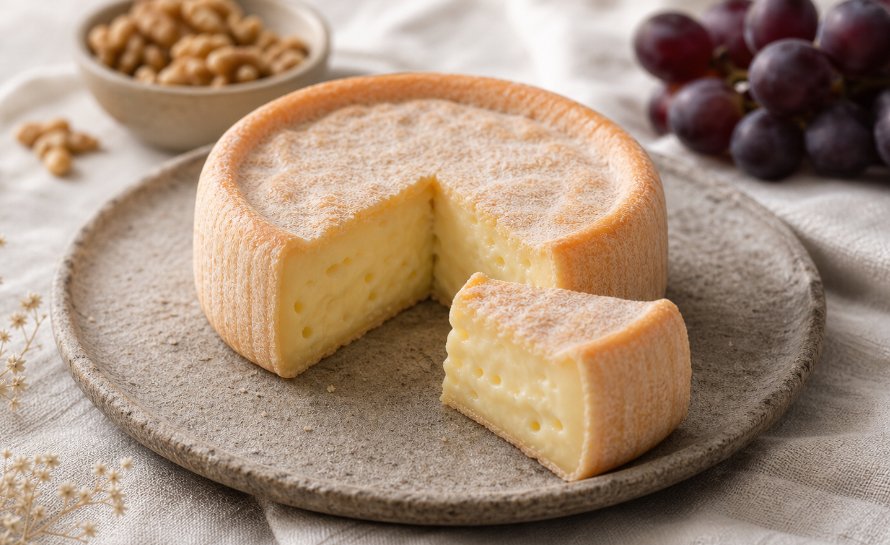
The rind is thin, golden to pale orange and dusted with a fine white bloom, and it smells of cellar, hay and a little of the cowshed, though much more gently than a lowland washed rind. Inside, the paste is supple and creamy, soft enough to bulge when it’s ripe, with a mild, nutty, milky flavour and a slightly fruity finish. A young one is springy and fresh, while a riper one becomes almost runny towards the rind.
How to eat it
Reblochon is the cheese in tartiflette, the Savoie gratin of potatoes, onions and cream, finished with a whole Reblochon on top. Most accounts say the dish was popularised in the 1980s by the Reblochon trade association, and the traditional version includes bacon, though it’s just as good without. On a cheese board, serve it at room temperature with country bread and a white wine from Savoie, such as a Jacquère or a Chignin-Bergeron.
Raw-milk Reblochon is aged for far less than 60 days, so it can’t be sold in the US, and you’ll find pasteurised Reblochon-style cheeses there instead. In the UK, the real thing is available in good cheese shops.
Mont d’Or
Made in
The Haut-Doubs, in Franche-Comté, close to the Swiss border, at 700 m and above
Milk
Raw whole cow’s milk (Montbéliarde and French Simmental cows)
Aged
At least 21 days, including at least 12 days on spruce boards
AOP/PDO Status
Yes (AOP since 1996, AOC since 1981)
Fat content
At least 45% fat in the dry matter
Best Time
Only sold from 10 September to 10 May
Where it comes from
Mont d’Or, also called Vacherin du Haut-Doubs, is a winter cheese. It can only be made between 15 August and 15 March, when the cows are back near the farms and give less milk, too little for the big wheels of the mountain cheeses, so farmers turned it into smaller soft cheeses instead. It’s sold only from 10 September to 10 May.
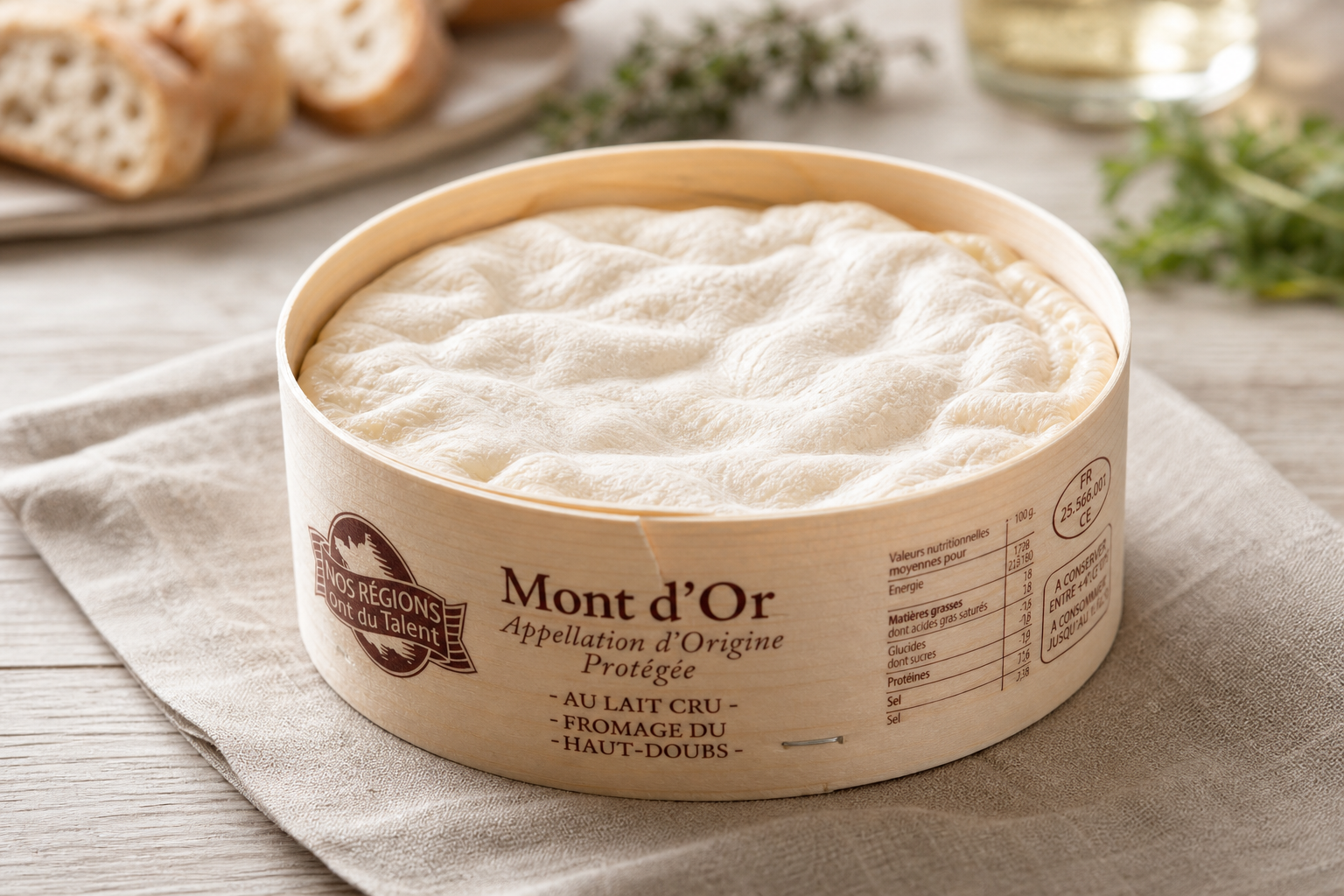
What makes it recognisable straight away is the spruce. Each cheese is bound with a strip of spruce bark, which holds the soft paste together, ripens on spruce boards and is sold in a round spruce box, and all three give it a light resinous scent.
What it tastes like
Under its wavy, golden to pinkish rind, a ripe Mont d’Or is so soft it’s almost liquid, and you eat it with a spoon. It tastes creamy and milky, with a light tang, a mushroomy note from the rind and the woody, slightly balsamic taste of the spruce. Younger ones hold their shape a little better, and the riper ones flow as soon as the top rind is cut.
How to eat it
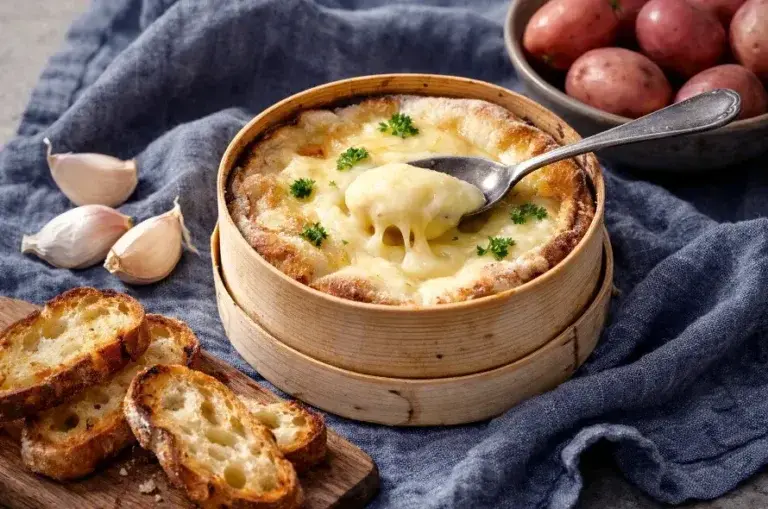
The classic is the boîte chaude, “hot box”: make a hole in the top of the cheese, pour in a splash of dry white wine and add a sliver of garlic, then wrap the box in foil and bake it until bubbling. Everyone dips potatoes and bread straight into the box. At room temperature, it’s lovely spooned onto bread, and a white wine from the Jura goes well either way.
French Mont d’Or is made with raw milk and aged for less than 60 days, so it isn’t sold in the US, but you’ll sometimes find the Swiss version, Vacherin Mont-d’Or, which is made with heat-treated milk. In the UK, Mont d’Or arrives in cheese shops every autumn.
Vacherin d’Abondance
Made in
The Abondance valley, in the Chablais, Haute-Savoie, near Lake Geneva
Milk
Whole cow’s milk, made on farms
Aged
Around three to four weeks
AOP/PDO Status
No
Fat content
Not specified
Best Time
Winter
Where it comes from
Vacherin d’Abondance is a rare winter cheese from the same valley as the big Abondance wheels. Local accounts trace it back to the Middle Ages and the canons of the Abbey of Abondance, though that’s difficult to prove. It’s made in very small quantities on a handful of farms, only in winter, and it has no AOP, so it’s mostly sold in the valley and in a few specialist cheese shops.
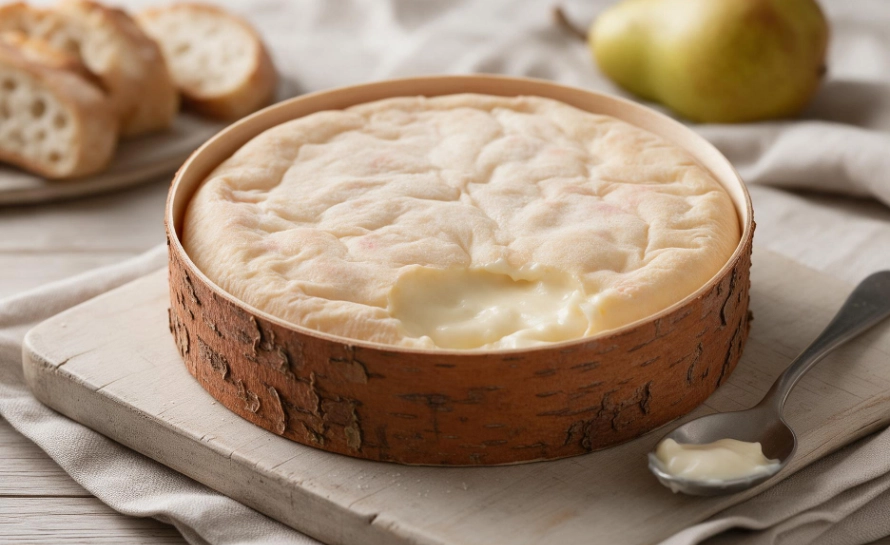
Like Mont d’Or, it’s bound with a band of spruce and aged on spruce boards, and it’s a thick disc of around 12 to 15 cm (5 to 6 in) across, weighing 500 to 600 g.
What it tastes like
The washed rind is smooth, brick-coloured to rosy, and the paste is creamy and supple, sometimes runny when it’s ripe. It smells lightly of fermentation and resin, and it tastes mild and milky, with the same slightly balsamic note from the spruce as Mont d’Or, but a little firmer and more delicate.
How to eat it
In the valley it’s eaten mostly as it is, on a cheese board, or warmed and spooned over jacket potatoes with a green salad. A white wine from the Chablais, such as a Crépy, is the local pairing.
You’re unlikely to find it outside France, so if you’re in Haute-Savoie in winter, look for it at markets and farm shops in the Chablais.
Abbaye de Tamié
Made in
The Abbey of Tamié, at about 900 m above Albertville, Savoie
Milk
Raw whole cow’s milk from nearby farms
Aged
Around four weeks
AOP/PDO Status
No
Fat content
Not specified
Best Time
All year
Where it comes from
Abbaye de Tamié is made by the Cistercian monks of Notre-Dame de Tamié, an abbey founded in the 1130s near the Tamié pass, between Albertville and Annecy. Sources disagree on when the monks started making cheese, but today they make it in the abbey dairy with raw milk collected every day from a few local farms, then age it in the abbey’s vaulted cellars.
It comes in two sizes, a small disc of around 600 g and a larger one of about 1.4 to 1.5 kg, and you’ll recognise it by its wrapping: blue paper printed with a white Maltese cross.
What it tastes like
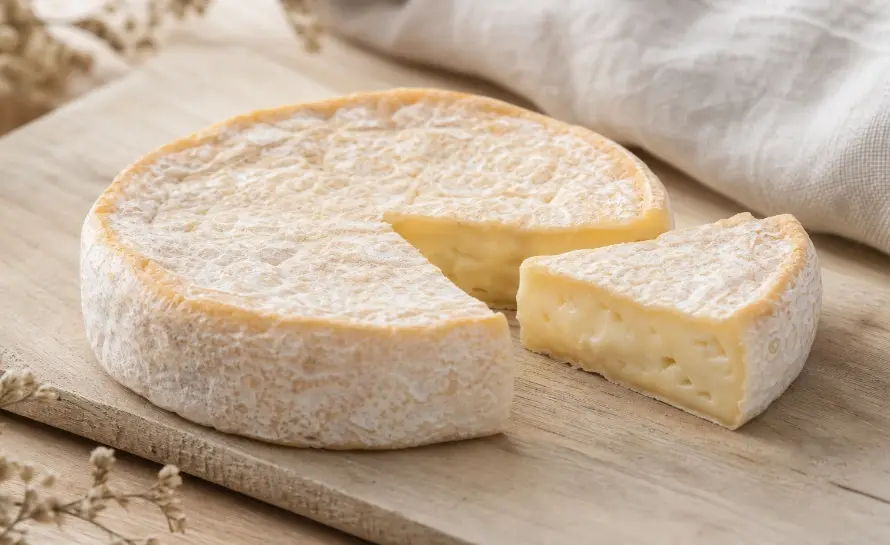
It’s made much like Reblochon and washed with brine during ageing, which gives it a thin, sticky, pinkish-orange rind with a fine white down. The smell is stronger than the taste, with hay and cellar on the rind, while the paste is smooth, soft and creamy, with a delicate flavour of cream, a little salt and hay, slightly firmer and fuller than a Reblochon.
How to eat it
Serve it on a cheese board at room temperature, with good bread and a white wine from Savoie, and let it be the cheese people ask about. It also melts well over potatoes in the same way as Reblochon, if you have a large one to use up.
Because it’s made in small quantities, it’s mostly found in good cheese shops in France and a few specialists abroad, and the abbey also sells it in its own shop.
Chevrotin
Made in
The mountains of Haute-Savoie (Chablais, Mont Blanc and Aravis) and the Bauges in Savoie
Milk
Raw whole goat’s milk, from herds of at least 80% Alpine goats
Aged
About three weeks
AOP/PDO Status
Yes (AOC since 2002)
Fat content
At least 40% fat in the dry matter
Best Time
Spring to autumn, when the goats are out on the pastures
Where it comes from
Chevrotin is the goat’s milk cousin of Reblochon, made in the same mountains with a similar method. According to its appellation file, it’s been known since at least the 17th century, and it turns up in old leases where farmers renting mountain pastures paid part of their rent in cheese. Goats were often kept alongside the cows, and their milk was made into small cheeses for the family.
It can only be made on farms, with raw milk from the farm’s own herd, and the goats must graze for at least 150 days a year in the area. Each cheese is a small, thick disc of 9 to 12 cm (3½ to 4¾ in) across, weighing 250 to 350 g.
What it tastes like
The washed rind is pale and pinkish, partly or fully covered in a fine white bloom. The paste is soft, smooth and slightly elastic, ivory in colour, with a gentle goat’s milk tang, a sweet, milky side and hints of hazelnut and mountain flowers. It’s much milder and rounder than most goat cheeses, and the finish is clean rather than strong.
How to eat it
Chevrotin is best on a cheese board at room temperature, with country bread, walnuts or a few slices of pear, and a crisp Savoie white. Because it’s small and delicate, it’s also a good cheese to serve whole, so everyone can cut their own wedge.
As a young raw-milk cheese it can’t be sold in the US, and it’s rare even in the UK, so it’s one to look for at markets and cheese shops in Savoie.
Conclusion
If you’re in France in September, you’ll notice something happen as soon as the first hint of coolness is in the air: people start talking about Mont d’Or coming back. The summer heat is finally breaking, and suddenly there it is on every cheese counter in its spruce box, while people who were perfectly happy with salads all summer start planning their first boîte chaude. These five cheeses belong to that time of year, from the Reblochon you put on the board when friends come over to the Mont d’Or you bake on a cold evening.
Start with a Reblochon and a Mont d’Or, then look out for Abbaye de Tamié and Chevrotin in a good cheese shop, and save the Vacherin d’Abondance for a winter trip to the Alps. Buy one when you see it, take it home, leave it out for an hour so it’s not cold, and eat it with whatever good bread you have!
Which of these five have you tried, and is there another Alpine cheese you’d like to see in a future list? Tell me in the comments!
A Complete Hosting Guide
This complete guide takes the intimidation out of French cheese and wine hosting, so you can create an impressive, memorable evening that feels effortless.
Just so you know, a few links here earn us a commission. Doesn’t cost you anything extra, and we only link to things that are actually worth your time.