Meringues
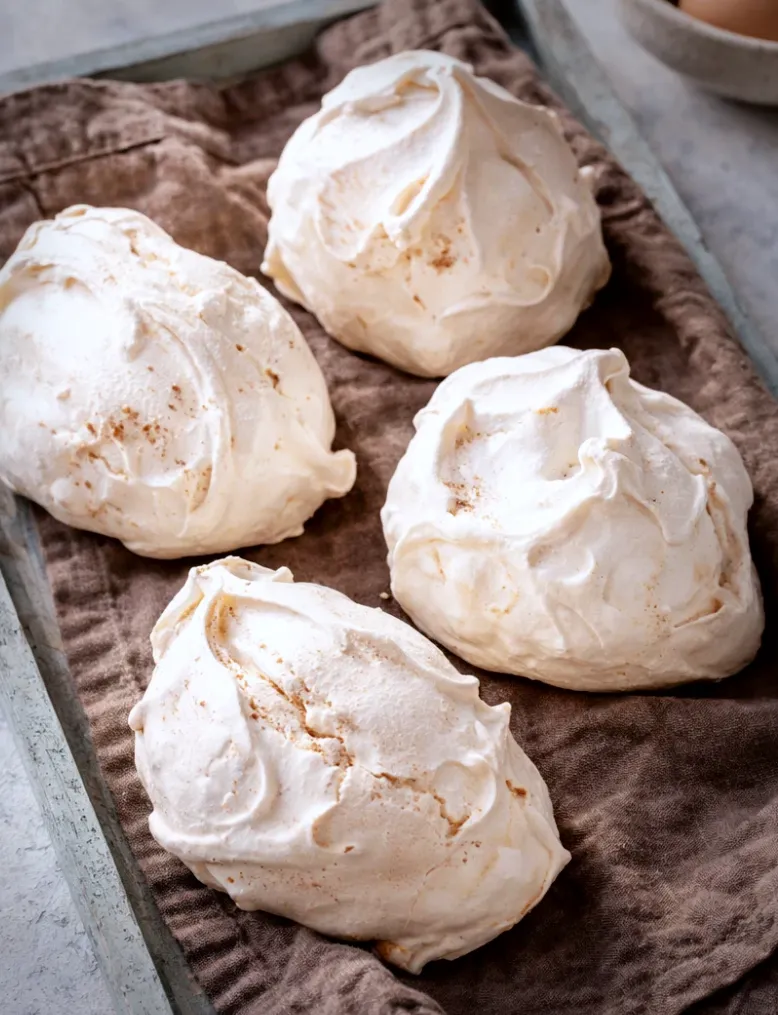
Big, cloud-white meringues that shatters and dissolve into something sweet on your tongue. Crisp all the way through, light as air, with that faint chew right at the centre!
Ingredients
- 3 eggs about 90gr, at room temperature
- 90 gr caster sugar
- 90 gr icing sugar
- 1 pinch salt
Instructions
1. Prepare your setup
- Heat the oven to 100°C (90°C fan). Line a tray. Wipe the bowl and whisk with vinegar or lemon juice and dry, so they're grease-free. Separate the eggs carefully (no yolk in the whites) and bring the whites to room temperature.
2. Start whisking the egg whites
- Whisk the whites with the salt on medium speed until foamy, then to soft peaks that flop over, about 2 to 3 minutes.
3. Add the caster sugar gradually
- With the mixer running, add the caster sugar a tablespoon at a time, waiting 15 to 20 seconds between each. The meringue turns glossy and smooth.
4. Whisk to stiff peaks
- Increase to medium-high and whisk to stiff, glossy peaks that stand straight up, another 5 to 7 minutes. Rub a little between your fingers; if gritty, keep whisking until smooth.
5. Fold in the icing sugar
- Sift the icing sugar over and fold in gently with a spatula, keeping the air in.
6. Shape large meringues
- Using two large spoons, shape 6 generous domes onto the tray, spaced at least 5cm apart. Keep them rustic.
7. Bake low and slow
- Put them in and immediately reduce to 90°C (80°C fan). Bake for 2 hours, until they lift cleanly and sound hollow when tapped underneath, crisp outside, dry inside.
8. Cool completely
- Turn off the oven, crack the door open, and leave them to cool completely inside, about 1 hour. If still soft in the centre, return to the low oven for 30 minutes.
Notes
- The traditional French ratio: French meringue uses the "tant-pour-tant" (equal weights) method: the same weight of egg whites, caster sugar, and icing sugar. Total sugar = 2x the weight of egg whites. For this recipe: 90g egg whites + 90g caster sugar + 90g icing sugar = 180g total sugar. This is the classic French proportion found in virtually all traditional recipes.
- Why two types of sugar? The caster sugar is whisked into the whites to stabilize them and create structure. The icing sugar is folded in at the end, it adds extra sweetness and helps create that signature crisp, shattering texture. Both are essential to proper French meringue.
- Room temperature matters: Room temperature egg whites whip to greater volume than cold ones.
- Don't make meringues on a rainy or humid day. The sugar absorbs moisture from the air. On humid days, your meringues will never crisp up properly and will turn sticky and soft. Wait for a dry day.
- Store cooled meringues in an airtight container at room temperature for up to 2 weeks. Don't refrigerate them, the moisture will make them sticky. If they do get soft, you can re-crisp them in a low oven (90°C) for 15-20 minutes.
- Troubleshooting weeping meringues: If your baked meringues develop sticky beads of moisture on the surface, you either didn't whisk long enough to dissolve all the sugar, or you baked them at too high a temperature. The sugar is weeping out. They're still edible, just not as pretty.
- Traditional French meringues have no added flavoring, just the pure sweetness of sugar and egg whites. If you want to add a little something, you can add vanilla, use 1/2 tsp vanilla extract folded in with the icing sugar.