Nobody prepares you emotionally for Oradour-sur-Glane.
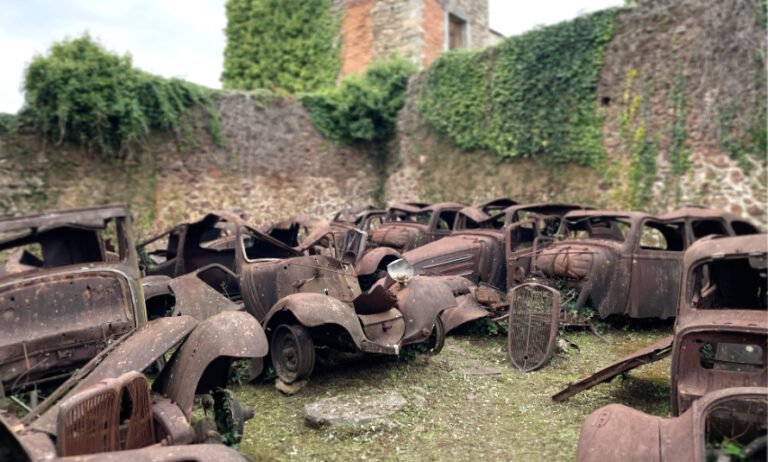
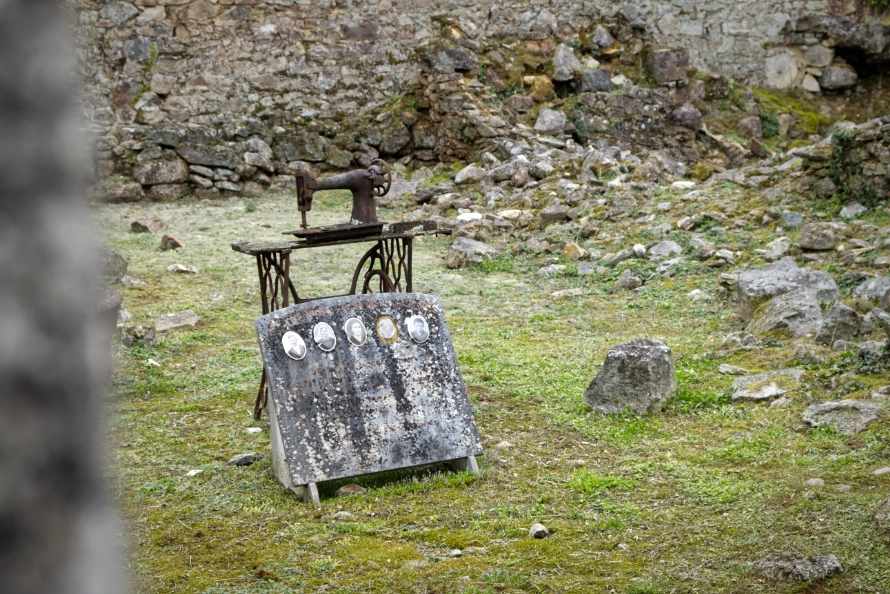
You walk into the ruins expecting rubble, and rubble is what you get for the first minute. Then you start noticing what’s in it. A sewing machine, rusted into its table. A bicycle frame against a wall. Car bodies in what used to be a garage. Scales on a shop counter. Bed frames. Saucepans.
The village wasn’t cleared. It was left. And what that means is that you aren’t walking through a monument, you’re walking through somebody’s Saturday, stopped at two in the afternoon on 10 June 1944 and never restarted.
We went, walked the length of the main street more or less in silence, and we paid our respects with heavy hearts. I thought for a while about whether to write this at all, because it isn’t a place you recommend the way you recommend a market or a village with a nice church. But sharing this story is vital. By writing about Oradour, we shine a light on humanity’s darkest moments and hope to ensure that such tragedy is never repeated.
It’s twenty minutes from Limoges, around three hundred thousand people go every year, and a lot of them arrive knowing only that something terrible happened here. So here is what happened, what you’ll actually see, and the part of the story almost nobody outside France.
Table of Contents
What happened on 10 June 1944
Four days after the Normandy landings, the 2nd SS Panzer Division Das Reich was moving north from the south-west towards the front, and was being harried the whole way by the Resistance.
At around two in the afternoon on 10 June, somewhere between one and two hundred men of that division drove into Oradour. To the villagers it looked at first like a routine identity check. Nobody in Oradour-sur-Glane had been involved in Resistance action. Most people there had never even seen a German soldier in the village.
Robert Hébras, who was nineteen that day, said afterwards that this was precisely how they knew nothing was coming. If there had been the least thing, he said, they would never have walked to the assembly point like a flock of sheep.
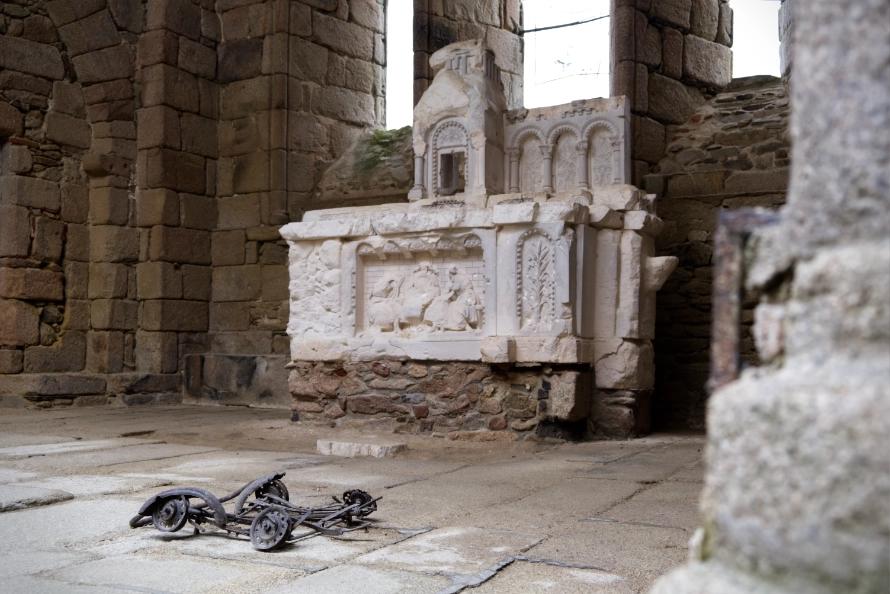
The population was gathered on the fairground. The men were divided up and taken into barns and garages. The women and children, around four hundred and fifty of them, were put into the church.
The men were shot, deliberately low, at the legs, and then the buildings were set alight. In the church the soldiers set off a smoke device, fired on the women and children who tried to get out through the windows and the doors, and then burned the building. The floor gave way.
By the end of the afternoon 643 people were dead: 190 men, 247 women and more than 200 children. Sixty-eight of the children were under six. The village had been burned to the ground.
Six men survived, out of the barns, by lying under the bodies of their neighbours. One woman survived the church. Her name was Marguerite Rouffanche. She got out through a window behind the altar and lay in the ground behind the church until the next morning.
Why Oradour-sur-Glane was chosen has never been settled. The likeliest explanation involves a confusion with another village of a similar name and the capture of an SS officer nearby. No good reason has ever been established, because there wasn’t one.
What happened afterwards
Most stop at the story of the massacre. What follows is, to French people, almost as important, and it explains several things you’ll notice while you’re there.
The ruins were kept on purpose
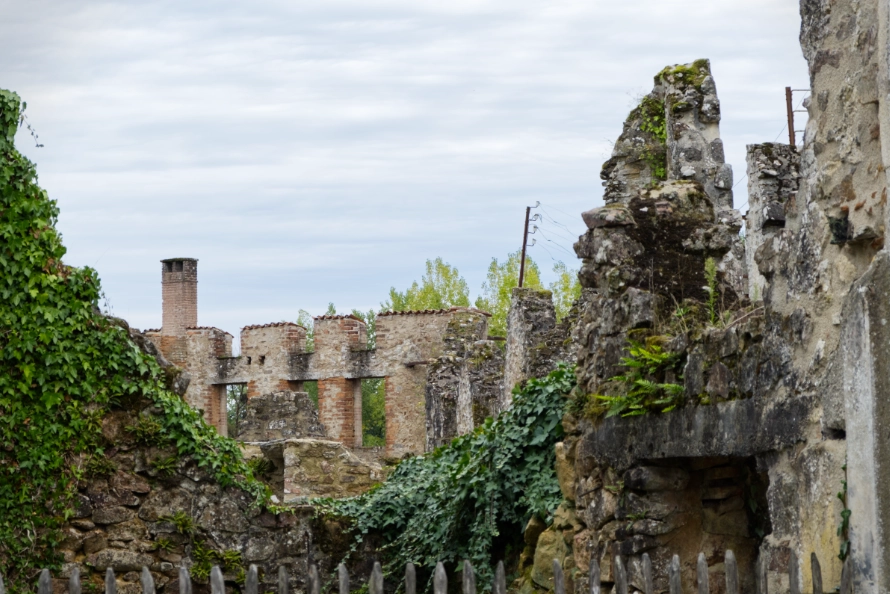
Charles De Gaulle came in March 1945 and it was decided the village would be left standing exactly as it was, as evidence and as an enduring symbol of Nazi brutality and war’s cruelty. A new Oradour was built alongside, and the old one was classified as a historic monument in 1946. The survivors and the bereaved families moved a few hundred metres up the road and spent the rest of their lives living next to it. You might think this cruel, but some might agree that staying near the memory of their loved ones might be what they wanted and needed.
The trial was a catastrophe
It opened in Bordeaux in January 1953, nine years after the fact. Of sixty-five men identified, twenty-one turned up. Not one of them was an officer. The commander who gave the order had been killed in Normandy. His captain had vanished. The general, Lammerding, was living in Düsseldorf in the British zone, entirely untouchable, and had the nerve to write to the court saying his men had only been obeying orders.
Of the twenty-one in the dock, fourteen were French. They were Alsatians, and thirteen of them were so called malgré-nous: men from the annexed departments of Alsace and Moselle who had been conscripted into German uniform against their will. That one fact made the trial impossible to resolve. Alsace saw its own forced conscripts sitting beside actual Germans. The Limousin saw the men who had burned their families.
The verdict came on 13 February 1953 and satisfied nobody at all. Two death sentences. Prison terms of five to twelve years for the rest and one acquittal.
And then, eight days later, parliament amnestied the Alsatians in the name of national unity. They walked out of prison the same day. The men under sentence of death were pardoned soon after.

What Oradour-sur-Glane did next
This is the part I find hardest to shake, and it’s why this war village feels the way it does.
Oradour sent everything back. The Croix de Guerre. The Légion d’honneur. The commemorative plaque de Gaulle himself had presented in 1945. All of it returned to the state.
The families refused to allow the ashes of their dead into the crypt the state had built for them, and buried them elsewhere instead.
Government representatives were barred from the commemorations for more than twenty years.
And at the entrance to the village they put up the names of the 505 parliamentarians who had voted for the amnesty.
Two wounds facing each other, neither of them closing. The historian Pascal Plas describes it as a Franco-French injury that has never really healed, and he’s probably right. It took decades before the village and the state were properly reconciled.
It wasn’t until September 2013 that a German president came. Joachim Gauck walked through the ruins with François Hollande and with Robert Hébras, who was by then in his late eighties all holding hands.
Robert Hébras died on 11 February 2023, aged ninety-seven. He was the last of the survivors.
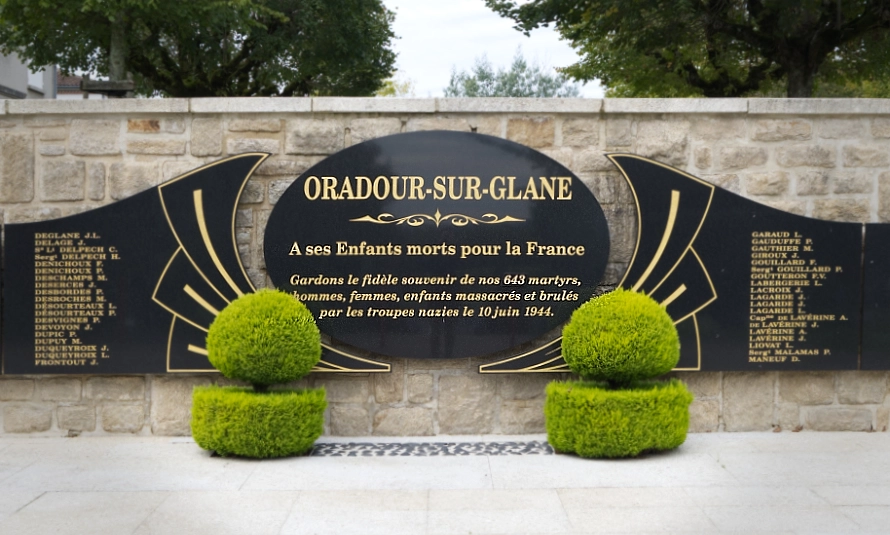
What you’ll see
The ruins are open and free, all year, in daylight. You go in through the Centre de la Mémoire and come up into the village at the end of the main street.
Then you walk the length of it. Tram rails still set in the road. Shopfronts with the lettering still faintly legible. The garage with the cars in it. Small signs at each of the barns, marking who the people were that were shot. And the church at the far end where you can go inside if you have the courage as this is by far the hardest part.
Allow yourself time. It’s around two kilometres of walking, but if you’re like us, you will stop often to try to really stand still and reflect on the horrors of war and the importance of peace.
The memorial and The Centre de la Mémoire
Since 1999, the site of Oradour-sur-Glane has been accessible through the Centre de la Mémoire. This underground museum offers a profound experience with exhibits, photographs, testimonies, and a short film shot within the ruins, compiled from the stories of survivors. It aims to educate visitors about the sheer brutality of the massacre, the context of the Nazi occupation, and the importance of remembrance.
The centre also includes a special tribute: a gallery displaying portraits of the victims printed on porcelain plaques. This tribute particularly highlights the six people who survived the massacre, giving a human face and personal story to those few who lived through the tragedy, alongside remembering all the lives lost.
The site is a place for education, remembrance, and the ongoing fight against forgetting. The French government and various organisations continue to develop educational programs, exhibitions, and commemorations to ensure that the tragedy of Oradour-sur-Glane remains etched in collective memory.
A powerful beacon
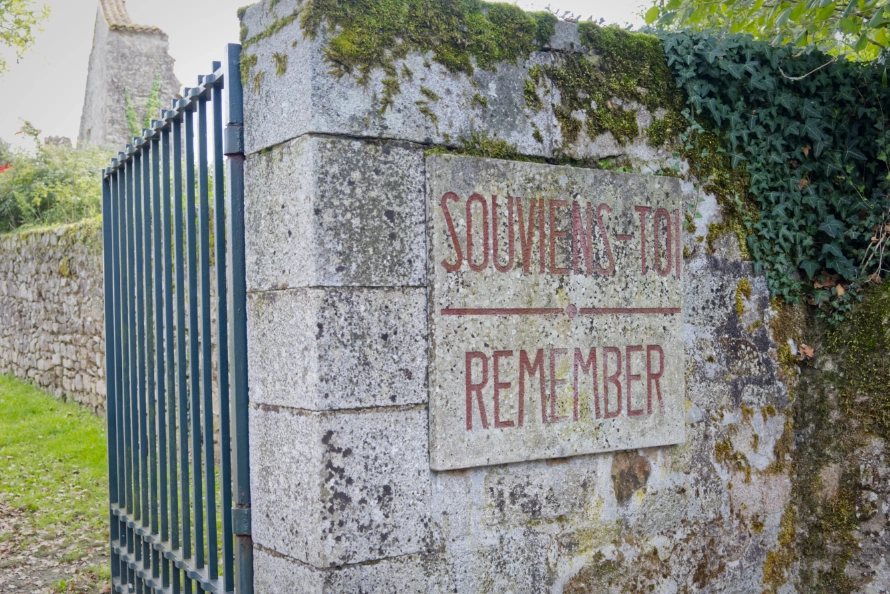
Oradour-sur-Glane is not a place for a light-hearted stroll, nor should it be. It is a village frozen in time, where the silence between the crumbling walls speaks louder than words ever could. Visiting here is a solemn invitation to witness history’s darkest hour and to remember the lives brutally torn away. Yet, amidst the ashes, Oradour-sur-Glane also shines as a powerful beacon, an enduring testament to resilience, memory, and the unyielding hope for a world where such horrors are never repeated.
I think you should go because 643 people were killed in an afternoon for no reason at all.
Stepping into Oradour-sur-Glane is walking alongside the past with open eyes and an open heart. It demands reflection, respect, and the commitment to keep these stories alive, not just for France, but for humanity. If ever a place could teach the true cost of war, this is it.
So, when planning your travels through the beautiful Limousin region, carve out time for Oradour-sur-Glane. It will challenge you, move you, and stay with you long after you leave. And that, truly, is the power of visiting a place that never forgets.
Practical information for Oradour-sur-Glane
- Getting there
Oradour-sur-Glane is located about 20–22 kilometres northwest of Limoges. The site is easiest reached by car, with well-marked routes from Limoges via the D9 or D941. While direct public transport options are limited, you can take a train to Limoges then catch a taxi or a rare local bus towards the village. - When to visit
The Centre de la Mémoire is open year-round from 15 January to 15 December, seven days a week, opening at 9 am and closing between 5 and 7 pm depending on the season. The ruined village itself is open and freely accessible during daylight hours. Spring to early autumn offers the most pleasant weather for walking the ruins and exploring the surrounding countryside. - Admission
Entry to the old village ruins is always free and open. The permanent exhibition at the Centre de la Mémoire costs €7.80 for adults, €5.20 for concessions, or €22 for a family group. Temporary exhibitions, events and special activities may have additional charges.
FAQ
What happened at Oradour-sur-Glane?
On 10 June 1944, four days after the Normandy landings, men of the 2nd SS Panzer Division Das Reich entered the village, gathered the population, shot the men in barns and garages, and burned the women and children inside the church. 643 people were killed and the village was destroyed.
How many people died at Oradour-sur-Glane?
643: 190 men, 247 women and more than 200 children, 68 of them under six years old. Six men and one woman survived.
Why was Oradour-sur-Glane attacked?
No satisfactory reason has ever been established. The likeliest explanation combines a confusion with another similarly named village and the capture of an SS officer nearby. Oradour itself had no Resistance activity, which is why the villagers assembled without resistance when ordered to.
Can you visit Oradour-sur-Glane?
Yes. The ruined village is preserved as it was and is freely accessible in daylight hours, all year, at no charge. The Centre de la Mémoire, an underground museum at the entrance, charges around €8 for adults and provides the historical context.
Is Oradour-sur-Glane suitable for children?
There is nothing graphic on display, but the subject is extremely difficult and signs mark where children were killed. Broadly, secondary-school age and above, with a conversation beforehand. For younger children, consider walking the ruins but skipping the Centre de la Mémoire.
Who was the last survivor of Oradour-sur-Glane?
Robert Hébras, who was nineteen at the time and survived by lying beneath the bodies of his neighbours in a barn. He spent his life giving testimony and died on 11 February 2023, aged ninety-seven.
Was anyone punished for the Oradour massacre?
Barely. The trial opened in Bordeaux in January 1953. Of sixty-five men identified, twenty-one appeared and none was an officer. Sentences were handed down in February 1953, and eight days later parliament amnestied the Alsatian defendants in the name of national unity. They were released the same day.