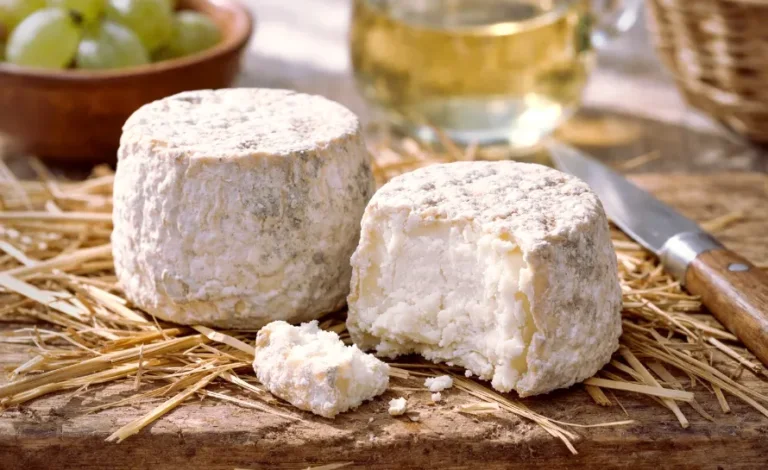
Introduction
Bloomy rind cheeses do have mould on them, and it is worth saying that out loud. The thing is, it is intentional, carefully grown mould that turns plain milk into something pretty wonderful.
You know these cheeses straight away. They are the white wheels and rounds that turn up on almost every cheese board: Camembert, Brie, and all their cousins. That soft white bloomy rind is the really interesting bit. Under it, there is a firm, chalky centre that slowly turns creamy from the outside in, picking up mushroomy, buttery flavours as it ripens.
Like all cheeses, they never really stop changing over time. From the moment they are made, they keep ripening a little every day. The Camembert you bring home when it is still fairly firm will not stay that way. It moves from mild and gentle to fully ripe and complex and, if you leave it too long, to something with a very sharp smell. Knowing at what stage your bloomy cheese is makes a huge difference to picking the right one.
In the end, it is all about what you like. My husband loves his Camembert very ripe and runny, I like it younger, when there is still a chalky line in the middle and neither of us is wrong. You just have to find the point on that curve that makes you happiest.
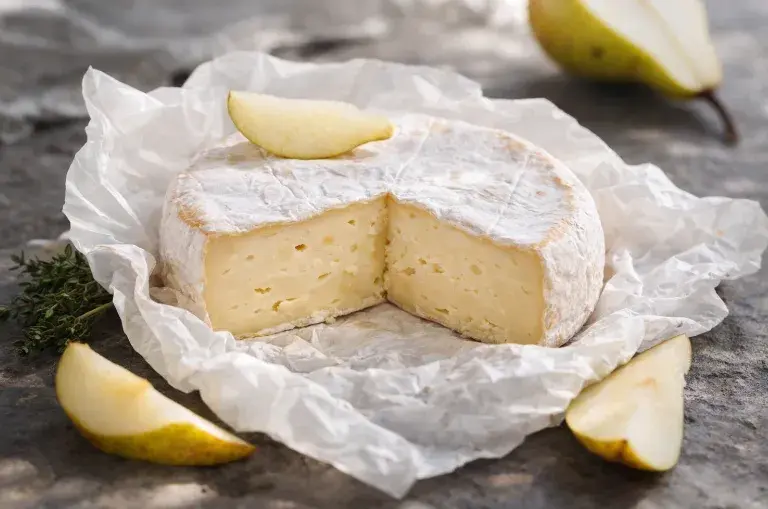
What are French soft bloomy rind cheeses?
In French, these are called “fromages à pâte molle à croûte fleurie,” which translates literally as “soft paste cheeses with flowered rind.” I love that name. It’s so French and poetic and actually quite accurate when you look closely at the rind.
That white, velvety rind comes from specific moulds, mainly Penicillium candidum or Penicillium camemberti, added on purpose during cheesemaking. They are either mixed into the milk or sprayed onto the surface after the cheeses are formed, and as they age the mould spreads over the outside and turns into that familiar fluffy white coat.
It is not there just to look pretty. The mould is busy breaking down proteins and fats from the outside in, which is what creates that softer, more liquid layer just under the rind that cheesemakers call the creamline. When the cheese is young, the centre is still chalky and firm. As it ripens, that creamline slowly moves towards the middle until the whole inside turns creamy, sometimes almost runny at its peak.
The flavour changes along the same path. It starts mild and milky, then becomes more mushroomy and earthy as the mould does its work, and ends up buttery with a slightly funky edge when it is fully ripe.
One more thing that is useful to know: these cheeses are always on the smaller side, usually between 250 g and 3 kg. That is not random. Because they ripen from the outside in, the cheese has to be small enough for the ripening to reach the centre before the outside goes too far, which is why you never see a huge Camembert wheel.
Explore the soft bloomy rind cheeses collection
If you want to learn more, each variety of soft bloomy rind cheeses has its own story. I’ve written individual articles on the main types, with five varieties for each one worth knowing.
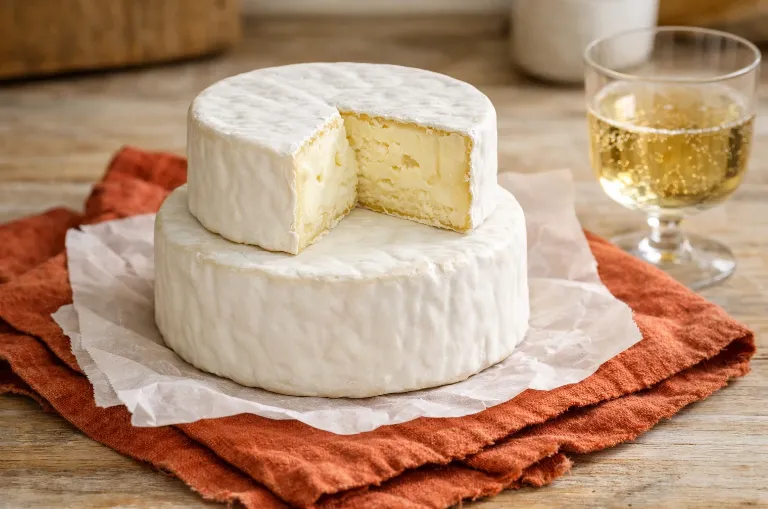
The defining characteristics
What makes bloomy rind cheese distinct?
- White, fuzzy edible rind
Soft, velvety coating from Penicillium candidum/camemberti - Soft paste that ripens progressively
Firm and chalky when young, becoming creamy from outside in - Outside-in ripening
The creamline advances inward as aging continues - Mushroomy, earthy flavours
From the active mold breaking down fats and proteins - Short to medium aging
Typically 2 weeks to 2-3 months maximum - Small format cheeses
Usually 250g-3kg to allow proper ripening - Living, evolving character
These cheeses change continuously, with distinct stages of ripeness
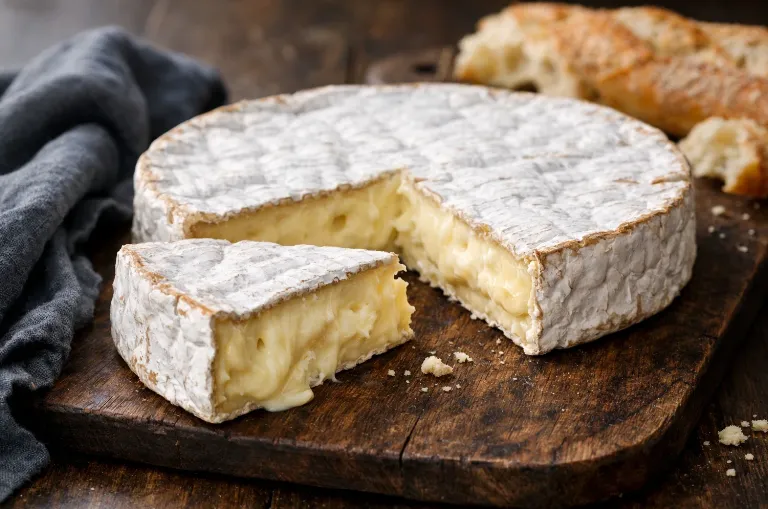
How French soft bloomy rind cheeses are made
The production creates conditions for Penicillium molds to thrive whilst developing the characteristic soft, creamy texture.
1. Milk Preparation
Most bloomy rind cheese uses cow’s milk, though some use goat’s or sheep’s milk. The milk is typically pasteurized for commercial production, though traditional varieties may use raw milk. The milk is gently warmed to around 30-32°C.
2. Culturing and Molding
Mesophilic lactic acid bacteria are added, cultures that work at moderate temperatures to acidify the milk slowly. This is crucial; bloomy rind cheeses need gentle, slow acidification. The white mold spores (Penicillium candidum) are added either at this stage or sprayed on after molding. Rennet is added, and coagulation proceeds for 1-2 hours. The resulting curd is much softer than for pressed cheeses, bloomy rinds need tender curds that drain slowly whilst retaining moisture.
3. Cutting and Draining
The curds are cut gently into large pieces or ladled whole into molds, depending on variety. For traditional Camembert, curds are carefully ladled in thin layers, allowing each to drain slightly before adding the next. This creates specific texture and promotes proper drainage. The cheeses drain naturally, no pressing. They’re flipped regularly (sometimes hourly) during the first day to ensure even draining. The goal is removing enough whey for the cheese to hold its shape whilst retaining sufficient moisture for that characteristic creamy texture.
4. Salting
After draining (typically 24 hours), the cheeses are salted. Most are dry-salted, salt rubbed directly on the exterior, though some are briefly brined. The salt controls moisture, provides flavor, and moderates mold growth during aging.
5. Mold Development
Here’s where the magic happens. The cheeses are moved to aging rooms maintained at cool temperatures (10-14°C) with high humidity (85-95%). If the mold wasn’t added to the milk, it’s sprayed on now. Within days, the Penicillium spores germinate and begin growing, forming the characteristic white fuzz. The cheeses are regularly flipped to ensure even mold coverage. After 7-14 days, the rind is fully formed, soft, white, velvety, completely covering the cheese.
6. Aging and Ripening
Once the rind forms, the real aging begins. The mold produces enzymes that break down proteins and fats, working from the outside inward. The surface becomes soft first, creating the creamline. Over days and weeks, this softening progresses toward the center.
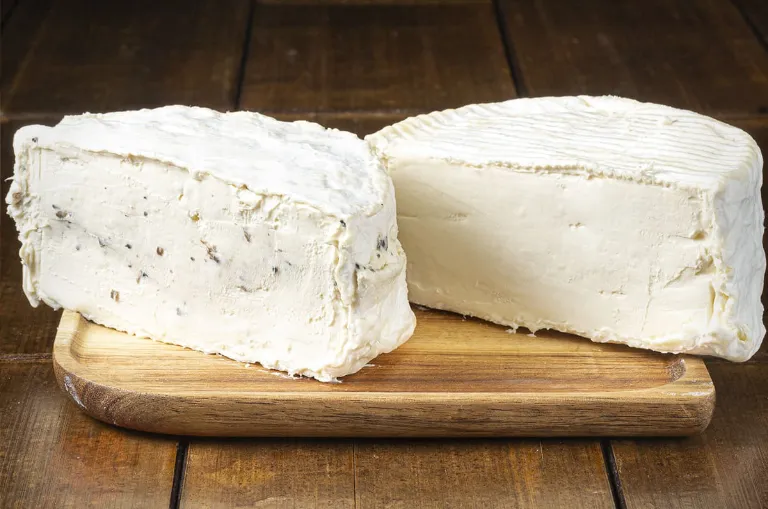
Young bloomy rind cheese (2-3 weeks old) has firm, chalky centers with just a thin creamline. Medium-aged (4-6 weeks) has progressed significantly, with thick creamlines and softening centers. Fully ripe (6-8+ weeks) is creamy throughout, sometimes almost liquid.
The aging time varies by format, smaller cheeses ripen faster than larger ones because there’s less distance for the ripening to travel. Most bloomy rind cheeses are sold at 4-8 weeks, at or approaching peak ripeness.
French soft bloomy rind cheese types
Despite sharing production methods, bloomy rind cheeses offer surprising variety.
By Size and Shape
Large, Flat Wheels (Brie-Style)
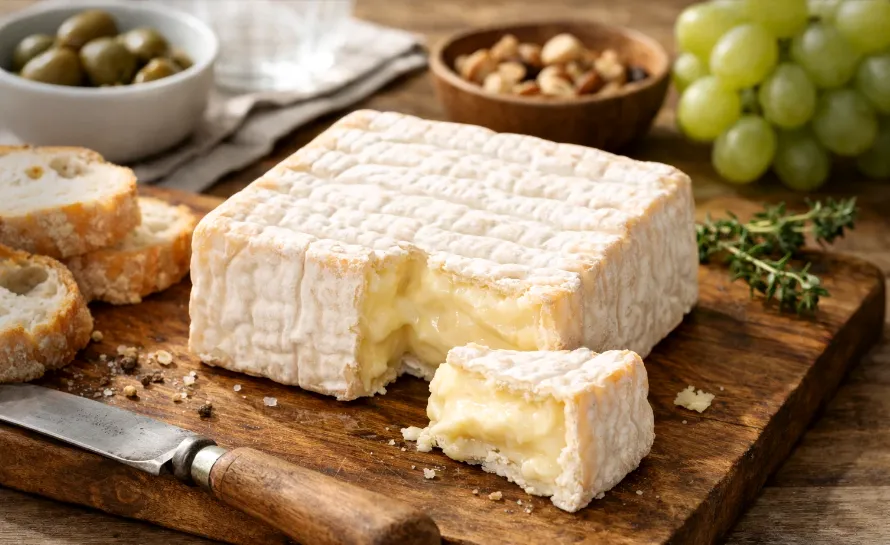
These are the show-off cheeses, large, flat wheels (30-40cm diameter, 3-4cm thick) designed for dramatic presentation. The flat shape means high surface area relative to volume, so ripening progresses quickly throughout. When fully ripe, these wheels become almost liquid in the center, perfect for spreading but challenging to slice neatly.
Expect mild, buttery flavors when young, developing mushroomy depth and slight funk as they ripen. The large format means you’re buying quantity, which can be challenging for small households since these cheeses ripen continuously.
Small, Thick Rounds (Camembert-Style)
More compact format, typically 10-12cm diameter, 3-4cm thick. The thicker profile means ripening takes slightly longer to reach the center, and these cheeses maintain better structure even when fully ripe.
The flavors tend to be more concentrated than large flat wheels. Expect earthy, mushroomy notes with buttery richness. These are practical for home use, a full wheel serves 2-4 people comfortably.
Thick Cylinders and Tall Shapes
Some bloomy rind cheeses are formed as thick cylinders or tall shapes. These take longer to ripen because the ripening must travel further to reach the center. The result is often cheese with distinct textural layers, creamy exterior, firm interior, even when fully aged.
These varieties often maintain a chalky center indefinitely, never becoming fully gooey throughout. Some people prefer this textural variation; others find it frustrating.
By Richness
Standard
Made from whole milk with standard fat content (around 45-50% fat in dry matter), these represent classic bloomy rind character. Expect creamy texture when ripe, mushroomy flavors, pleasant richness without overwhelming fat content.
Double and Triple Cream
Some bloomy rinds have cream added during production, dramatically increasing fat content. Double cream (60% fat in dry matter) and triple cream (75%+ fat) varieties are extraordinarily rich and unctuous.
These develop almost spreadable, butter-like texture even when not fully ripe. The flavors remain relatively mild, the fat coats your palate, moderating the mushroomy funk. They’re indulgent treats rather than everyday cheeses.
By Milk Type
Cow’s Milk
The vast majority use cow’s milk, which creates mild, approachable flavors and reliably creamy textures. These are the bloomy rinds most people know, accessible, crowd-pleasing, versatile.
Goat’s Milk
Less common but increasingly popular, goat’s milk creates distinctively different character. Expect tangier, brighter flavors alongside the mushroomy notes from the rind. The texture tends to be slightly chalky compared to cow’s milk versions, maintaining more structure even when ripe. The contrast between tangy goat’s milk paste and earthy white rind creates interesting complexity.
How to buy French soft bloomy rind cheeses
The label already tells you a lot about what you are buying. An AOC or AOP mark means it has been made in a traditional way under pretty strict rules. With Camembert de Normandie AOC, for instance, you know it has to come from Normandy and be made with raw milk, so that stamp is a good sign you are getting the real thing rather than an imitation.
When you see “lait cru” on the label, which means raw milk, they usually have more depth and complexity in the flavour. Definitely worth hunting down if you can. I also always look at the fat content. Most bloomy rind cheeses sit around 45 to 50% fat, double creams are around 60%, and triple creams are 75% and up, so the higher you go, the richer and more indulgent it will be. If you spot fermier, that means farmhouse made, small scale, traditional methods, and in my experience it is almost always worth choosing.
In the shop, I always give the cheese a gentle press to see where it is in its ripening. If it feels firm all the way through, it is still young. If the outside feels soft but there is a bit of resistance in the middle, it is nicely ripe. If it gives easily from edge to centre, it is fully ripe and the flavour will be quite strong.
From there, you have two options. You can buy it young and let it ripen at home, or pick one that is already close to its sweet spot. A Camembert is usually at its best around four to six weeks after it is made, so if you are planning to eat it that weekend, it is worth checking dates and choosing one that is roughly that age.

How to store French soft bloomy rind cheeses
Storing bloomy rind cheeses is a bit tricky because they never stop ripening. So what you’re really trying to do is control that ripening so you can eat them at the right moment.
The fridge slows everything down dramatically. If your cheese is still young and firm, it can take weeks to ripen in the cold. But leave it at room temperature and the same cheese might be fully ripe in just a couple of days. So you can actually use that to your advantage. If your cheese feels too firm and you want it riper, just leave it out for a day or two. And if it’s getting close to perfect but you’re not ready to eat it yet, put it straight back in the fridge.
Packaging and Containers
For wrapping, bloomy rind cheese needs to breathe but not dry out. Cheese paper or sheets of parchment paper works well, wrapped loosely. What you really want to avoid is cling film. It traps moisture and ammonia, which speeds up overripening and makes the flavour go off.
If your cheese is still actively ripening, you can also store it unwrapped in a covered container, flipping it daily. This lets the gases escape while keeping the humidity right. Once it’s ripe, wrap it to slow things down.
How long will it keep?
As for how long it keeps, that really depends on where it’s at. A young firm cheese will keep for 2 to 3 weeks in the fridge, slowly ripening. A medium ripe one gives you about 5 to 7 days. And a fully ripe soft cheese should really be eaten within 2 to 3 days before it goes too far.
Can you freeze it?
I really wouldn’t. It completely ruins the texture. When it thaws it goes grainy and watery and loses all that creaminess. If you really need to avoid waste, you can freeze it for cooking, but don’t expect much from it.
Serving French soft bloomy rind cheeses
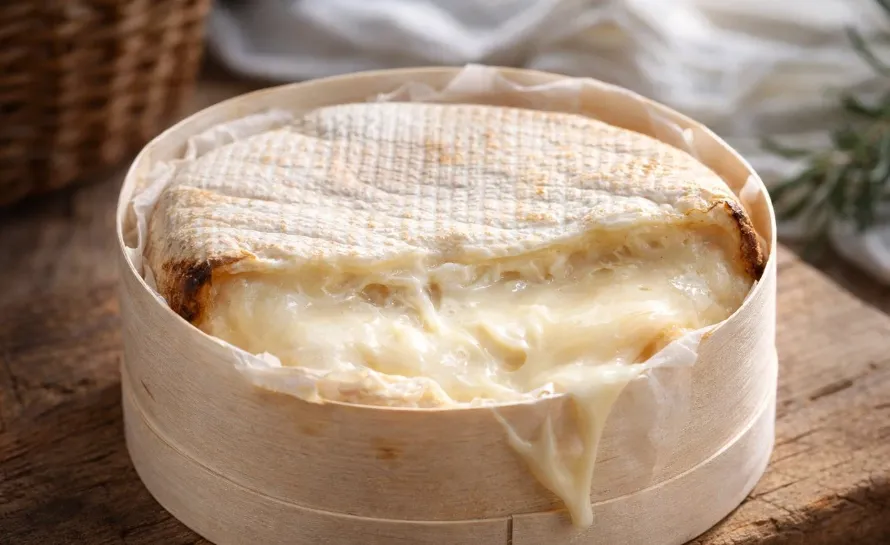
The most important thing with bloomy rind cheeses is to take them out of the fridge in time. At least an hour before serving, ideally longer. Cold bloomy rind cheese tastes flat and the texture is all wrong. You lose everything that makes it special. But give it time to come to room temperature and it completely transforms. The paste softens, the flavours come through, and you get that buttery, mushroomy richness these cheeses are known for. It really makes that much of a difference.
Presentation
For serving, a wooden board and a cheese knife is really all you need. If your Camembert is very ripe though, don’t even bother with a knife., just put a spoon next to it.
The Rind Question
The white rind is completely edible and meant to be eaten. It adds earthy, mushroomy flavors and interesting textural contrast.
Cooking with French soft bloomy rind cheeses
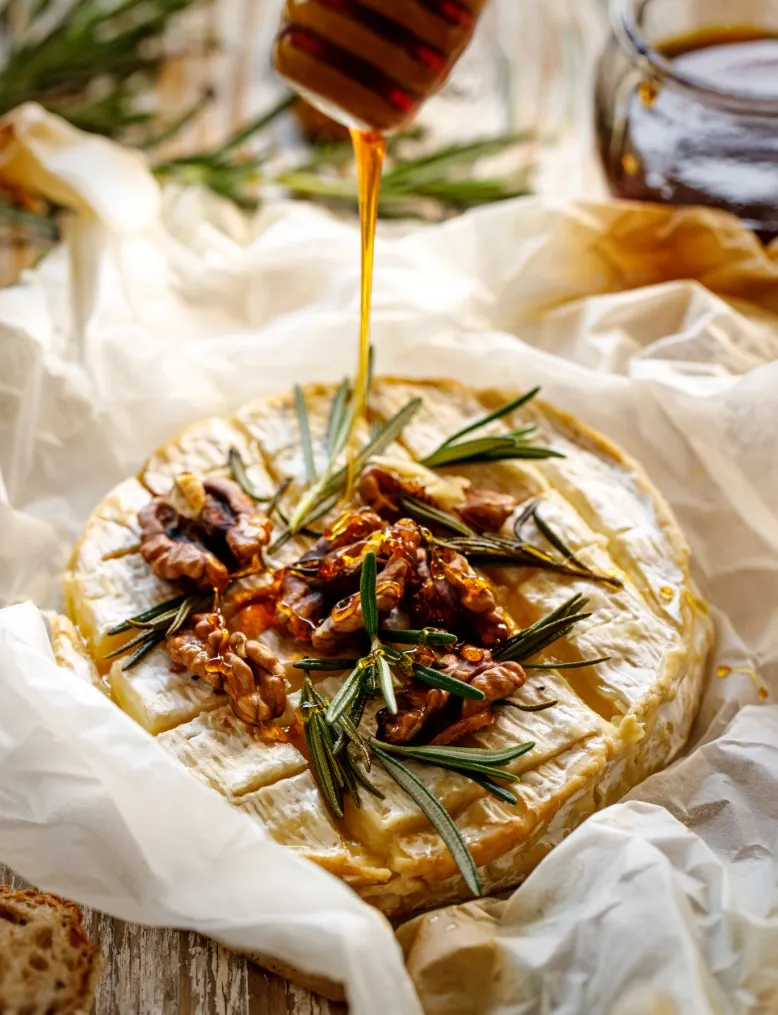
Bloomy rind cheeses are wonderful to cook with. That creamy texture melts beautifully and adds a richness that’s hard to get from other cheeses.
The classic is brie en croûte. You wrap the whole wheel in puff pastry with whatever you fancy inside: jam, nuts, herbs, caramelised onions, or keep it plain and let the cheese shine. Then you bake it until the pastry is golden and the cheese is completely molten inside. You slice it like a pie to serve and it never fails to impress.
We also use it a lot in quiches and tarts. Just cut it into slices and distributed on top of tarts or diced and through the filling. It melts into little pockets of creamy, mushroomy richness throughout. It pairs really well with leeks, mushrooms, or spinach.
For pasta or risotto, stir cubed bloomy rind cheese in just before serving. It melts into a creamy sauce while still keeping a little structure. And mushroom soup with melted Camembert stirred through is a classic French bistro dish that’s so simple and so good.
Even in a sandwich it works beautifully. Sliced bloomy rind with apple and honey makes a really elegant lunch. And if you grill it as a panini, even better.
Health benefits of French soft bloomy rind cheeses
Bloomy rind cheeses are actually pretty good for you. Obviously everything in moderation, but there are some genuinely good things in there.
They’re a decent source of protein, around 20 to 21g per 100g, and they have good calcium too, between 180 and 390mg per 100g depending on the cheese. So if you’re not eating a lot of other dairy, a good piece of Brie or Camembert is doing more for you than you might think. They’re also rich in vitamin B12, vitamin A, and riboflavin, all important for things like nerve function, immune health, and energy.
The fat content is substantial, around 24 to 28g per 100g, which is why they’re so satisfying. A little goes a long way.
The ripening process also creates some interesting compounds. It produces conjugated linoleic acid, or CLA, which research suggests may have anti-inflammatory properties. There’s even some research suggesting that the Penicillium moulds may have probiotic-like effects, though scientists are still looking into that one. Either way, it’s a good excuse to eat more cheese.
Final thoughts
Soft bloomy rind cheeses are French cheesemaking at its most approachable. They don’t need months of aging to be special. What makes them fascinating is how alive they are.
Buy a Camembert today and it tastes one way. Check it in three days and it’s already different. Wait a week and it’s transformed completely. You get to decide when to eat it, and that’s actually part of the fun.
They’re also a great starting point if you’re new to French cheese. Less challenging than a strong blue or a washed rind. Yes, there’s mould. And yes, a properly ripe bloomy rind has funk. But it builds gradually, and you can easily find the stage that suits you.
If you’re just getting into it, start young. A Camembert or Brie that still has a firm chalky centre is a good place to begin. Leave it at room temperature and check it every day, tasting as it goes. You’ll quickly work out where you like it best.
Then when you’re ready, let it go further. A Camembert approaching liquid in the centre, smelling distinctly funky: that’s the full picture. Not everyone wants to go there, and that’s completely fine. But it’s worth trying at least once.
Just pick one good cheese, eat and savour it slowly at room temperature and that’s really all it takes to understand these beautiful cheeses.

A Complete Hosting Guide
This complete guide takes the intimidation out of French cheese and wine hosting, so you can create an impressive, memorable evening that feels effortless.
Just so you know, a few links here earn us a commission. Doesn’t cost you anything extra, and we only link to things that are actually worth your time.