Camembert and 4 Essential French Bloomy Rind Cheeses
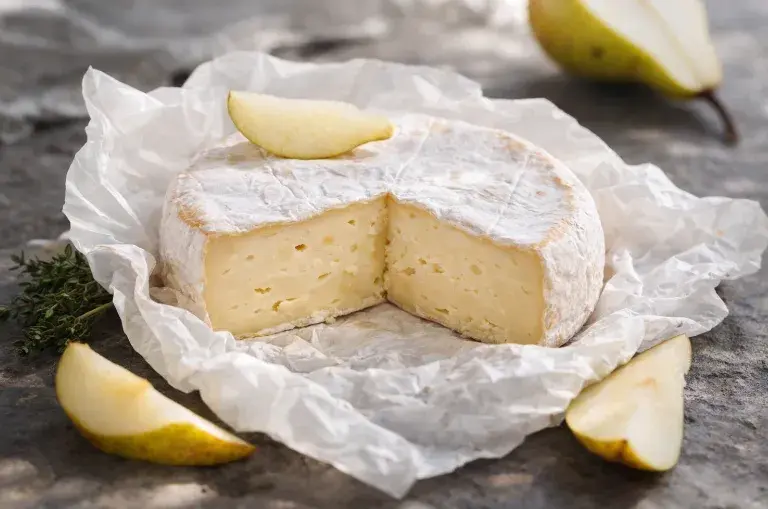
Bloomy rind cheeses are what most people picture when they think of French cheese: soft rounds and wheels with a velvety white rind and a creamy inside that ripens from the outside in. That white coat is a mould, mainly Penicillium camemberti, grown on purpose, and as it slowly breaks down the paste underneath, it gives these cheeses their soft texture and their buttery, mushroomy flavour.
Camembert is the most famous! So famous that it has become a name for a whole style of cheese around the world, but it’s far from alone. Brie de Meaux is much older, Coulommiers is its smaller, chunkier neighbour, Chaource comes from the southern edge of Champagne, and Neufchâtel is the Norman cheese often shaped like a heart. Four of them are protected by an AOP and Coulommiers isn’t, but all five show how much variety you can get from a white rind. If you’d like the basics of how these cheeses are made and how they ripen, my bloomy rind cheese guide explains it all.
Table of Contents
Camembert de Normandie
Made in
Calvados, Manche and Orne, plus the western edge of the Eure, in Normandy
Milk
Raw cow’s milk, from herds of at least 50% Normande cows
Aged
At least 21 days before it reaches the shops
AOP/PDO Status
Yes (AOC since 1983)
Fat content
At least 45% fat in the dry matter
Best Time
All year, at its best from spring to autumn, when the cows are out on grass
Where it comes from
The name comes from the village of Camembert, in the Orne, and the story everyone in Normandy knows is that of Marie Harel, a farmer’s wife who, in 1791, is said to have learned the recipe from a priest she was hiding on her farm during the Revolution. Even the appellation file calls the story unconfirmed. What is certain is that the cheese spread in the 19th century, helped by the railway to Paris and the round wooden box, which made it easy to transport.
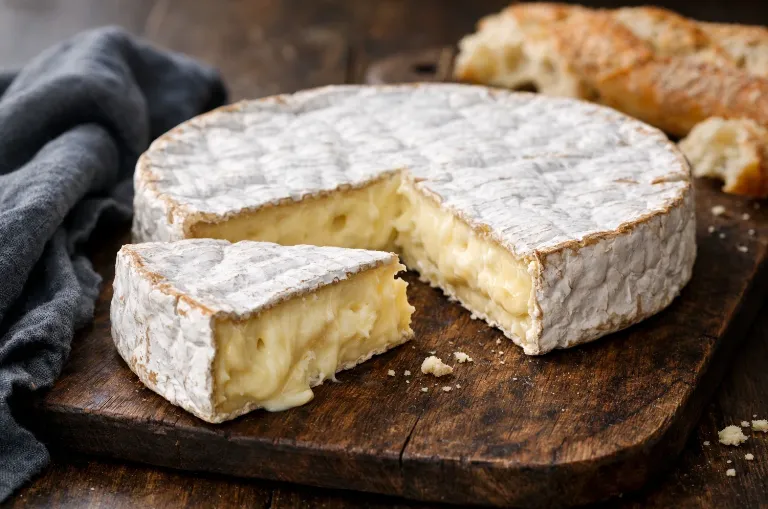
Only Camembert de Normandie is protected. It must be made with raw milk, the curd is ladled into the moulds in at least five passes, and each cheese is a small, flat disc of 10.5 to 11 cm (about 4¼ in) across, weighing at least 250 g. A cheese labelled “Camembert fabriqué en Normandie” or plain “Camembert” isn’t covered by the AOP and is usually made with pasteurised milk.
What it tastes like
The rind is white and velvety, sometimes with reddish speckles, and smells of mushroom, cream and damp cellar. A young Camembert de Normandie still has a chalky centre, while a ripe one is soft and supple all the way through, with a rich, earthy, mushroomy taste, a little tang and, as it gets older, a stronger, farmy note. Very ripe ones start to smell of ammonia, which is the sign to eat them quickly!
How to eat it
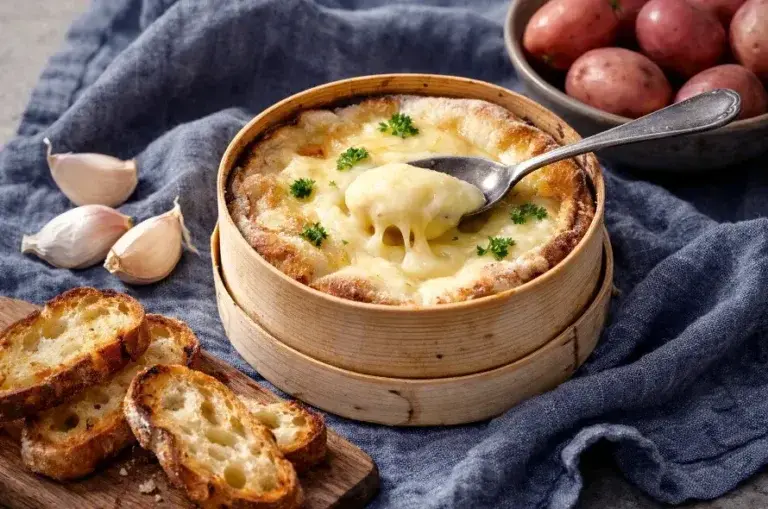
The French eat it at room temperature with a fresh baguette, and in Normandy with a glass of dry cider or, after a big meal, a small Calvados. Camembert baked whole in its box with a little garlic and thyme, it makes an easy dinner with bread and potatoes for dipping. Or you can make little Camembert bites for apero. It also goes really well with apples, walnuts and a little honey.
Raw-milk Camembert de Normandie is eaten well before 60 days, so it can’t be sold in the US, where you’ll find pasteurised Camemberts instead. In the UK, good cheese shops stock the AOP version.
Brie de Meaux
Made in
Seine-et-Marne and parts of the Aube, Loiret, Marne, Haute-Marne and Meuse, east of Paris
Milk
Raw cow’s milk
Aged
At least 4 weeks
AOP/PDO Status
Yes (AOC since 1980)
Fat content
At least 45% fat in the dry matter
Fat content
All year
Where it comes from
This one is close to my heart, as I was born in Meaux, so technically it’s my cheese! Brie de Meaux was originally made on farms around the town and sold at the Meaux market to Parisian cheese merchants, and in the 19th century production spread east towards the Meuse, where larger dairies took over. Two famous stories go with it: Charlemagne is said to have tasted it in the 8th century, and at the Congress of Vienna in 1815, Talleyrand is said to have had it crowned “king of cheeses” in a contest between the delegations. Neither can be proved, but they are lovely tales.
It’s made in large, flat wheels of 36 to 37 cm (about 14 in) across, usually sold by the slice, and it must be made with raw milk.
What it tastes like
The rind is white, often streaked with reddish-brown, and the paste is pale straw yellow, supple and creamy, bulging slightly when it’s cut at the right moment. It tastes of butter, mushroom and hazelnut, with a savoury, slightly fruity depth, and it’s rounder and more delicate than a Camembert de Normandie, though it gets stronger with age.
How to eat it
Buy a wedge from a large wheel, cut at the counter, and eat it at room temperature with a fresh baguette. The French usually serve it on its own on the cheese board, with a light red Burgundy or a glass of Champagne. Grapes and fresh figs go well with it too.
Like Camembert de Normandie, raw-milk Brie de Meaux isn’t sold in the US, but it’s easy to find in the UK.

Coulommiers
Made in
Around Coulommiers, Seine-et-Marne, now made more widely
Milk
Cow’s milk, raw or pasteurised
Aged
A few weeks (no official rules)
AOP/PDO Status
No
Fat content
Not specified
Best Time
All year
Where it comes from
Coulommiers takes its name from a market town in Seine-et-Marne, in the same Brie country as Brie de Meaux, and the French often think of it as a little Brie. Unlike its neighbour, it has no AOP, so it can be made anywhere and with any milk, and most of what you’ll find today comes from dairies, though some farms in the Brie still make it with raw milk.
It’s much smaller and thicker than a Brie, about the size of a side plate, which makes it easy to buy whole and means it ripens more quickly and evenly.
What it tastes like
The rind is white, developing a few rusty patches with age, and the paste is smooth, supple and creamy. It tastes mild, milky and mushroomy, similar to a Brie but a little stronger for its size, and a raw-milk Coulommiers bought from a farm has more depth than a supermarket one.
How to eat it
Serve it whole on a cheese board for a few people, with bread, nuts and fruit, and a light red wine or a cider. Because of its size, it’s also a good cheese to bake whole, like a Camembert, for a warm starter.
Pasteurised Coulommiers can be sold in the US, so you have a better chance of finding it there than the AOP cheeses in this list.
Chaource
Made in
The Aube and the Yonne, in the south of Champagne and the north of Burgundy
Milk
Whole cow’s milk, raw or pasteurised
Aged
About two weeks or more
AOP/PDO Status
Yes (AOC since 1970)
Fat content
At least 50% fat in the dry matter
Best Time
All year
Where it comes from
Chaource comes from the village of Chaource, in the Aube, in an area of clay soils and pastures called the Champagne humide. According to its appellation file, monks spread cheesemaking skills there in the Middle Ages, and the cheese became well known in the 19th century, when it was sold to the workers of the hosiery mills in nearby Troyes.
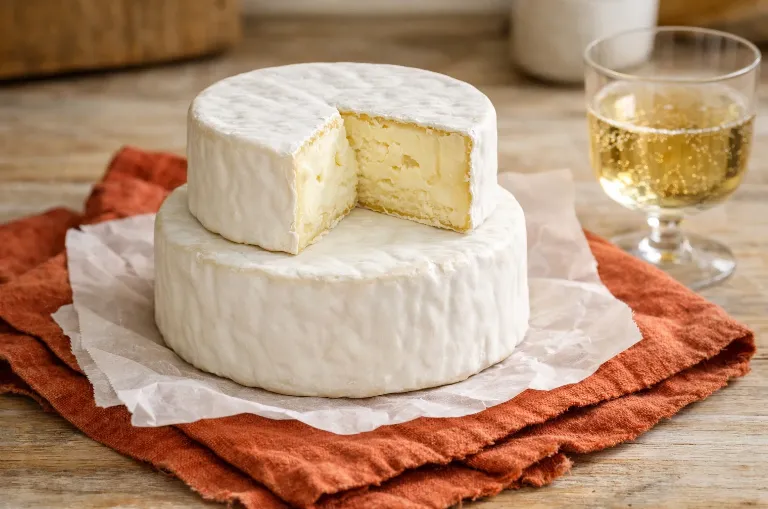
It’s a tall cylinder, about 10 cm (4 in) across, made in two sizes of about 250 g and 450 to 500 g. Unlike Camembert or Brie, its curd sets slowly, mostly through souring, which gives it a different texture.
What it tastes like
The rind is thin and white, and under it there’s a creamy, almost melting layer, while the centre stays fine, dense and slightly chalky for longer than in most bloomy rind cheeses. It tastes milky, buttery and slightly tangy, with a gentle mushroom note, and it’s richer than most because of its higher fat content, without being strong.
How to eat it
Eat it at room temperature on bread, and pour a glass of Champagne, the classic local pairing, or a Chablis from just over the border in the Yonne. It’s one of the gentlest cheeses in this list, so it’s a good one for people new to bloomy rinds.

Neufchâtel
Made in
The Pays de Bray, across the Seine-Maritime and the Oise, in Normandy and Picardy
Milk
Cow’s milk
Aged
At least 10 days
AOP/PDO Status
Yes (AOC since 1969)
Fat content
At least 45% fat in the dry matter
Best Time
All year
Where it comes from
Neufchâtel takes its name from Neufchâtel-en-Bray, in the Pays de Bray, and it’s one of the oldest Norman cheeses: its appellation file traces it back to the 10th century, with a first written mention in a charter from 1037. A popular legend says that during the Hundred Years’ War, young women from the area gave heart-shaped Neufchâtels to English soldiers as tokens of affection, which makes a charming story but can’t be traced back to any source.
It’s the only cheese here that comes in several shapes: the famous heart (cœur) and a large heart, a small cylinder called a bonde and a double bonde, a square (carré) and a little brick (briquette). The smaller shapes weigh at least 100 g and the heart at least 200 g.
What it tastes like
The rind is white and slightly fluffy, and the paste is firmer and more grainy than a Camembert, with a fine, slightly crumbly texture that softens under the rind as it ripens. It tastes saltier and tangier than the others here, with a mushroomy note, and it becomes creamier and stronger with age.
How to eat it
Serve it on a cheese board with a dry Norman cider, or with apple compote or a little honey to balance its tang. The heart shape makes it a lovely cheese to bring to a dinner or to serve on Valentine’s Day.
Don’t confuse it with American Neufchâtel, which is a soft, unripened cream cheese with no rind and nothing in common with the Norman one apart from the name.
Conclusion
Camembert may be the famous one, but put these five side by side and you’ll see how different a white rind can be: the rich, earthy Camembert, the large, buttery Brie de Meaux, the small and easy Coulommiers, the creamy, lactic Chaource and the salty, grainy Neufchâtel. If you’re new to them, start with a Chaource or a Coulommiers, then try a Camembert de Normandie or a slice of Brie de Meaux at their ripest.
Whichever you choose, take it out of the fridge at least an hour before eating, and eat it with a slice of fresh bread and nothing else, at least the first time.
Which of these five have you tried, and is there another bloomy rind cheese you’d like to see in a future list? Tell me in the comments!
A Complete Hosting Guide
This complete guide takes the intimidation out of French cheese and wine hosting, so you can create an impressive, memorable evening that feels effortless.
Just so you know, a few links here earn us a commission. Doesn’t cost you anything extra, and we only link to things that are actually worth your time.