Washed Rind Cheeses

Every French fromagerie has a corner you smell before you see it. That’s where the washed rind cheeses live: Époisses, Maroilles, Munster, Livarot, the sticky orange ones that make first-time visitors take a polite step back from the counter. And yet these are the cheeses a lot of French people would save from a burning fridge.
Munster was the one always on the table when I was a kid. My mum loved it, so I grew up loving it too, and I still buy it regularly. The last one I found was a farmhouse Munster that tasted of the cows that made it, which is about the best thing you can say about a cheese.
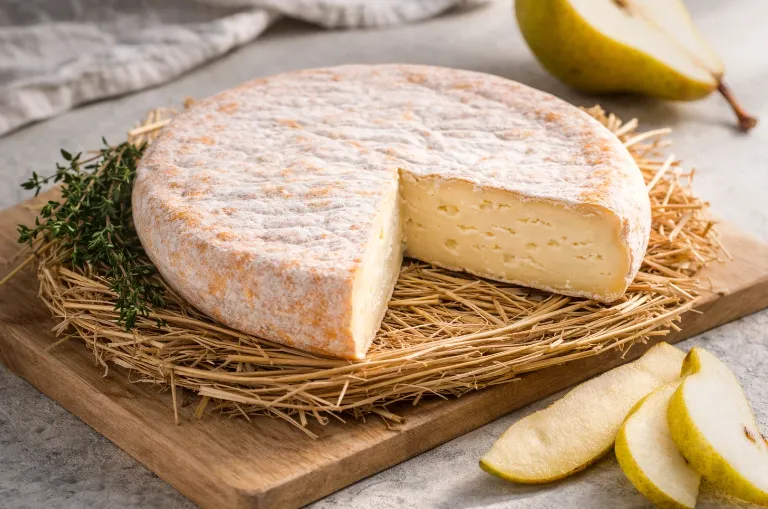
As an adult, I’ve made a habit of trying every soft washed rind cheese I can find wherever I go. Langres became a favourite, even though it looks a bit like an orange brain (I know, not a great selling point). Inside, it’s soft and creamy with a properly good flavour. Picking an overall favourite is impossible, though. They’re all so different, and I love every one of them.
So what is washed rind cheese, exactly? It’s a cheese whose rind is regularly wiped, brushed or bathed while it ages, usually with salted water and sometimes with beer or a local spirit. That damp, salty surface grows orange bacteria that give these cheeses their sticky rind, their famous smell and a flavour that’s usually far gentler than the aroma!
Washed rind cheeses smell like a farmyard (or a rugby changing room) and then taste of cream, broth, hazelnuts and warm milk. That gap between the smell and the taste is what wins most people over.
Table of Contents
What is a washed rind cheese?
In French they’re called fromages à croûte lavée, literally “washed crust cheeses”. Most of the famous ones are soft cheeses, which is why the official French family name is pâte molle à croûte lavée: soft paste, washed rind. Reblochon is the odd one out, as its curd is lightly pressed, but it’s washed during ageing, so it belongs in the family too.
During ageing, a cheesemaker takes each cheese, wipes or rubs it with a cloth or brush dipped in the washing liquid, turns it, and puts it back on its shelf. Depending on the cheese, that happens every couple of days or a few times a week, for anything from two weeks to a couple of months.
Why does washed rind cheese smell like feet?
Because, chemically speaking, it sort of is feet.
A freshly made cheese is too acidic for most bacteria to grow on its surface. So the first to move in are yeasts, which eat the lactic acid on the rind and make it less acidic. That opens the door to salt-loving bacteria from the Brevibacterium family. Brevibacterium linens used to get all the credit, but more recent research shows a close cousin, Brevibacterium aurantiacum, is often the dominant one on washed rinds.
These bacteria break down the proteins on the surface and release sulphur compounds. Their relatives on human skin, especially between the toes, produce some of the same compounds. They like warm, damp and salty conditions, which describes a cheese cellar and the inside of a trainer (sneaker) equally well. Appetising, isn’t it?
Most of the smell sits in the rind. The paste underneath is milder, and much of what you taste comes through the back of your nose once the cheese is in your mouth, which is why the flavour feels so different from the first sniff.
Why are washed rind cheeses orange?
Brevibacterium and some of the yeasts that live alongside them produce orange-pink pigments as they grow, so a washed rind gradually turns from pale ivory to orange to brick red as it ages. On Époisses, that colour has to be entirely natural: the official rules for the cheese don’t allow any added colouring.
Other cheeses get a helping hand. Livarot and Langres, for instance, are washed with salted water that contains rocou, better known in English as annatto, a natural orange colouring from the seeds of a tropical shrub. If you see rocou, annatto or E160b on a label, that’s where the brighter orange comes from.
Explore the washed rind cheese collection
This guide covers the basics. For a closer look at individual cheeses, our collection articles each feature five varieties, with tasting notes and where to find them:

The defining characteristics
What makes a washed rind cheese a washed rind cheese?
- Sticky, coloured rind: Usually orange, pink, or reddish-brown, sometimes pale, occasionally quite vivid
- Distinctive aroma: Ranging from pleasantly earthy to properly pungent, often described as “barnyardy” (being polite here)
- Regular washing: Cheeses are bathed periodically throughout ageing, from daily to monthly depending on the variety
- Creamy to firm texture: Despite looking similar, washed rind cheese range from soft and spreadable to quite firm
- Complex flavours: Often meaty, savoury, nutty, frequently much milder than the aroma suggests

How French washed rind cheeses are made
The early stages look like any other soft cheese. The difference is what happens in the cellar.
1. The curd
Cow’s milk is warmed, ferments and rennet are added, and it sets into a curd. The curd is cut and ladled into moulds, where the whey drains off under its own weight (Reblochon gets a light press).
2. Salting
The young cheeses are rubbed with dry salt or soaked in brine for a short time.
3. Into the cellar
They go into a damp, fairly warm ageing room, usually somewhere around 11 to 15°C (52 to 59°F), much more humid than a cellar for hard cheeses.
4. The washing
Every few days, each cheese is wiped or brushed with the washing liquid and turned. This keeps the rind damp and salty, which suits the good bacteria and discourages unwanted moulds.
5. The rind takes over
Yeasts, then bacteria, colonise the surface. The rind turns sticky and orange and the smell builds.
6. Ripening from the outside in
Enzymes from the rind slowly soften the paste, working from the edges towards the centre. That’s why a young Maroilles or Époisses has a chalky white core, and a riper one is creamy all the way through.
What are they washed with?
Mostly salted water. Beer and spirits may be what people expect, but most French washed rind cheeses are looked after with brine. Maroilles, Munster, Livarot, Langres and Pont-l’Évêque are all washed or brushed with salted water, sometimes with ripening cultures or annatto added.
The famous exception is Époisses, which is washed with water mixed with marc de Bourgogne, a Burgundy brandy distilled from grape skins and pips left over from winemaking. The proportion of marc goes up as the cheese ages, so the last washes are the strongest.
Wine turns up too: Affidélice, made by Fromagerie Berthaut in Burgundy, is washed with Chablis. Beer-washing exists as well, mainly in the north. Vieux-Boulogne, made near Boulogne-sur-Mer, is washed with local beer, and you’ll find beer-washed Maroilles at some cheesemongers in the region. But the official AOP Maroilles is washed with brine.
The monastic connection
A lot of washed rind cheeses have monastic roots, and some of those stories are better documented than others.
Maroilles takes its name from the village of Maroilles, in the far north of France, and its history is tied to the Benedictine abbey there. The official appellation body dates the cheese to the 10th century, although local tradition likes to push it back even further. Époisses, according to its own appellation history, was first made by a religious community in Burgundy in the early 1500s, before the farmers’ wives of the Auxois took it over. And Munster is named after the town of Munster in Alsace, which itself grew up around a monastery.
Why monks? Abbeys had cellars, cows, time and a lot of people to feed, so they were natural cheesemakers. Damp stone cellars were also perfect for this style of cheese.

The spectrum of French washed rind cheeses
Despite sharing the washed-rind treatment, these cheeses come in remarkable variety. Understanding the main types helps navigate this aromatic category.
By texture
Soft and spreadable
These are the most dramatic, nearly liquid when ripe, intensely aromatic, with sticky, deeply colored rinds. Expect powerful farmyard aromas but complex, meaty flavors. Perfect for baking whole or serving as showstopper cheese courses.
Semi-soft and supple
More approachable whilst still characterful. Yielding, creamy texture you can slice cleanly. Moderate aromas, sweet and nutty flavors. Excellent for cooking, they melt beautifully without becoming oily. Great introduction to the category.
By washing method
Brine-washed
Saltwater creates milder, more approachable varieties. Clean, savoury flavors that let milk quality shine through. Golden to orange rinds. Good starting point for washed-rind newcomers.
Spirit & wine-washed
Marc, wine, or brandy washing adds aromatic complexity. Expect woody, vinous notes alongside typical washed-rind character. More intensely pungent, deeply colored, complex. These are the category’s showstoppers.
Beer-washed
Creates distinctive earthy, yeasty, malty notes. Deep orange to brown rinds, pronounced bread-like aromas. Pair naturally with beer. Northern French specialty.
By intensity
Mild to moderate
Washed less frequently or consumed younger. Pleasant earthy aromas without overwhelming pungency. Perfect for those curious about the category.
Strong and powerful
Frequently washed, often with spirits, aged longer. Very soft textures, intensely sticky rinds, fearsome aromas. Surprisingly, often taste milder than they smell. Beloved by serious cheese enthusiasts.
The Jura and the Alps
Mountain pastures and cow’s milk again, with blues that are usually mild and creamy, with a nutty sweetness and fairly light veining.
By region
Alsace
Brine or white wine washing, earthy and yeasty character. Often served with cumin.
Burgundy
Spirit-washing with marc or wine. Intensely aromatic, deeply complex. Pairs with Burgundian wines.
Normandy
Exceptional dairy quality, sometimes cider or Calvados washing. Balanced, approachable style.
Savoie/Alps
Simple brine washing, excellent mountain milk. Creamy, nutty, great melting properties.
Northern France
Beer-washing traditions. Earthy, yeasty, powerfully aromatic.

How to buy washed rind cheese
Buying washed rind cheese requires confidence. Don’t be put off by the aroma at the cheese counter, it’s supposed to smell that way.
What to look for
- The rind should be moist and slightly tacky, in shades of yellow, orange or reddish brown. Avoid rinds that are cracked and dry, or have fuzzy blue, green or black mould (a fine white bloom is fine on cheeses like Reblochon and Pont-l’Évêque).
- The feel. Press gently with a finger if the shop lets you. Soft cheeses should give easily without feeling like they’re about to burst.
- The inside, if it’s cut. A chalky white core means the cheese is young and will keep ripening. Creamy all the way through means it’s ready now.
- The smell. Strong is fine. A sharp ammonia smell that stings your nose means the cheese is past its best.
Don’t be shy about asking for the ripeness you want. In France, a good fromager will ask when you’re planning to eat it and pick a cheese accordingly.
Reading the labels
AOP (Appellation d’Origine Protégée, the EU’s protected designation of origin) means the cheese follows strict rules on where the milk comes from, how it’s made and how long it’s aged. Most of the cheeses in the table above have one.
Fermier means a farmhouse cheese, made on the farm with the farm’s own milk. Laitier means it was made in a dairy from milk collected from several farms. Farmhouse versions tend to vary more and often have more character. Reblochon makes this easy: farmhouse cheeses carry a small green casein disc on the rind, dairy ones a red one.
Lait cru means raw milk, which hasn’t been heated. Raw-milk versions usually have a more complex flavour, but there are safety considerations, especially in pregnancy (see the note further down). Some AOPs, like Reblochon and Mont d’Or, must be made with raw milk. Others, like Époisses and Pont-l’Évêque, can be made with raw or pasteurised milk, and you’ll find both.

How to store washed rind cheese
Washed rind cheeses are living things and they keep ripening in your fridge. They also make your fridge smell, but both can be managed.
- Keep it cold, but not the coldest spot. The vegetable drawer is ideal: it’s slightly warmer and more humid than the main shelves, which suits these cheeses.
- Wrap it in paper, never cling film (plastic wrap). Cheese paper or baking paper (parchment paper) lets the cheese breathe without drying out. Cling film traps moisture and ammonia, and the rind turns slimy.
- Then put it in a box. A lidded container with the lid resting loosely on top contains the smell and protects your butter, which will absorb it happily otherwise. Cheeses sold in wooden boxes, like Époisses and Mont d’Or, can stay in their box inside the container.
- Change the paper if it gets damp. These cheeses give off a fair amount of moisture.
How long does washed rind cheese keep?
Not long. As a rule of thumb, aim to eat soft washed rind cheeses within about a week of buying them, and semi-soft ones like Reblochon within a week or two. Always check the date on the packaging, and ask the cheesemonger how ripe it already is.
It’s gone too far when:
- the rind turns slimy rather than tacky, or grows fuzzy mould that wasn’t there before
- the ammonia smell stays strong even after the cheese has been unwrapped and left to air for a few minutes
- the paste turns grainy, separated or unpleasantly runny
A light whiff of ammonia when you first unwrap a very ripe cheese is normal. If it fades after a few minutes, you’re fine.
Can you freeze washed rind cheese?
Technically yes, but please don’t. The high moisture content forms ice crystals that wreck the texture, so the cheese thaws grainy and weeping. If a cheese is getting too ripe to enjoy on its own, cook with it instead: overripe washed rind cheese is brilliant melted into potatoes or a gratin.

How to serve washed rind cheese
Let it warm up first. This matters more for washed rind cheeses than for almost any other kind. Cold, the flavour is muted and the texture is rubbery, while the smell somehow survives. At room temperature, the paste softens, turns creamy and the flavours open up.
Take the cheese out of the fridge at least 30 minutes before serving, and up to an hour for a whole soft cheese like Époisses. Leave it in its wrapping until you serve it.
Can you eat the rind?
Yes, the rind of French washed rind cheeses is edible, and it’s where the most intense, savoury flavour is! Some people love it, some find it too salty or slightly bitter, especially on older cheeses. There’s no rule. On soft cheeses like Époisses, the rind is thin and most people eat it with the paste. On firmer, older rinds, try a bit and decide.
One exception: the reed bands on Livarot and the spruce band on Mont d’Or are not for eating.

Cooking with washed rind cheeses
Washed rind cheeses melt beautifully, and cooking softens the smell while keeping the flavour. In France, they turn up in a lot of winter dishes.
Tartiflette
Tartiflette is the recipe I look forward after summer. It isn’t an ancient mountain recipe, the dish as we know it dates from the 1980s, when the Reblochon producers were keen to sell more cheese and promoted it in the ski resorts! It was built on an older Savoyard potato and onion dish called péla. It’s been a staple of ski resort menus ever since, and the 1992 Albertville Winter Olympics gave it an international audience.
Baked Mont d’Or (Mont d’Or chaud)
This one is more often considered as a preparation method rather than cooking. It’s kind of like a fondue straight from the cheese spruce box! You score the top of the cheese in its box, add white wine and garlic, wrap in foil, and bake until molten and you serve it with boiled potatoes and bread for dipping into the now molten cheesy centre.
Croûte au Munster
Simple but delicious toast slices of country bread, cover with slices of Munster, with a few cumin seeds scatter over and grilled until bubbling. You can serve it with a green salad for lunch! It’s simple and very Alsatian.
Tips for cooking with washed rind cheese
- Go easy on quantities. These cheeses are strong, and a little goes a long way in a sauce or gratin.
- Keep the heat gentle. Washed rind cheeses melt at fairly low temperatures and turn oily or grainy if they boil. For a sauce, take the pan off the heat before stirring the cheese in.
- Rind on or off? On thin rinds like Reblochon’s, leave it on: it adds flavour and melts in. Thicker, older rinds can turn bitter, so trim them.

FAQ
Why does washed rind cheese smell so bad?
The washing keeps the rind damp and salty, which encourages bacteria from the Brevibacterium family. As they break down proteins on the rind, they release sulphur compounds, some of the same ones produced by the bacteria behind smelly feet. Most of the smell stays in the rind, which is why the paste inside usually tastes much milder than it smells.
Is the rind on washed rind cheese edible?
Yes. The rind of French washed rind cheeses is edible and carries the strongest, most savoury flavour. Whether you eat it is down to taste: some people love it, others find it too salty or slightly bitter, especially on older cheeses. The only parts not to eat are the reed bands on Livarot and the spruce bark band around Mont d’Or.
What is the smelliest French cheese?
In a 2004 test by Cranfield University in England, Vieux-Boulogne, a beer-washed cheese from Boulogne-sur-Mer, came out as the smelliest of the cheeses tested. In everyday life, Époisses, Maroilles and Livarot are the ones with the strongest reputations. Ripeness changes everything, though, and a very ripe cheese of almost any washed rind variety can clear a room.
What’s a good washed rind cheese for beginners?
Reblochon and Pont-l’Évêque are the gentlest of the classic French washed rind cheeses, with soft, buttery, nutty flavours and only a mild farmyard smell. Langres and Mont d’Or are a good next step. Leave Époisses and Maroilles until you know you like the style. In the US, where raw-milk Reblochon isn’t sold, ask your cheesemonger for a mild pasteurised washed rind.
How long does washed rind cheese last in the fridge?
As a rule of thumb, about a week for soft washed rind cheeses and up to a couple of weeks for semi-soft ones like Reblochon, depending on how ripe they were when you bought them. Wrap them in cheese paper or baking paper, keep them in a loosely closed box in the vegetable drawer, and check the date on the packaging.
Buy a small piece, let it warm up properly and have some bread ready. Your fridge will forgive you eventually.
Explore all the cheese families
Final thoughts
Washed rind cheeses ask a bit more of you than most cheeses do. They smell, they don’t keep long, and they need time out of the fridge before they’re at their best. In return, you get a farmhouse Munster that still tastes of the cows that made it, an Époisses ripe enough to eat with a spoon, and a Langres that’s soft and creamy under its wrinkly orange rind.
If you’re new to them, start with Reblochon or Pont-l’Évêque, let it warm up properly and have some bread ready. Your fridge will forgive you eventually.
Now over to you: which washed rind cheese did you try first, and did it win you over straight away or did it take a few goes? Is there one you love that I haven’t mentioned, maybe a local cheese from your corner of France or from a cheesemaker near you? Tell me in the comments. I’m always looking for the next one to try!

A Complete Hosting Guide
This complete guide takes the intimidation out of French cheese and wine hosting, so you can create an impressive, memorable evening that feels effortless.
Just so you know, a few links here earn us a commission. Doesn’t cost you anything extra, and we only link to things that are actually worth your time.