French Fresh Cheese

The cheese counter gets the attention in a French supermarket, but the longest stretch of fridge is usually the fresh dairy aisle: big tubs of fromage blanc, faisselles dripping whey into their plastic trays, logs of fresh goat cheese and petit-suisse in packs of six. These are the cheeses I grew up eating for breakfast!
The cheese board gets the photos and don’t get me wrong, I love a good cheeseboard with friends. But on a normal Tuesday night, a French fridge is far more likely to hold a pot of fromage blanc than a Munster, and that pot does a lot of work: breakfast with honey, a cake at the weekend, dessert with a spoonful of jam.
So what is fresh cheese, exactly? It’s cheese eaten young, with no ageing at all. The milk is soured, the soft curd is left to drain, and it’s ready within days, with no rind and a mild, lightly tangy taste. Fromage blanc, faisselle, petit-suisse and fresh goat cheese (chèvre frais) are the French classics.
Table of Contents

What is fresh cheese?
French cheesemongers usually sort cheese into different families, and fresh cheese (fromage frais, or pâte fraîche) is one of them. Nothing goes into an ageing cellar, so there’s no rind and no waiting.
The other big difference is water. Most fresh cheeses are around 80% water, which is why they’re spoonable or spreadable rather than sliceable. French law even sets lower minimum dry matter for fromage blanc than for other cheeses, and requires the very wettest ones to say on the label that they contain more than 82% moisture.
Explore the fresh cheeses collection
This guide covers the basics. For a closer look at individual cheeses, our collection articles each feature five varieties, with tasting notes and where to find them:

The defining characteristics
What makes a fresh cheese a fresh cheese?
- No rind. It’s eaten long before a rind could form.
- Lots of moisture. Hence the creamy, spoonable texture.
- Mild flavour. Milky and lightly tangy, never strong.
- Short life. Days or a couple of weeks, not months, and always with a use-by date.
- A range of textures. From pourable and yoghurt-like to thick enough to spread on bread.
With no rind or ageing to add flavour, fresh cheese tastes of the milk it was made from. That’s why a farmhouse fromage blanc from the market and a supermarket tub can taste so different.

How French fresh cheese is made
Fresh cheese needs no cellar and very little equipment, which made it an easy cheese for farms to make for themselves.
1. The milk
Cow’s, goat’s or sheep’s milk, whole or skimmed, depending on how rich the cheese should be.
2. Souring
Lactic cultures are added and left to work slowly, usually overnight, souring the milk.
3. Curdling
As the milk sours, it sets into a soft curd. Some fresh cheeses rely on the acid alone; others get a small dose of rennet to help.
4. Draining
The curd is ladled into cloths or perforated moulds called faisselles, and the whey drips out under its own weight.
5. Finishing
Some cheeses are beaten smooth, some get cream added, some are salted or mixed with herbs.
Fromage frais vs fromage blanc
You’ll see both names on French labels, and they’re very similar. Fromage blanc is the general name for this smooth, white fresh cheese. If a fermented fromage blanc is sold as fromage frais, or with the word frais on the label, French law says it must still contain living cultures when you buy it.
The spectrum of French fresh cheeses
Despite looking rather similar at first glance, French fresh cheeses actually come in quite the variety. Understanding the main types helps when you’re faced with that overwhelming French supermarket dairy aisle.
Classic spoonable varieties
These are the everyday ones, with a texture somewhere between Greek yoghurt and soft cream cheese. Fromage frais and fromage blanc are the big tubs in every French supermarket, from 0% fat up to around 8% for the creamiest. Faisselle belongs here too: it’s fromage blanc sold in its draining mould, so you get soft, wobbly curds sitting in a little whey. And then there’s petit-suisse, the small cylinders French children (includin me!) eat with a bit of sugar.
They all go on the breakfast table with honey, end dinner as a light dessert, and turn up in cakes, sauces and dips the rest of the time.
Regional specialities
Some French regions have a fresh cheese of their own. In Provence, Brousse du Rove is made only from the milk of the Rove goat, a local breed, and curdled with a little white vinegar. It’s light and delicate, and lovely with honey or a sprinkle of sugar.
Corsica has brocciu, made by heating the whey left over from another cheese and adding sheep’s or goat’s milk. It’s the same idea as ricotta, which is why it’s so light. Corsicans use it in everything from cannelloni to fiadone, a lemony brocciu cake.
Lyon has cervelle de canut, which translates rather unfortunately as “silk worker’s brain”. Strictly speaking, it’s a preparation rather than a cheese: fromage blanc beaten with shallots, chives, white wine and oil. Don’t let the name put you off!
Around Niort, jonchée is traditionally drained on rushes (jonc), which leave their pattern on the cheese. And Fontainebleau, from the Île-de-France, is fromage blanc with whipped cream folded through it. It’s so light it’s almost a mousse, and very much a dessert.
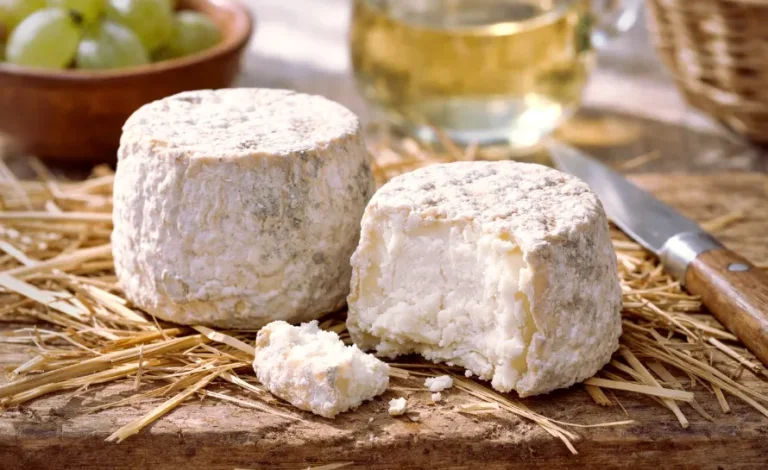
Plenty of farms that make aged goat cheese also sell it fresh, just a few days old. Those won’t carry the AOP name, because the AOP cheeses have to be aged first (Pélardon needs at least 11 days), but if you see them at a market, buy one, you won’t be disappointed.
Cooking varieties
Some fresh cheeses are bought for the kitchen more than for the spoon. Plain, unsweetened fromage frais (nature) works in sweet and savoury dishes alike, from cheesecake to herb dips. Plain petits-suisses and well-drained faisselle (faisselle égouttée) can stand in for cream cheese in most recipes. French supermarkets also sell French-made ricotta and mascarpone, used just like the Italian originals. None of these are meant to be eaten straight from the pot, but nobody’s going to stop you!
Light versions
If you prefer something lighter, most brands make a 0% fromage blanc, and you’ll find reduced-fat petits-suisses too. They’re a little thinner and sharper than the full-fat versions, but still good with fruit or in a dip. For baking and sauces, full-fat gives a creamier result.

How to buy French fresh cheese
Reading the labels
Fat content. French labels now show fat as a percentage of the finished cheese, so “8%” means 8 g of fat per 100 g. Older labels showed fat as a percentage of the dry matter, which is why you may still see figures like “40%” on petit-suisse and some traditional cheeses. They’re not as rich as they sound.
Milk. The label must say whether the milk is raw (au lait cru) or pasteurised (au lait pasteurisé). Most supermarket fresh cheese is pasteurised. Farmhouse fresh goat cheese is often raw milk.
Ingredients. A good fresh cheese has a short list: milk, cultures, maybe cream and salt. A long list of thickeners and stabilisers usually means it’s built to last longer on the shelf rather than to taste of anything.
What to look for
Buy the freshest you can find and check the use-by date. The cheese should be bright white to creamy white and look moist, but not sitting in lots of liquid (faisselle is the exception, since the whey is part of it). Skip anything with yellowing, an off smell or a swollen lid.

How to store fresh cheese
Keep fresh cheese properly cold: in the main part of the fridge, at 4°C (39°F) or below, and never in the door, where the temperature goes up every time it opens.
Once opened, cover it well or move it to an airtight container so it doesn’t dry out or pick up other smells. A glass jar, glass container, or a stainless steel container with a tight lid all work. A faisselle can stay in its mould, inside a covered container to catch any whey that keeps dripping.
How long does fresh cheese keep?
Not long. Fresh cheese has a use-by date (DLC, date limite de consommation in France), which is a firm deadline, not a suggestion. Once a pot is open, most labels say to eat it within a few days, so follow what’s on yours.
Throw it away if you see any mould, or if it smells sour beyond its usual light tang, turns slimy or separates badly. Because fresh cheese is so moist, mould spreads through it, so you can’t just scrape it off as you might with a hard cheese.
Can you freeze fresh cheese?
You can, but the texture suffers. Ice crystals break up the curd, and smooth fresh cheese comes out grainy and watery once thawed. If you freeze it to avoid waste, only use it afterwards in cooking, such as baked cakes, tarts or sauces, where texture matters less.

How to serve fresh cheese
Unlike most French cheeses, fresh cheese doesn’t need an hour on the counter. Serve it cold or just out of the fridge for 10 minutes or so. Petit-suisse and individual pots go straight on the table in their packaging, which is how it’s done in most French homes.
In France, you can eat fresh cheese at any meal of the day. Breakfast might be fromage blanc with sugar or honey. Lunch might start with cervelle de canut on bread. And dinner often ends with fromage blanc or faisselle instead of a pudding, sometimes with fruit or a spoonful of jam.
What to serve with fresh cheese
Sweet. Fresh berries, peaches, apricots and figs. Honey (lavender honey from Provence or a mild acacia honey), jam, fruit compote or coulis. A spoonful of blackcurrant jam or freshly made apple compote stirred through fromage blanc is an instant French pudding.
Savoury. Chopped chives, parsley or dill, a little garlic, black pepper, flaky salt from Camargue and a drizzle of good olive oil. Walnuts add crunch. Go easy, though: fresh cheese is mild and easy to overpower.
Bread. A fresh baguette, wholemeal bread, or homemade French biscuits.
Drinks. Crisp whites like Muscadet, a young Chablis or a dry Alsace white, or something sparkling like a Crémant. Fresh goat cheese and Sancerre is a classic Loire pairing.

Cooking with French fresh cheese
Instead of cream
Fromage blanc can replace some or all of the cream in plenty of dishes and makes them lighter. Stir it into pasta sauces or soups at the very end, off the heat, because it curdles if it boils. It also makes a creamy salad dressing whisked with Dijon mustard, vinegar and oil.
In baking
French home bakers use fromage blanc a lot. It makes moist, tender cakes, and gâteau au fromage blanc is the French take on cheesecake: lighter and less sweet than the American kind. Alsace has its own version, the tarte au fromage blanc (Käsküeche in Alsatian).
Use it at room temperature so it blends smoothly into batters. If you’re swapping it for cream cheese, remember it’s wetter, so drain it first in a sieve lined with a cloth, or reduce the other liquids a little.
In savoury dishes
Mix fresh cheese with herbs for a quick dip or spread. Use it in quiche fillings, stuffed aubergines (eggplant) or tomatoes, or layered into a vegetable lasagne. Fresh goat cheese is brilliant crumbled over salads, spread on warm toast, or baked in a tart with caramelised onions.
In Corsica, brocciu goes into omelettes, fritters, stuffed courgette flowers and fiadone, a lemony brocciu cake.

FAQ
What is French fresh cheese?
French fresh cheese (fromage frais) is cheese that hasn’t been aged. The milk is soured and curdled, the whey is drained off, and the cheese is ready within days. It has no rind, lots of moisture and a mild, slightly tangy flavour. Fromage blanc, faisselle, petit-suisse and fresh goat cheese are the best-known types.
What is the difference between fromage frais and fromage blanc?
They’re very close. Fromage blanc is the general name for smooth, white fresh cheese. When a fermented fromage blanc is sold as fromage frais, French law requires it to still contain living cultures at the time of sale. In everyday use, the two names are often interchangeable, and you can use them the same way in recipes.
What is petit-suisse?
Petit-suisse is a small, rich French fresh cheese made from cow’s milk enriched with cream, usually sold in 30 or 60 g cylinders. Despite the name, it comes from Normandy, where a Swiss dairy worker came up with the idea in the 1850s. French children eat it with sugar, but it also works with jam, honey or herbs.
Is fresh chèvre the same as goat cheese?
Fresh chèvre is one type of goat cheese: the young, unaged kind, soft, white and tangy, often sold as a log. In French, chèvre just means goat, so a French goat cheese can also be aged, with a rind and a much stronger flavour. In the US, “chèvre” on a label nearly always means the fresh kind.
What can I use instead of fromage blanc?
Quark is the closest substitute, followed by strained Greek yoghurt or a mix of ricotta and plain yoghurt blended smooth. For baking, drain your substitute well, as texture and moisture vary. For petit-suisse, a thick, full-fat cream cheese loosened with a little cream gets you close.
How long does fresh cheese last once opened?
Not long. Fresh cheese carries a use-by date, which is a firm deadline. Once opened, most labels say to eat it within a few days. Keep it covered at 4°C (39°F) or below, never in the fridge door, and throw it away at the first sign of mould, a sour smell or a slimy texture.
Explore all the cheese families
Final Thoughts
Fresh cheese doesn’t need a cellar, a cheese knife or a wine pairing. A pot of fromage blanc with honey and a few berries is a proper French dessert, and fresh goat cheese on warm toast is lunch! Start with a plain fromage blanc or a faisselle, taste it on its own, then add a little honey or some herbs and see which way you like it.
Over to you: how do you eat your fresh cheese, sweet or savoury? And if you grew up with petit-suisse, did you have yours with sugar, jam or something else entirely? Tell me in the comments.

A Complete Hosting Guide
This complete guide takes the intimidation out of French cheese and wine hosting, so you can create an impressive, memorable evening that feels effortless.
Just so you know, a few links here earn us a commission. Doesn’t cost you anything extra, and we only link to things that are actually worth your time.