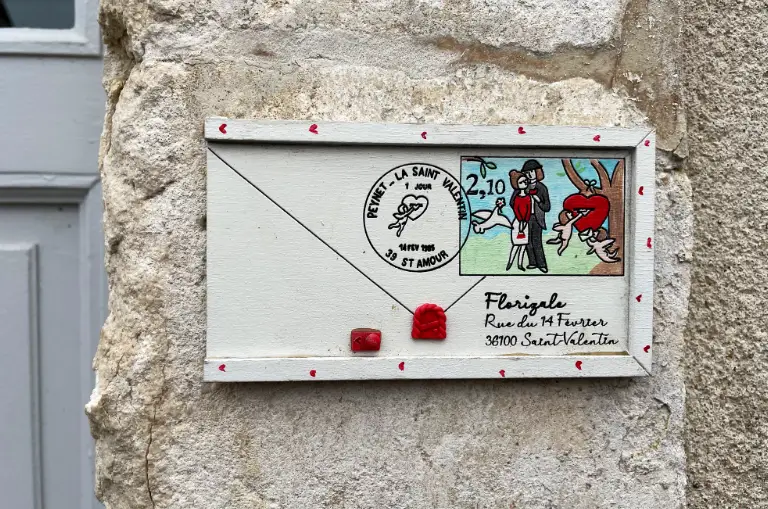
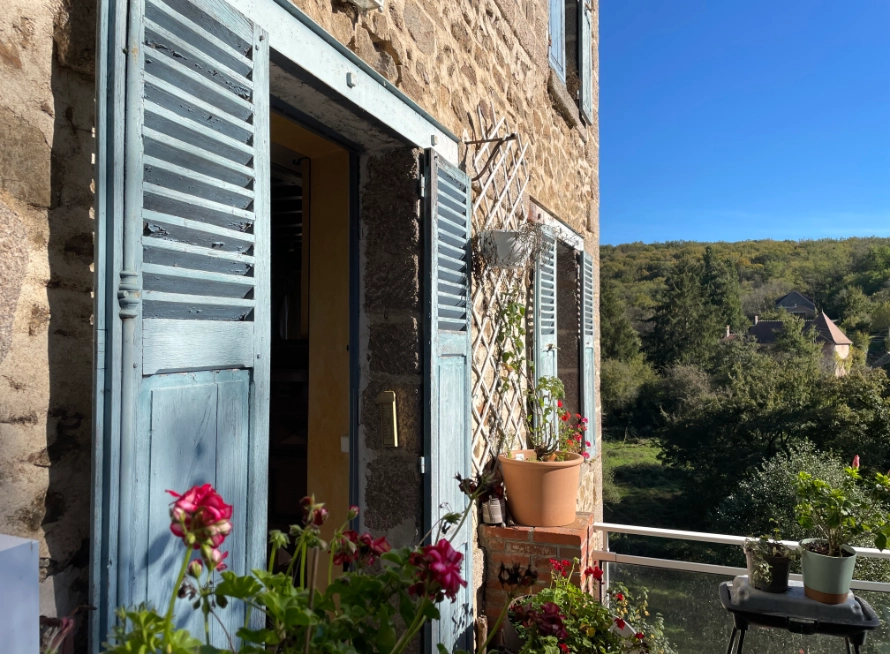
There’s a road near Argenton-sur-Creuse that winds down through the trees into a valley, and at the bottom of it is Gargilesse. This village with it’s cobbled lanes and steeply pitched roofs is so small you can walk the whole village in twenty minutes. We go regularly, to slow down and smell the roses.
And at the centre of it there’s a small house that belonged to one of the most famous writers in 19th-century Europe.
It’s tiny and only has four rooms, dry-stone walls and local tiles on the roof. I think it tells you more about George Sand than any biography does, because underneath all the scandal and the cigars and the seventy novels was a woman who needed a modest and quiet room in order to work. She found one there, up a lane, in a village of two hundred people.
She got there first in June 1857, walking along the Creuse with Alexandre Manceau. She wrote afterwards that you have to arrive at sunset, because everything has its moment for being beautiful. If you ever go to the Indre region of France, do as she tells you, because she is right.
Table of Contents
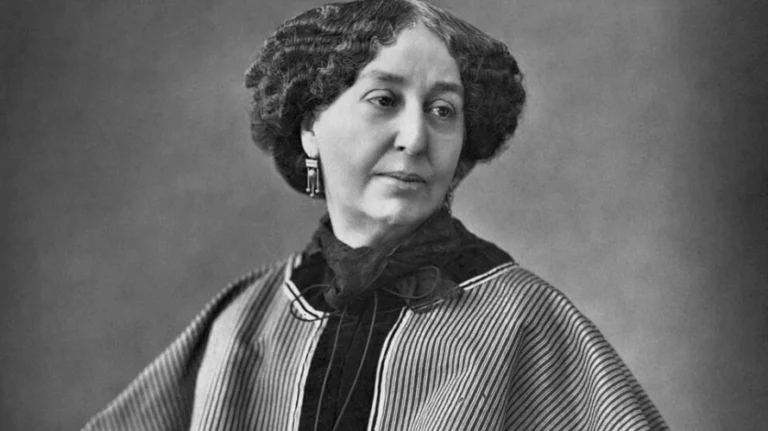
Who was George Sand?
George Sand was not born with that name. She was actually Amantine Lucile Aurore Dupin, born in Paris in 1804 and raised mostly at Nohant (her grandmother’s estate in the Berry) about an hour east of Gargilesse. Her childhood in the countryside shaped absolutely everything: what she wrote, what she believed, and what she thought was worth caring about.
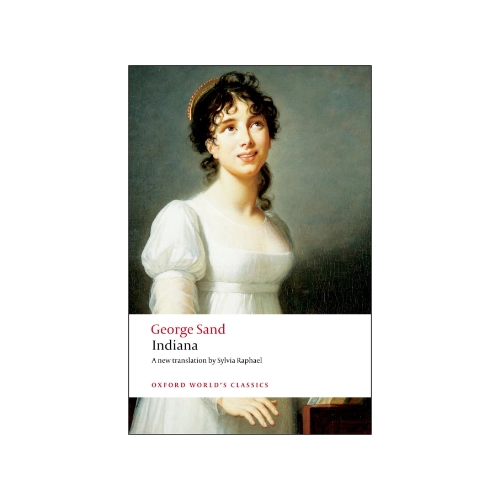
By her late twenties she had already rebuilt herself from scratch. After a short collaboration with the writer Jules Sandeau, she published her first solo novel, Indiana, in 1832, under a name she’d made up. It was both a practical decision and a statement. Women writers at the time published under men’s names or didn’t publish, and she picked one that was unmistakably male and kept it for the next forty-four years. And not just on the books, it’s even written on her gravestone.
What followed is difficult to take in as a body of work. She wrote around seventy novels. Thirty-odd short stories, twenty fairy tales, around thirty plays, roughly four hundred newspaper articles, a ten-volume autobiography, and an estimated forty thousand letters!
Just really think about that last number for a second. Forty thousand. That’s someone writing several letters a day, every day, for most of an adult lifetime, on top of the novels.
By the 1840s she was outselling both Victor Hugo and Balzac in England. She was, for a stretch of the 19th century, simply the most popular writer in Europe.
A life lived entirely on her own terms
The version of her most people know is the scandal, and sure, there was plenty of it.
The first is that she married at eighteen, found the marriage suffocating, and so she left. She also wore men’s clothes in Paris, partly because they were cheaper and more hard-wearing and partly because a woman in a frock coat could go into theatres and cafés and streets that a woman in a dress could not. She smoked in public. She took lovers openly and without much apparent interest in what anybody thought: Alfred de Musset, Pierre Leroux, the actress Marie Dorval, Chopin, and at the end of her life Alexandre Manceau, the engraver who bought her the house at Gargilesse.
But besides the scandals she was also a strong and wise woman I personally admire.
She raised her children herself and she ran her own finances, which for a woman of that period was closer to a legal obstacle course than a decision. She was a republican and a socialist when both could get you into serious trouble, and during the 1848 revolution she was writing political pamphlets and corresponding directly with the provisional government. She thought literature had a job to do in the world and she used hers accordingly, for forty years, in print, under a name everyone knew was hers.
Turgenev, who knew her well, said afterwards that she had been a brave man and a good woman. He meant it as the highest compliment he had, and you can hear him fumbling with the categories available to him in 1876 and not quite finding one that fit.
Author George Sand’s Books
Her books are much more varied than her reputation suggests. She was not simply a romantic novelist. She was a writer who moved between registers and genres throughout her career, always returning to the countryside of Berry as her most reliable subject.

The early novels are bold
Indiana (1832) goes directly at marriage, with a heroine who simply refuses to accept that her husband owns her inner life. Lélia (1833) went further and was considered outrageous, because its heroine turns down both marriage and motherhood in favour of being left alone to think. It was even banned in places, but she stuck to her guns and didn’t soften a line of it.
The rustic warm novels
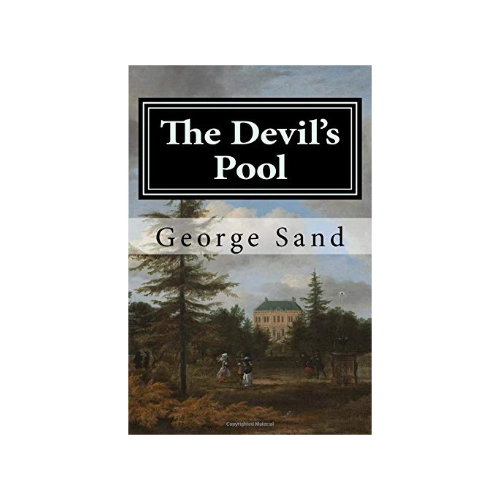
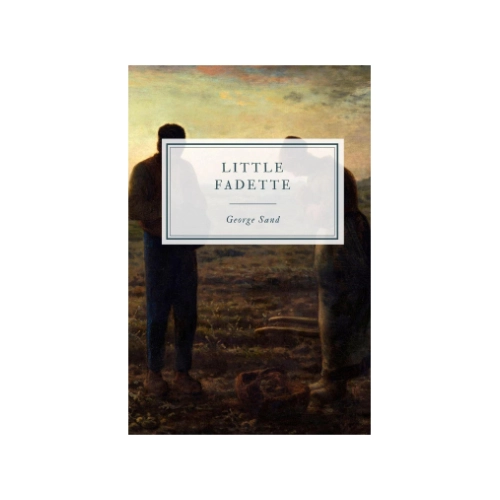
This is where I’d start you. La Mare au Diable (1846), François le Champi (1847), La Petite Fadette (1848). All set in the Berry countryside, she celebrate the lives of ordinary rural people: peasants, farmers, craftsmen, children. They are not sentimental, instead they are attentive, which is something very different.
La Mare au Diable is the one I read first. It’s short, it’s genuinely beautiful, and it pulls the folklore of the region straight into the story: the legends, the witches and the wandering lights over the marshes. It’s also the most read of her books outside France, partly because it is short and partly because it is really beautiful.
The non fictions
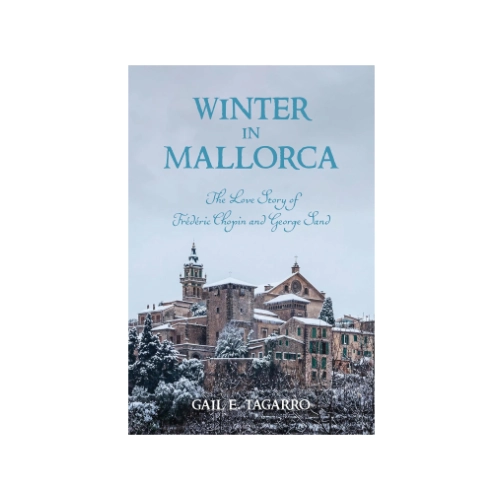
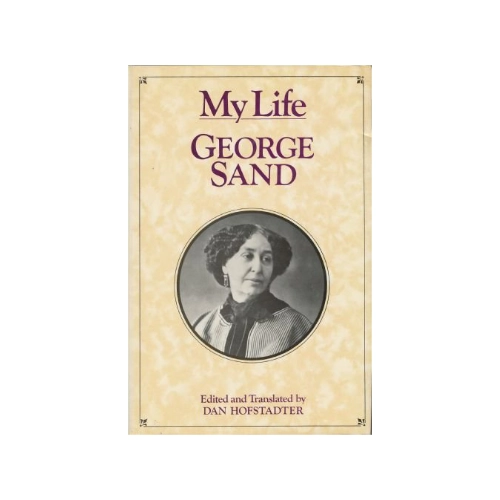
If you’d rather have her voice without the fiction, try Un hiver à Majorque, about the winter she spent in Mallorca with Chopin, which is bracing and often very funny about the Mallorcans. Or dip into Histoire de ma vie, which is enormous but you can open it anywhere.
The relationship with Berry
George Sand was born in Paris and famous across Europe, but she was a Berrichonne first and foremost and that’s the identity that stuck.
The landscape of Berry and Indre in central France turns up in her writing more than anywhere else: the flat marshy ground, the dense little woods and the farms sitting on their own miles from anything. She gave the countryside around La Châtre a name in her novels, la Vallée Noire, the Black Valley, which isn’t an official term on any map but everybody still uses it.
What she actually did was listen carefully to the people of Berry. She wrote down the dialect, the legends, the stories people told about witches and will-o’-the-wisps, and it gave her books a texture that purely urban writers coming out from Paris for the summer could never fake or replicate. She was not romanticising rural life, but she was observing it, which is why those novels still feel true.
Her house in Gargilesse was the other half of her Berry life. Smaller than Nohant, quieter, and crucially further from the family and the endless visitors. Manceau bought it for her and she called it the Villa Algira, after a rare butterfly they’d found on one of their walks, which tells you a great deal about the pair of them. She worked on several novels there and kept going back until Manceau died in 1865.
If you want the town she wrote about rather than the houses she lived in, La Châtre is ten minutes from Nohant and definitely worth an afternoon.
Chopin and George Sand
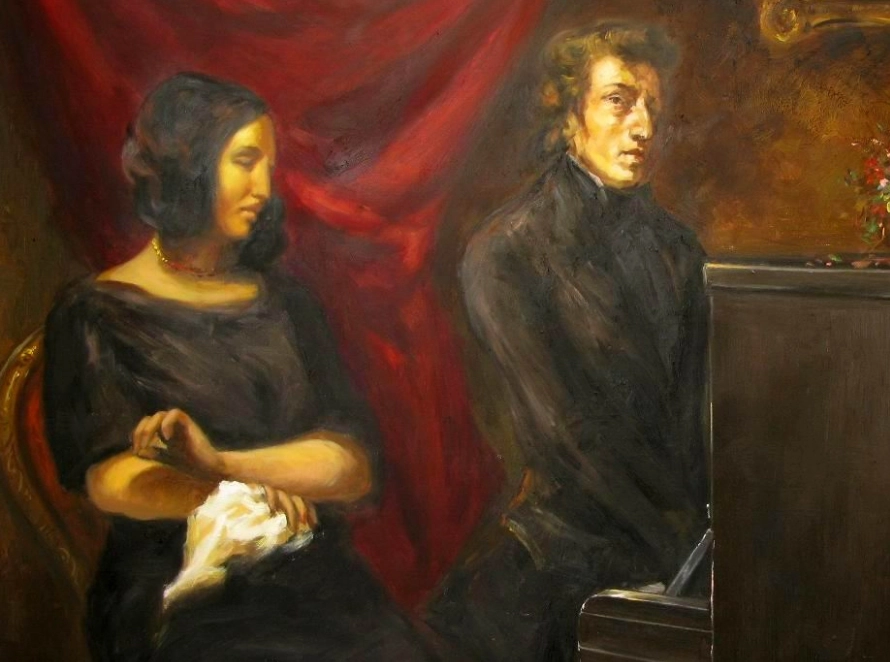
The story of Chopin and George Sand gets told as a love story but it was considerably more than that. It was a working arrangement between two people at the top of their form, and it produced an extraordinary amount of art.
They met in Paris in 1836 and got together two years later. That first winter, 1838 to 1839, they went to Mallorca with her two children, hoping the warmth would help Chopin’s lungs. But it was a disaster as the weather was foul, the lodgings were worse, and the locals worked out he was consumptive and wanted them gone. His health fell apart, she nursed him through it and then wrote a book about it.
Back in France they settled into a rhythm: winters in Paris, summers at Nohant. And Nohant is where the work happened. Chopin had his own room and his own Pleyel piano, and he wrote a great deal of his best music in it. The third Ballade, the Fantaisie, the Barcarolle, a good number of the nocturnes. Meanwhile she was running the house, raising two children and turning out novels.
You can still stand in that room. That’s the thing that gets me about Nohant, honestly. Not the furniture. The fact that the Barcarolle happened in a room you can walk into!
It ended badly in 1847, in a family row involving her daughter Solange, and it ended for good. Chopin died two years later at thirty-nine without ever really speaking of her again. She wrote about him afterwards with feelings that clearly hadn’t resolved and probably never did.
Nine years. It remains one of the most productive partnerships in 19th-century art, and one of the most argued-over.
How it ended
She died at Nohant on 8 June 1876, at seventy-one. She had been writing until days before, on an unfinished novel called Albine, and her last piece of journalism came out in Le Temps a few days after she’d gone.
The funeral was on 10 June and there was a real argument about whether the Church would have her at all, given how she’d lived and what she’d written. Her friends carried the coffin themselves. Thousands of people from the surrounding villages walked behind it through the rain.
Two things about that day I keep coming back to.
Victor Hugo did not speak, although you’ll read everywhere that he did. He sent his eulogy from Paris by telegraph and their mutual friend Paul Meurice read it out at the graveside. “I weep for a dead woman, and I salute an immortal one.” And here’s the part that surprises everyone: Hugo and Sand had never met. Twenty years of correspondence, beginning in 1855 with a letter of condolence he sent her after her granddaughter died, because he had lost his own daughter Léopoldine and knew what to say. Twenty years of letters, and they never once sat in the same room.
And Flaubert, who had been her closest friend for the last ten years of her life, who called her chère maître while she called him her dear old troubadour, stood in the rain and thought it looked like a chapter out of one of her own books. He wrote to a friend afterwards that he’d cried like a calf.
She’s buried in the small family plot behind the chapel at Nohant. The stone says George Sand.
The legacy of George Sand
George Eliot took a male pen name partly with her in mind, and read her carefully. Virginia Woolf wrote about her. Proust cited her, and put François le Champi in the hands of a child in the opening of the Recherche. The scandal of the 1830s had become, by the end of the century, one of the pillars of French literature.
Her political legacy is at least as substantial. She wrote about women’s rights, the conditions of the rural poor and the hypocrisy of bourgeois marriage at a time when every one of those subjects carried a real cost. She didn’t win all of it. She kept saying it anyway, publicly, for four decades.
2026 marks a hundred and fifty years since her death, and there’s a live campaign to move her to the Panthéon. Given who’s already in there and what they did to get there, I’d say she’s earned it.
Visiting George Sand’s world
For anyone who wants to encounter the George Sand novelist in context, two places are essential, and they’re twenty minutes apart.
Nohant
Nohant is the family estate where she grew up, wrote most of her major work and died. It’s a Centre des Monuments Nationaux site now, seen by guided tour of about an hour, and it’s one of the best-preserved writers’ houses anywhere in France. The rooms are as she left them. The dining table is laid. Her marionette theatre is there with the costumes she sewed. Chopin’s room is there. The park is six hectares with a Jardin Remarquable label, and you can walk it without doing the house tour. The sense of her presence is strong.
Book ahead in summer. Hours change several times a year, so check before you set off. Entry is free for EU residents under twenty-six. And if your dates line up, the Nohant Festival Chopin in June and July puts the music back in the house it came from.
Gargilesse
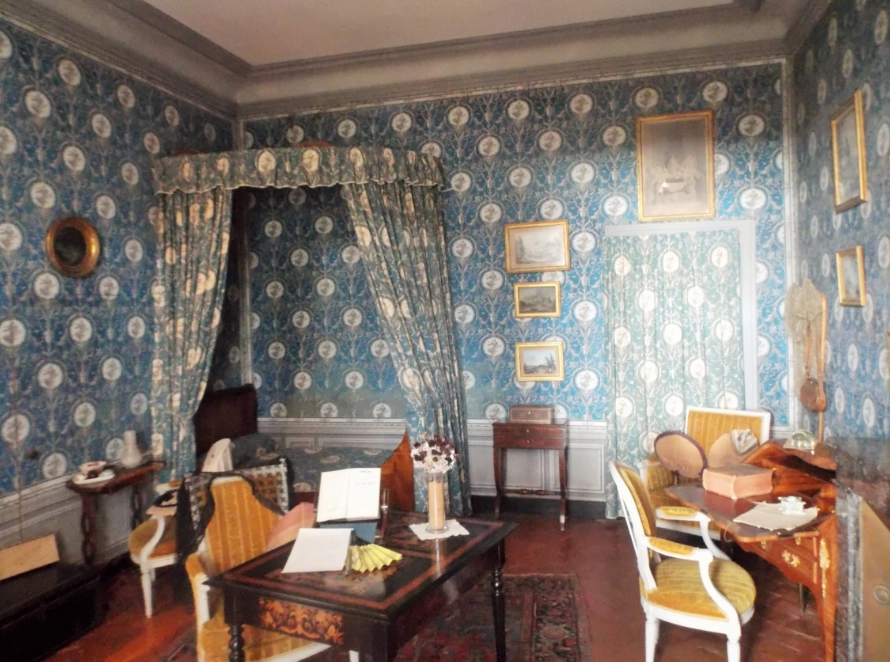
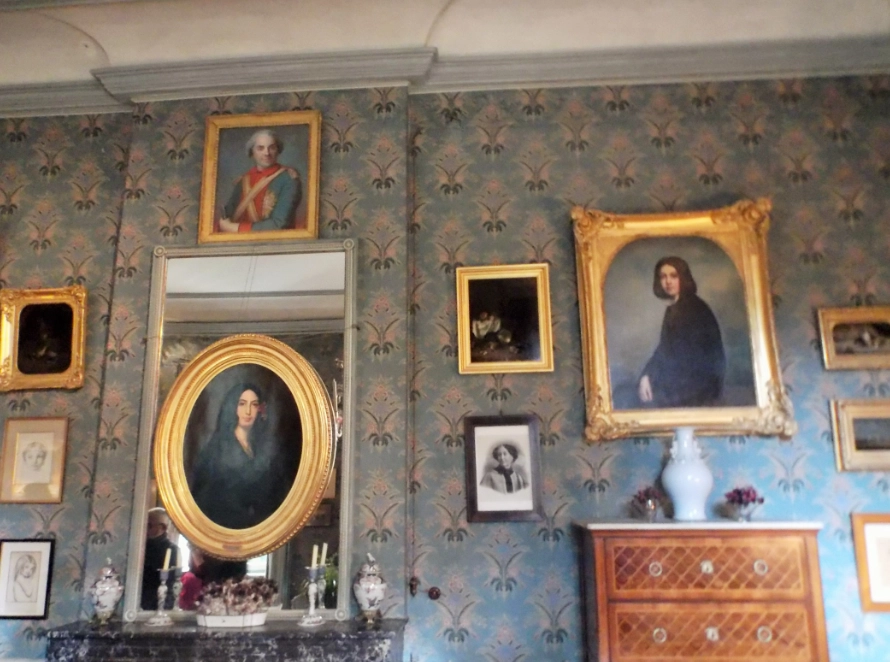
Gargilesse is where her beloved Villa Algira is. It’s open to visitors and contains her personal things, drawings by her son Maurice, and the particular atmosphere of a retreat rather than a residence. The village around it is full of artists’ workshops and has a Romanesque church with a crypt of medieval frescoes, plus a harp festival every August and is worth visiting in its own right.. Go in the late afternoon.
One thing worth knowing before you plan: the Musée George Sand in La Châtre is closed and has been since September 2025, with a rebuild running to 2029 or 2030. So Nohant and Gargilesse are the two. Both are in the Berry region of central France. If you are passing through, neither requires much detour. And both are considerably better than reading about George Sand second-hand.
FAQ
Who was George Sand?
A French novelist, born Amantine Lucile Aurore Dupin in Paris in 1804 and raised at Nohant in the Berry. She wrote around seventy novels under a male pen name, was the most popular writer in Europe for part of the 19th century, and lived openly on her own terms in a period when that carried a real cost. She died at Nohant in 1876.
Why did George Sand use a man’s name?
Because women writers in 1830s France published under men’s names or struggled to publish at all. She chose one that was unmistakably masculine, used it for the rest of her life, and had it carved on her gravestone.
Did George Sand really wear trousers?
Yes, and openly. Men’s clothing was cheaper and more hard-wearing, but the real advantage was access: a woman in a frock coat could go into theatres, cafés and streets where a woman in a dress could not.
Which George Sand novel should I read first?
La Mare au Diable (1846). Short, beautiful, set in the Berry countryside, and full of the region’s folklore. If you want the confrontational early work instead, start with Indiana (1832). For her own voice, try Un hiver à Majorque about the winter in Mallorca with Chopin.
How long were Chopin and George Sand together?
Nine years, from 1838 to 1847. They spent winters in Paris and summers at Nohant, where Chopin had his own room and piano and composed a great deal of his best work, including the third Ballade, the Fantaisie and the Barcarolle. The relationship ended in a family conflict involving her daughter Solange.
How many books did George Sand write?
Around seventy novels, plus roughly thirty short stories, twenty fairy tales, around thirty plays, some four hundred press articles, a ten-volume autobiography, and an estimated forty thousand letters.
Where is George Sand buried?
In the small family cemetery behind the chapel at Nohant-Vic in the Indre, next to her house. The stone reads George Sand.
Did George Sand and Victor Hugo know each other?
They corresponded for twenty years, from 1855 until her death, but never met in person. Hugo’s eulogy was sent from Paris by telegraph and read at her graveside by their mutual friend Paul Meurice.
Why is George Sand important?
Beyond the novels, she wrote about women’s rights, rural poverty and the hypocrisy of bourgeois marriage over four decades, when all three carried real risk. George Eliot took a male pen name partly with her in mind. Proust, Woolf and Turgenev all wrote about her. There is currently a campaign to move her to the Panthéon.
Over to you
I’ve been to Gargilesse more times than I can count and it still does the same thing to me every time, that peaceful feeling of slowing down sipping on an espresso at the top of the valley at Ò Gargilesse.
What I find most incredible is her life and the size and quality of work she produced. Forty thousand letters, seventy novels, revolutions, Chopin, a funeral thousands of people walked to in the rain. She was a force to be reckoned with and I admire her for that.
Have you read any of her? And if you haven’t, does she sound like someone you’d want to? I’m always curious which book people start with, because everyone seems to arrive at her from a different direction. Tell me in your story the comments!
This post may contain affiliate links. If you buy through them I earn a small commission at no extra cost to you, and it helps keep this blog running. Please read my disclosure policy for more information. I am grateful for your support.