Timeless tales with everlasting wisdom
I still know them by heart. The Grasshopper and the Ant, The Crow and the Fox, The Frog and the Ox. I grew up with these stories, and even now, decades later, these short stories with moral come back to me at the most unexpected moments. When someone flatters me a little too enthusiastically. When I watch someone spend everything today with no thought for tomorrow.
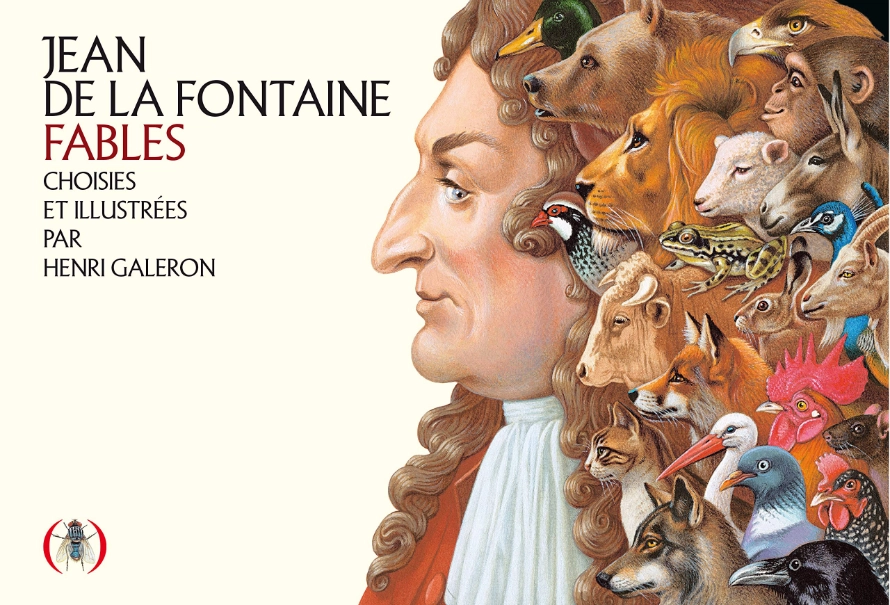
Jean de la Fontaine wrote these animal tales so precise and so human that they simply stick. These aren’t stories you read once and forget. Yes they are children’s tales, but they hold up a mirror to human nature, alive with subtle satire and great wisdom for all ages.
Who Was Jean de La Fontaine?
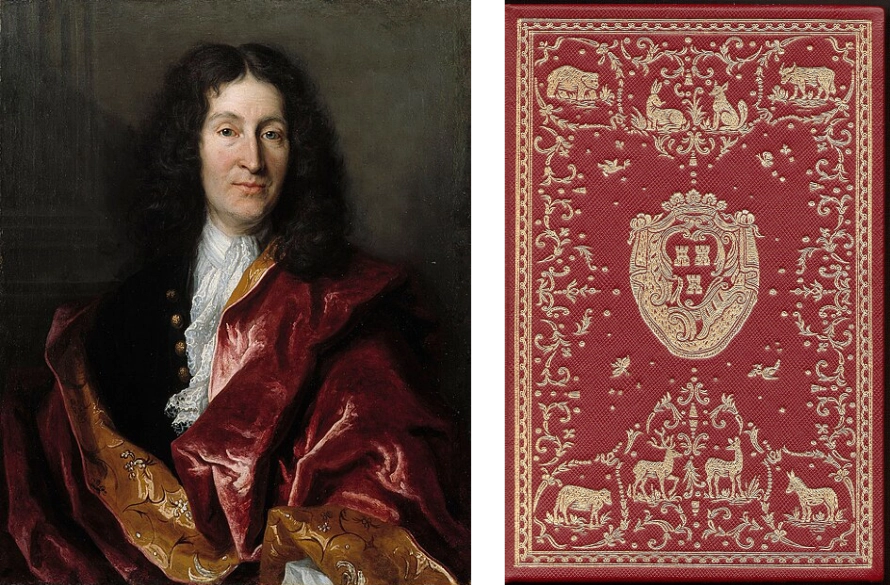
Jean de La Fontaine was born in 1621 in Château-Thierry, a small town in the Champagne region of France. He was not a prodigy. He did not set out to be a fabulist or write animal tales. He studied theology, then law, worked as a forest administrator for years, and only turned seriously to writing in his late thirties, when most people have long since decided what they are.
What he became was one of the most widely read French poets of the 17th century, and arguably of any century.
He was charming, socially gifted, and perpetually in need of a patron. His life reads like one of his own fables: a man of genuine talent who understood that survival at court required wit, flattery, and knowing exactly which powerful people to cultivate. He moved through a succession of aristocratic households, collecting protectors and writing some of the most elegant French poems ever put to paper.
He counted Molière, Racine, and Boileau among his close friends. He was elected to the Académie Française in 1684, though Louis XIV initially blocked his admission, apparently unimpressed by his reputation for irreverence. He died in Paris in 1695, at the age of 73, and his remains now rest in the famous Père Lachaise Cemetery.
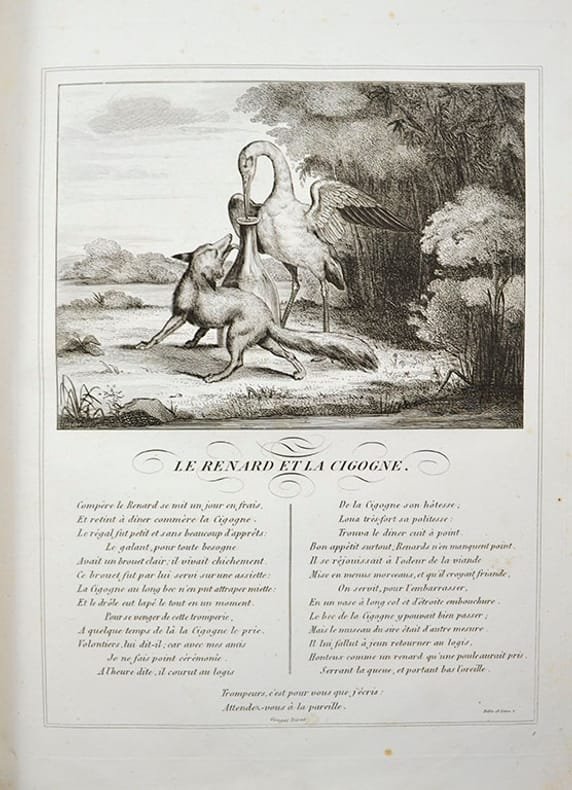
Writing Under the Sun King: The Politics of Animal Tales
To understand La Fontaine’s fables fully, you have to understand the world he was writing in. Louis XIV’s France was one of the most magnificent and suffocating courts in European history. Absolute monarchy ruled. The king was everything. And saying the wrong thing to the wrong person could destroy your career, your freedom, or worse.
La Fontaine knew this perfectly well. He had watched it happen to his patron Nicolas Fouquet, the Superintendent of Finance, who threw a legendary party at his château Vaux-le-Vicomte in 1661 that was so magnificent it apparently provoked the king’s envy. Fouquet was arrested three weeks later and imprisoned for the rest of his life.
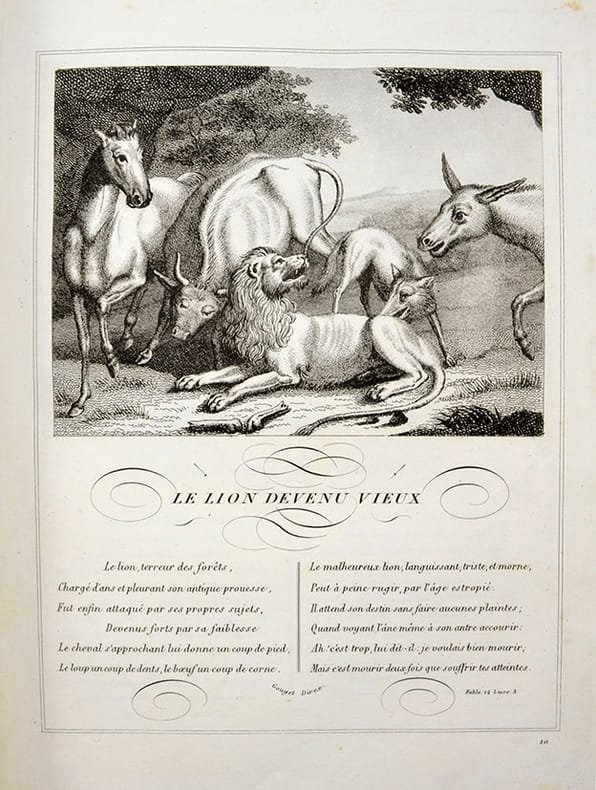
La Fontaine remained loyal to Fouquet publicly, which was a dangerous thing to do. Fontaine fables, written in this climate, are not simply charming animal tales. They are sharp social commentary dressed in fur and feathers. The lion who bullies the other animals is not just a lion. The fox who flatters the crow is not just a fox. These stories let La Fontaine say things about power, vanity, and the absurdities of court life that no one could safely say directly.
The disguise was part of the genius.
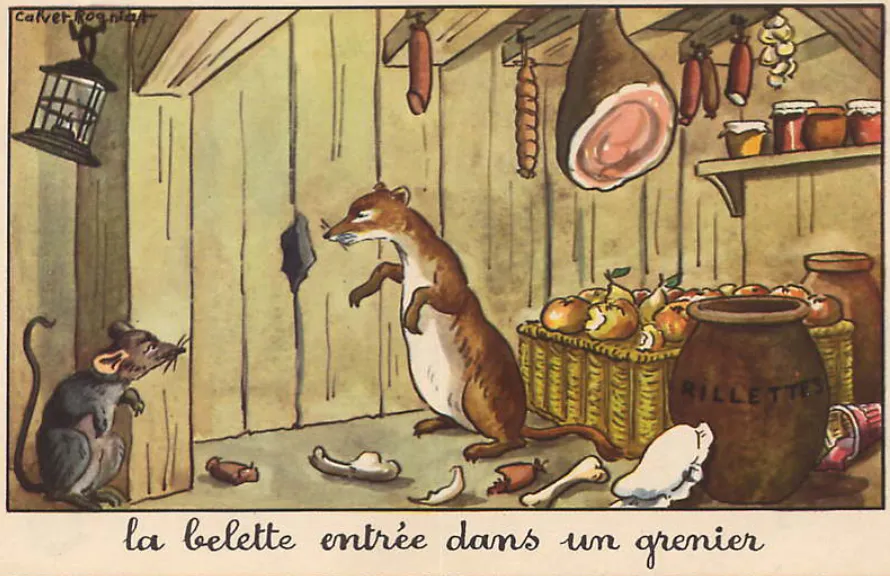
From Aesop to La Fontaine: A History of the Fable
La Fontaine did not invent the fable. He was the first to say so himself.
The tradition stretches back to Aesop, the Greek storyteller from the 6th century BC, whose animal tales had been circulating in various forms across Europe and Asia for more than two thousand years by the time La Fontaine got hold of them. He also drew on Phaedrus, the Roman fabulist, and on the Panchatantra, the ancient Sanskrit collection of animal stories from India that had made its way West through Arabic translation.
What Jean de La Fontaine did with these borrowed plots was transform them completely. Where Aesop’s fables are brief, functional, and prose-based, La Fontaine’s are poems. Proper, musical, elegantly structured French poems. He took the bare bones of an old story and dressed them in verse that rhymes, sings, and moves with the natural rhythm of spoken French.
He added characters. He gave the animals personality, vanity, hesitation, pride. He added scenes and settings. He introduced irony that Aesop never attempted. The morals, rather than being tacked on as afterthoughts, emerge from the stories themselves, which is far harder to do and far more effective when done well.
His first collection of short stories with moral was dedicated to the six-year-old Dauphin, heir to the French throne, which positioned them as suitable for children. But La Fontaine was quite clear that he was writing for adults. The animal tales work on two levels simultaneously: simple enough for a child to follow, complex enough to occupy a philosopher.
The Three Collections: A Poet’s Changing World
Jean de La Fontaine published his short stories with morals across three distinct collections over twenty-six years. Reading them in order is like watching a man age and deepen.
Books I to VI (1668) came first, dedicated to the Dauphin while La Fontaine was attached to the court at the Luxembourg Palace. These early fables are the most classical, closest in structure to Aesop, and the most immediately recognisable. The Grasshopper and the Ant is here. So is The Crow and the Fox. These are the stories that entered the French bloodstream and never left.
Books VII to XI (1678-1679) followed a decade later. By then La Fontaine had left the Orléans court and moved into the intellectual salon of Madame de La Sablière in Paris. The fables from this period are richer, more philosophical, more willing to sit with ambiguity. The animals are still there but the humans are closer to the surface. The morals are less clean.
Book XII (1693) appeared when La Fontaine was in his seventies, after a serious illness that led him to convert to a more devout life. It was dedicated to the young Duke of Burgundy, Louis XIV’s grandson. These final fables are quieter, more introspective, the work of someone looking back. The wit is still there, but it sits alongside something closer to wisdom.
Together, the three collections contain 239 fables across 12 books, and they chart not just the evolution of a poet but a fascinating journey through the shifting landscapes of 17th-century French aristocracy and culture.
The Most Famous French Animal Fables and What They Really Mean
Jean de La Fontaine wrote 239 fables, but a handful have woven themselves so deeply into French culture that they feel less like literature and more like shared memory. Here are the ones that matter most, and what they are actually saying.
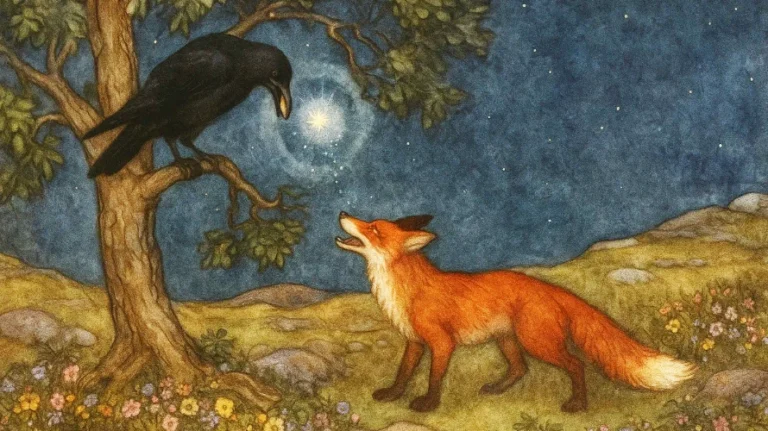
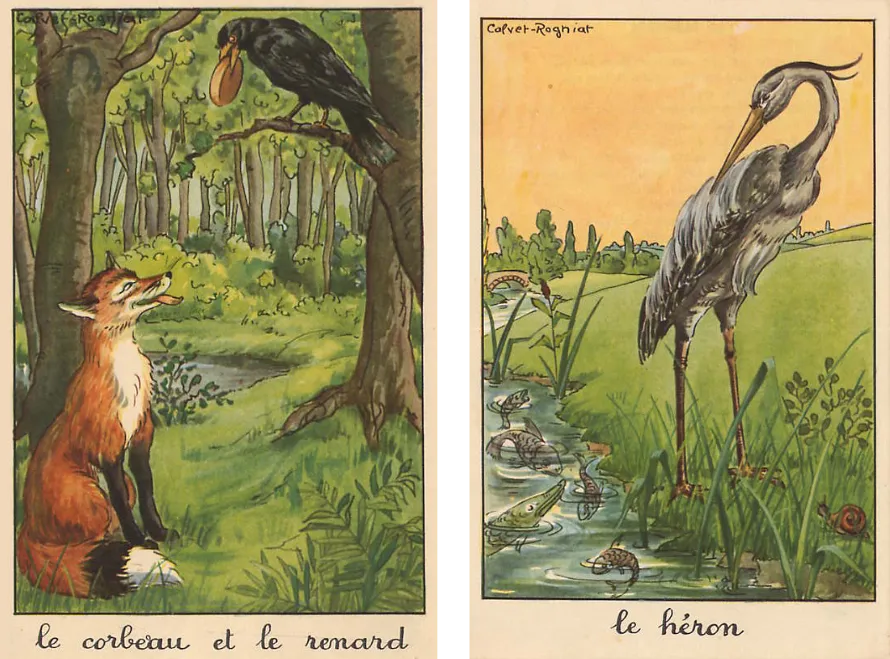
The Crow and the Fox
A fox, wanting the cheese a crow holds in its beak, does not try to take it by force. He compliments the crow on its beauty, its fine appearance, its surely magnificent singing voice. The crow, delighted, opens its beak to perform. The cheese falls. The fox takes it and departs, noting that a flatterer always finds a willing audience.
This is one of the great short stories with moral at its sharpest. The lesson is not just “beware of flattery.” It is also about the crow’s vanity, which is what made the flattery work. La Fontaine puts the responsibility on both parties.
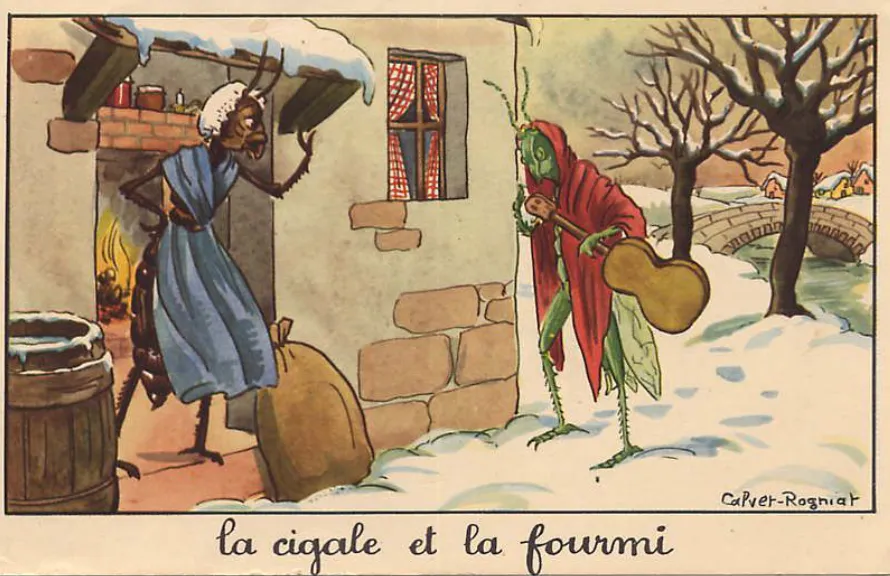
The Grasshopper and the Ant
The most famous of all La Fontaine’s fables, and the most brutal. The grasshopper sings all summer while the ant works. Winter comes. The grasshopper has nothing and asks the ant for help. The ant refuses. End of story.
There is no softening here, no second chance, no redemption arc. French culture absorbed this fable deeply. The word cigale (grasshopper) entered the French language as a way of describing someone who lives carelessly in the present with no thought for the future. It is not a compliment.
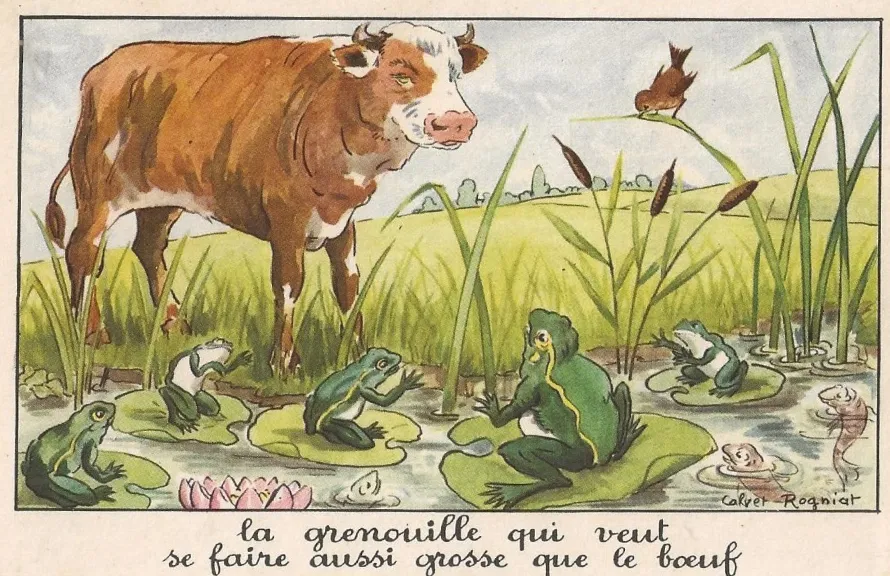
The Frog and the Ox
A small frog, watching a vast ox, decides to make herself as large. She puffs up. She puffs up more. She asks a companion if she is now the ox’s equal. Not quite. She puffs up further, and bursts.
La Fontaine’s moral on vanity and the fatal error of trying to be something you are not. It is aimed squarely at the social climbers of Louis XIV’s court, though he never says so.
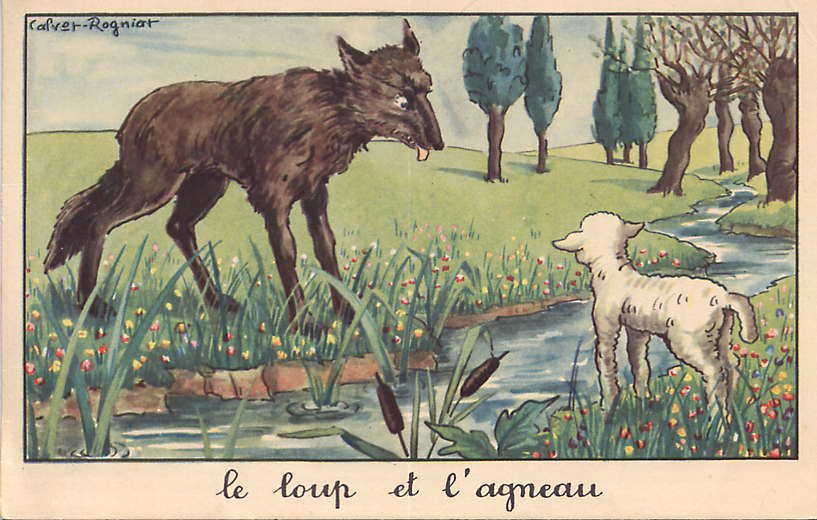
The Wolf and the Lamb
A wolf accuses a lamb of muddying his drinking water. The lamb points out, politely, that it is downstream from the wolf and could not possibly have done so. The wolf produces further accusations. The lamb refutes each one. The wolf eats the lamb anyway.
This is La Fontaine at his most politically pointed. The moral, stated plainly at the start: the strongest reason always belongs to the most powerful. It is a fable about injustice, not a reassuring one.
The Oak and the Reed
A great oak tree taunts a reed for bending in every wind, while the oak stands firm. A storm comes. The oak is uprooted. The reed survives.
One of La Fontaine’s most beautiful animal poems, and one of his most philosophical. Flexibility as a form of strength. Rigidity as a path to ruin. He wrote it in the shadow of Fouquet’s fall, and you can feel it.
La Fontaine’s Style: Why These Moral Stories Are Also Great Poetry
La Fontaine wrote in what the French call vers libres, free verse with lines of varying length rather than the strict uniform metre that formal French poetry demanded. This was unusual for his time and controversial. Critics who preferred classical regularity found it sloppy.
They were wrong.
The varying line lengths create a rhythm that feels like speech rather than recitation, which is exactly what fables require. When the lines shorten, the pace quickens. When they lengthen, the story breathes. The compression and release mirrors the stories themselves, rushing toward the punchline, then pausing on the moral.
His use of irony is equally distinctive. Many of these short stories with morals do not end with a solemn lesson but with a dry, almost amused observation. La Fontaine delivers truth with a raised eyebrow rather than a pointed finger. That lightness of touch is what separates him from every other moralist of his era and what makes his French poems feel contemporary in a way that most 17th-century literature simply does not.
He was also a master of the telling detail. The fox’s tone of elaborate, excessive flattery. The ant’s curt final line to the grasshopper. The frog asking her companion, quite earnestly, whether she has matched the ox yet. These small moments of characterisation turn what could be dry morality exercises into stories with genuine wit and life.
The Grasshopper and the Ant
The Grasshopper, having sung
All summer,
Found herself extremely deprived
When the cold winds began to blow:
Not even one small morsel
Of a fly or a worm.
She cried famine
At the home of her neighbour the Ant,
And entreated her to lend her
Some grain on which to subsist
Until the next season.
“I shall pay you”, she told her,
“Before august, upon my word as an animal,
Both interest and principal.”
The Ant is not a money-lender –
That’s the least of her problems!
“How did you spend the warm days?”
She asked this borrower.
“Night and day, to all who came,
I sang, if you don’t mind.”
“You sang? I am glad.
Well! now you can go dance.”
La Fontaine’s Reach: From Versailles to the World
His influence spread far beyond France, and far beyond literature.
At Versailles, Louis XIV commissioned 39 fountains depicting La Fontaine’s fables, sculpted in lead and painted in vivid colours. The fables became part of the visual language of the most powerful court in Europe, which is a remarkable fate for stories about frogs and ants and foxes.
German philosopher Gotthold Ephraim Lessing wrote his own fables directly in response to La Fontaine, arguing with his approach and his conclusions. The Russian poet Ivan Krylov adapted many of the same fables for Russian audiences, where they became equally embedded in national culture.
In the 18th century, translations brought the tales to English, German, Dutch, and Spanish readers. In the 19th century, Elizur Wright’s American translation went through multiple editions on both sides of the Atlantic. Illustrators from Grandville to Gustave Doré to Marc Chagall have returned to these stories again and again, each finding something new in them.
They became part of school curricula across France and across Europe, which is both their great triumph and, perhaps, their one disadvantage. A text you are required to recite in class at the age of ten carries different associations than one you discover for yourself at thirty. The obligation can obscure the pleasure.
Discover them as an adult, without the obligation, and you find something rather different from the children’s tales you might expect.
Ready to Read The Fontaine Fables?
If you have never read La Fontaine’s fables, or have not revisited them since you were young, they are worth an afternoon of your time. Start with the first collection. The Crow and the Fox takes two minutes. The Grasshopper and the Ant takes three. By the time you reach the Oak and the Reed you will understand what all the fuss is about.
I have linked to a complete edition below. What looks like a quick read has a way of turning into something you sit with far longer than you planned. These are short stories with moral you won’t easily forget.
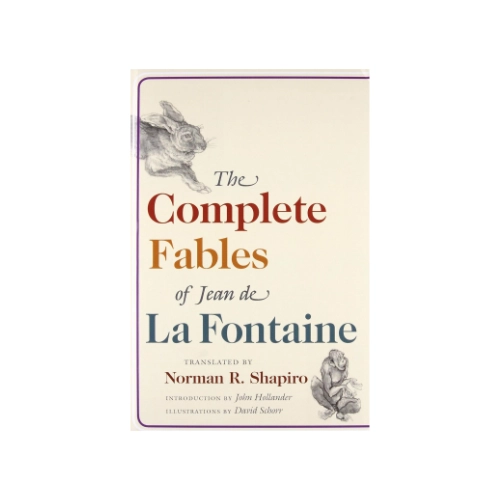
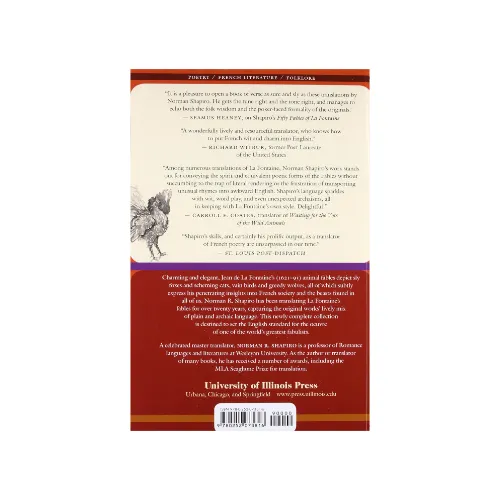
The Complete Fables of Jean de La Fontaine
Find it on Amazon >
Disclosure: Just so you know, this post contains sponsored content and/or affiliate links, If you make a purchase through these links, I may receive a small commission. Doesn’t cost you anything extra. I only link to things that are actually worth your time. All opinions are my own!