Is French Butter Better? The 82% Fat Difference That Changes Everything

There’s a whole aisle for butter in my local French supermarket. Not a shelf, an aisle. Doux, demi-sel, salted with crunchy sea salt crystals, raw-cream butter, butter in little wooden baskets, butter from Normandy, from the Charentes, from Brittany. I’ll happily stand there for ten minutes deciding, and I’m not embarrassed about it. My relationship with butter is sacred.
We’ve never bought margarine in our house, and we never will. Because once you’ve grown up with proper butter, everything else tastes like a compromise.
So, what is French butter exactly? It isn’t just butter that happens to be made in France. It’s held to its own rules: a high minimum fat content, cream that’s usually ripened before churning, and three regional butters protected the same way as Champagne. And yes, I do think tastes better. Spread it on a bit of warm baguette and you’ll see. Richer, creamier, slightly tangy, and it tastes of something beyond fat.
French butter must contain at least 82% fat (80% for salted), compared with an 80% minimum in the US and UK. Most French butter is also cultured: lactic ferments are added to the cream and left to ripen for hours before churning, which gives it a fuller, slightly tangy flavour. Three French butters have protected AOP status.
Table of Contents
How France became obsessed with butter
France wasn’t always butter country. The Mediterranean south cooked with olive oil, the north leant on lard and other animal fats, and the Romans had dismissed butter as something for barbarians. Right through the Middle Ages, butter was the fat of the poor: something you made because you had cows and needed to use up the cream.
The Butter Tower of Rouen
The Church gave butter its most famous moment. Dairy was forbidden during Lent, which was a real problem in Normandy, where olive trees don’t grow and butter was the everyday fat.
So Rouen came up with a very pragmatic solution. With the Pope’s permission, the faithful could buy the right to eat butter during Lent, and the money went into building the cathedral. Work on the south-west tower started in 1485, and it has been called the Tour de Beurre, the Butter Tower, ever since.
You’ll sometimes hear that the name comes from the stone’s buttery colour. That’s a nice story, but the money is the real reason. The golden tint just comes from the limestone.

From the poor man’s fat to the heart of French cooking
By the 17th century, butter had moved firmly into the kitchens of the rich. La Varenne’s Le Cuisinier françois, published in 1651, helped shift French cooking away from heavy spices and towards butter-based sauces. Brittany’s salted butter was already a valuable product: in 1590, a pot of it sold for one écu.
Then, in the 20th century, came the appellations. Because French people cannot do anything without making it official, certain butters were given protected status, with rules on where the milk comes from, what the cows eat and how the cream is ripened. Today three French butters carry the AOP label, and they make up only about 3.5% of the butter France produces.

What makes French butter different?
So how is French butter different from other butter? It comes down to three things: fat, culturing and the cows.
More fat, less water
In France, anything sold as plain “beurre” must contain at least 82% fat, and no more than 16% water. Salted and lightly salted butters can go down to 80%. The only additive allowed is beta-carotene, for colour.
In the US, the legal minimum is 80%, and the UK and the rest of the EU set the same floor (though plenty of brands sit higher). Two percent sounds trivial. But less water means a richer flavour, a silkier texture, and pastry that’s easier to work and flakes better. I go into that in more detail in my guide to French pastry doughs.
Cultured cream
This is the bigger difference. Most French butter is made from cream that has been “matured”: lactic ferments are added after pasteurisation, and the cream is left for hours to thicken and turn slightly acidic before it’s churned. That’s where the flavour comes from, the same way crème fraîche tastes fuller than fresh cream.
The other main style, made all over the world, is sweet cream butter, churned from fresh cream with no ripening. It’s clean and mild, and it’s brilliant when you want butter that quietly supports everything else. Cultured butter has more to say for itself, and that’s the style most French butter follows.
If you want to check, look at the ingredients. French cultured butter lists “crème pasteurisée, ferments lactiques” (pasteurised cream, lactic cultures).
The cows
The third factor is what the cows eat. Grass contains beta-carotene, which ends up in the milk fat and turns butter yellow. That’s why some French butter is pale ivory in winter and golden in spring and summer, when the cows are out on pasture. You can actually see the season.
That said, grazing rules aren’t universal. They belong to the individual AOPs, and they vary a lot from one to the next (more on that below).

Types of French butter
Walk into a French supermarket and you’ll find an entire chilled section given over to butter, which personally I just love. Here’s what you’re looking at.

Beurre doux (unsalted butter)
The default across most of France. It accounts for around 60% of the butter French households buy. French recipes assume unsalted butter unless they say otherwise, and baking almost always uses it, because you want control over the salt in your pastry.
The best unsalted French butters taste of fresh cream with a slight tang from the culturing. They’re brilliant on good bread, where you want to taste the butter rather than the salt.
Beurre demi-sel (lightly salted butter)
The compromise butter, with between 0.8% and 3% salt. It makes up about a third of French butter sales.
Demi-sel works brilliantly for everyday cooking and spreading. The salt brings out the butter’s flavour without taking over. It’s what I keep in my fridge most of the time, because it does both cooking and bread.
Beurre salé (salted butter)
This is Brittany’s butter, and Bretons are very serious about it. Beurre salé contains at least 3% salt, and the ones made with sea salt crystals (often labelled “au sel de mer” or “aux cristaux de sel”) crunch as you eat them.
Salted butter is contentious. Some French cooks never touch it, and many Bretons use nothing else. It’s traditional, it kept longer before fridges existed, and on warm bread with those salt crystals, it’s properly brilliant.
Normandy and Brittany have been arguing about whose butter is better for generations. Both are right, depending on what you’re making.
Beurre cru (raw butter)
Made from raw cream that hasn’t been heated at all, just chilled after milking. It’s legal in France and sold in cheese shops, at markets and on farms. Think of it as the butter equivalent of raw milk cheese: more complex flavour, more variation between batches, and a higher price.
Beurre cru tastes strongly of where it came from, and spring butter tastes different from autumn butter because the cows were eating something different. You can detect terroir, which sounds pretentious until you try it.
It’s rarely seen outside France, partly because it keeps for two or three weeks rather than the two or three months of pasteurised butter. If you find some, buy it, and use it where butter is the main event: on bread, with radishes, on boiled new potatoes.
Beurre extra-fin and beurre fin
You’ll see these on almost every pack, and they’re worth understanding. Extra-fin means the butter was made from pasteurised cream that has never been frozen, and production started within 72 hours of the milk being collected. Fin means up to 30% of the cream may have been frozen first.
Extra-fin is the one to buy. Fin isn’t bad, but it’s the cheaper, more industrial end of the shelf.
Beurre de baratte (churned butter)
A baratte is a churn: a rotating drum that tumbles the cream in batches until the butter separates from the buttermilk. Most modern butter is made in continuous machines, which are much faster. Barattes were traditionally made of wood.
Interestingly, the term isn’t legally defined in France. A 1993 court ruling restricted it to butter churned in batches from start to finish. Whether you can taste the difference is debatable, and whether it’s worth the extra cost depends on how much you care about traditional methods and small producers. I’d say yes for special occasions.
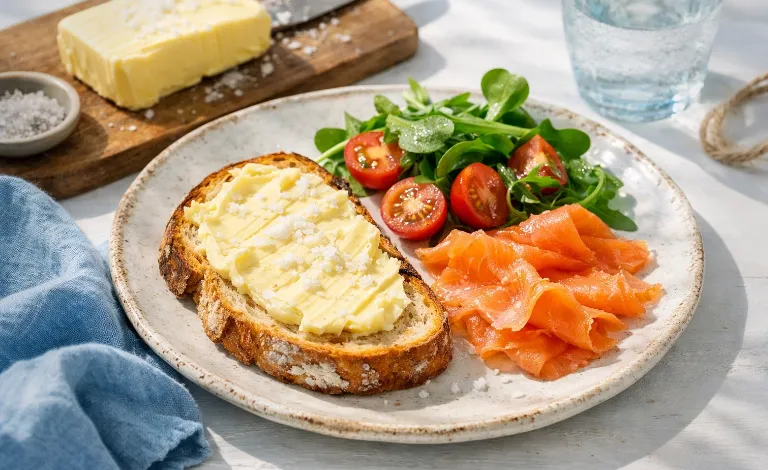
French artisan butter: the three AOP butters
These are the French butters protected by law, each with a detailed rulebook (the cahier des charges) covering the cows, their feed, and how the cream is ripened.


Beurre Charentes-Poitou (AOP)
Made in western France, across the Charente, Charente-Maritime, Deux-Sèvres, Vendée and Vienne. You might also see it sold as Beurre des Charentes or Beurre des Deux-Sèvres, which are alternative names within the same AOP rather than separate butters.
A nice bit of history: dairy farming took off here after phylloxera destroyed the region’s vineyards in the 1880s, and pasture replaced the vines. The cream must be ripened for at least 16 hours. Interestingly, the rules don’t set a minimum number of grazing days, and maize is allowed in the cows’ feed, so Charentes-Poitou butter tends to be paler.
It has a firm texture, and that’s why pastry chefs love it: it stays workable when you’re folding it into croissant and puff pastry dough.
Échiré is the most famous name, from the village of Échiré in the Deux-Sèvres, sold in blocks or little baskets. There’s the Echiré salted butter and the Echiré unsalted butter. Is it worth it? On good bread or a warm croissant, absolutely. It’s creamy and sweet, with a finish that lingers. Lescure is another Charentes-Poitou butter, easier to find and a bit cheaper. Still excellent.
Beurre d’Isigny (AOP)
From the Bessin and Cotentin in Normandy, around the Baie des Veys where several rivers meet the Channel. The appellation dates from 1986.
The rules here are much stricter on grazing: cows must be out on pasture for at least seven months a year, and at least 30% of each herd must be Normande cows. The cream is ripened for at least 12 hours. The result is butter that’s ivory in winter and golden yellow in grazing season, with notes of fresh cream and hazelnut.
Isigny butter is supple and spreadable, even straight from the fridge. That makes it fantastic on bread and less ideal for laminated pastry, where you want a firmer butter. Isigny Sainte-Mère is the big producer, and its butter is one of the easier AOP butters to find abroad. they also have the two classic versions, the Isigny Sainte-Mère salted butter, the Isigny Sainte-Mère unsalted butter and they also have the Isigny Sainte-Mère salt crystals butter.
Beurre de Bresse (AOP)
From the Bresse area in eastern France, across the Ain, Jura and Saône-et-Loire, better known for its chickens. At least half of each herd must be Montbéliarde cows, they must graze for at least 150 days a year, and the maize they eat can’t be irrigated.
The cream ripens for 18 to 24 hours, the longest of the three. Bresse butter is light to deep yellow depending on the season, soft and slightly grainy, with nutty notes of hazelnut and walnut. It’s the least exported of the three, so if you see it, try it.
Beurre de Bresse (AOP)
From the Bresse region in eastern France, known primarily for its chickens but also producing distinctive butter. Made from milk from Montbéliarde, Simmental, or Tarentaise cows grazing on Bresse pastures.
Bresse butter is golden yellow with a firm texture and assertive flavour. It’s less commonly exported but worth trying if you find it.
And Bordier?
Bordier isn’t an AOP, but you’ll see it on the menus of plenty of very good restaurants. Jean-Yves Bordier, from Brittany, works churned butter by hand in the 19th-century style, kneading it and flavouring it with things like seaweed, smoked salt or Espelette pepper, but also the classics: Bordier salted butter and the Bordier unsalted butter. It’s expensive, and it’s a treat.
How French butter is made
The process matters because each step affects the flavour.
- Separating. Milk goes through a centrifuge to separate out the cream.
- Pasteurising. The cream is heat-treated to kill unwanted bacteria (except for beurre cru).
- Maturing. Lactic ferments are added and the cream ripens at a cool, controlled temperature, from 12 hours up to a full day depending on the butter. This is where French butter gets its tang.
- Churning. The cream is tumbled in a baratte or run through a continuous machine until the fat clumps together into butter grains and the buttermilk drains off.
- Washing and kneading. The butter is rinsed in cold water to remove the last of the buttermilk, then kneaded (malaxé) to get a smooth, even texture. Salt goes in at this stage.
- Shaping and packing. The butter is moulded, wrapped and chilled.
For extra-fin butter, all of this has to start within 72 hours of the milk being collected. Faster production is cheaper, but it isn’t better.

What to use French butter for
French butter costs more, so use it where you’ll actually notice it.
On bread
Obviously. Warm baguette, good butter, a pinch of flaky salt from Camargue. This is where cultured butter shows what it can do: the slight tang works with the sweetness of the bread. It’s also brilliant in pain perdu, French toast made the French way.
Finishing dishes
A knob of cold butter stirred into a soup, risotto or sauce at the very end changes everything. French cooks call it “monter au beurre”. The butter emulsifies into the liquid and adds richness and gloss, and with cultured butter you get a little extra depth too.
Pastry
The higher fat content makes French butter easier to work with in every French pastry dough, and a firm butter like Charentes-Poitou is what you want for puff pastry and croissants.
Butter sauces
Beurre blanc, hollandaise and béarnaise use a lot of butter, and it’s the main flavour, so cheap butter makes a cheap sauce. Use unsalted so you can control the seasoning.
Radishes
The French bistro classic: radishes, soft butter, flaky salt from Camargue. It sounds simple because it is. The butter softens the radish’s peppery bite, and the radish cuts through the richness. Use salted butter if you’re feeling Breton about it.
Vegetables
Butter burns easily, so French cooks often mix it with a little oil for frying. But glazing vegetables in butter (glacer) is brilliant with good butter: carrots, turnips, green beans, asparagus. The vegetables pick up a nutty, buttery flavour.
Cakes and biscuits
This is where I’ll lose some people. You can taste the difference in cakes and biscuits, but whether it’s worth the cost is debatable. For a special-occasion cake, yes. For a Tuesday-night batch of biscuits (cookies), probably not.
Baked potatoes
Controversial opinion: French butter is wasted on baked potatoes. You need so much that the cost gets silly, and the fluffy potato hides the subtle flavours anyway. Use decent butter, but save your Échiré for something else.
The butter you actually see in France
Échiré, Bordier and the AOP butters are for special occasions, or for people who care enough about butter to spend money on it. Which, in France, is quite a lot of people. French households buy around 2.7kg of butter per person a year, and that’s before you count all the butter in croissants and pastries.
French supermarkets also sell cheap butter: beurre fin, own brands, the industrial end of the range. Even so, everyday French butter still has to reach 82% fat, and most of it is made from matured cream. Not because French cows are magic, but because ripening the cream became standard practice in France and stayed that way.
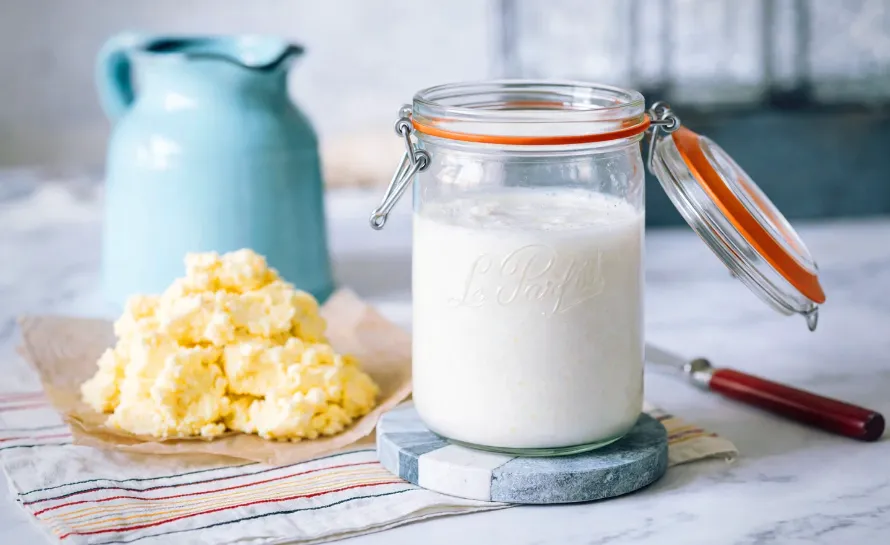
Making your own butter
Once you know why French butter costs twice as much, making it yourself seems less mad.
Cultured butter is surprisingly easy to make at home. You mix cream with a spoonful of live yoghurt or crème fraîche, leave it to ripen, then churn it. The hands-on work is about 20 minutes, and the rest is waiting. Is it practical for everyday toast? No. But for a special occasion, it’s absolutely worth doing.
I’ve written a complete guide to making homemade butter the French way, including temperatures, how to culture the cream properly, and why washing the butter matters more than most recipes admit. Fair warning: once you’ve made it yourself, you’ll understand exactly why the French are so precious about it.
How to store French butter
- In the fridge: Keep it wrapped or in a covered butter dish, because butter absorbs smells. Don’t store it next to onions or blue cheese unless you fancy onion-cheese butter. Take it out 30 to 60 minutes before using, so it spreads properly and creams well for baking.
- In the freezer: Butter freezes well for up to about six months if it’s tightly wrapped. That’s useful if you’ve found good butter on offer or brought some back from France. Defrost it slowly in the fridge. Note that raw butter doesn’t freeze well, so eat beurre cru fresh.
- In a butter bell: The ceramic butter bell that keep butter soft without refrigeration (a little water in the base seals out the air) work best with salted butter, as the salt helps preserve it. Change the water every couple of days. They’re fine with unsalted butter in winter and less reliable in a hot summer kitchen.

Serving French butter: the butter knife
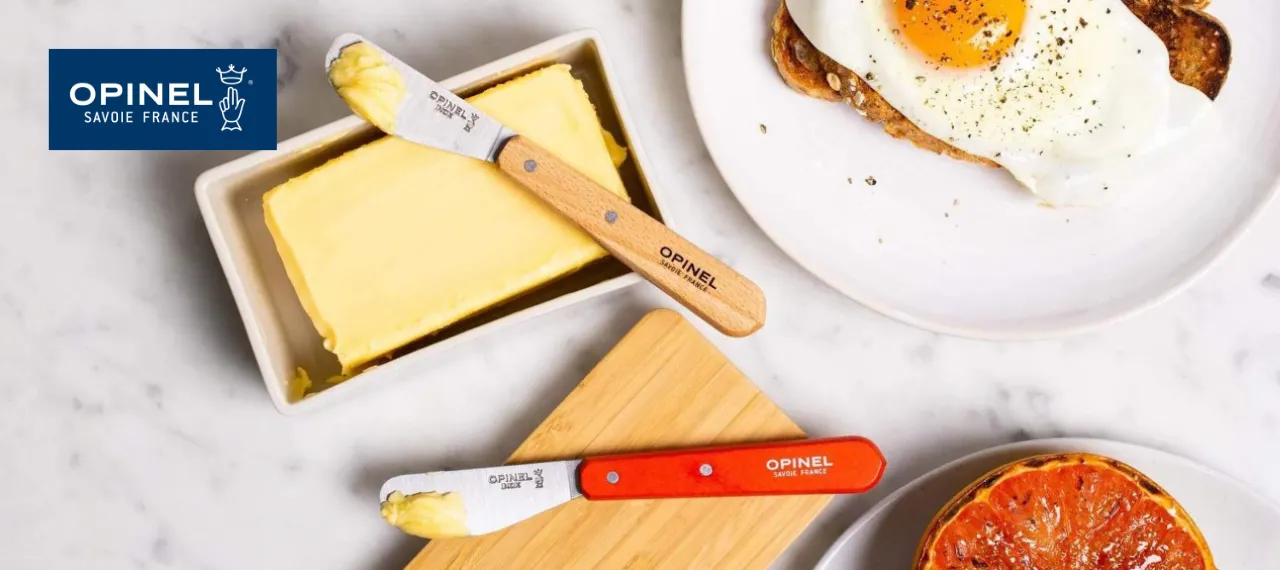
In France, butter is never an afterthought, and it’s served properly. Rather than hacking at a cold block with a dinner knife, French households use a butter knife or spreader with a wide, flat, rounded blade. It softens and spreads cold butter without tearing your bread.
Opinel, the Savoyard knife maker, makes one called the Tartineur N°117, a spreading knife with a wide blade and a wooden handle, in several colours if you’re interested!
Is French butter better? The honest answer
The question people ask most is simple: is French butter better than what you’re already using? Having tasted more butters than any reasonable person should, my answer is yes. Here’s how I’d put it.
The difference is real
A good cultured French butter tastes noticeably different from a basic block butter. The texture is smoother, the flavour fuller, and the taste lasts longer. On good bread, where butter is the main attraction, the difference is obvious.
But the returns diminish
The jump from cheap butter to decent cultured butter is huge. The jump from decent cultured butter to an AOP butter is real but smaller. The jump from there to an ultra-premium artisan butter is subtle enough that you might not notice it in a blind tasting.
Context matters
Premium butter on bread? You’ll taste it. In biscuits? Maybe. In a mushroom bourguignon? You’re wasting your money.
The snobbery is real, though. Some French people are insufferable about butter: refusing certain brands, insisting on specific regions, arguing about salt like it’s a moral issue. I’m not quite that bad. But I’ll take no butter over anything labelled “light” or heavily processed for sure!
The practical approach
Buy what fits your budget. Use regular butter for most things without feeling guilty, and save the good stuff for where it counts. But do try proper French butter at least once.

A little bit of France in your inbox
Once a month, I’ll write to you with recipes, French cheeses, a few tips and little stories from the neighbourhood. And you’ll get my Mother Sauces e-book free, straight away!
FAQ
What is French butter?
French butter is butter made to French rules: at least 82% fat for unsalted butter (80% for salted), with no additives except beta-carotene for colour. Most French butter is also cultured, meaning lactic ferments ripen the cream before churning, which gives it a fuller, slightly tangy flavour. Three regional butters, Charentes-Poitou, Isigny and Bresse, have protected AOP status.
How is French butter different from regular butter?
There are three main differences. French butter has more fat and less water, it’s usually cultured with lactic ferments for a fuller flavour, and protected AOP butters come with strict rules about the cows’ breed, their feed and how long they graze. The result is a richer, creamier butter with a slight tang that tastes noticeably better on bread.
Why is French butter so yellow?
The colour comes from beta-carotene, a natural pigment in grass. When cows graze on fresh pasture, it ends up in the milk fat and turns the butter golden. That’s why AOP Isigny butter, for instance, is ivory in winter and golden yellow during the grazing season. Butter from cows fed mostly on hay or maize is paler, even if it’s excellent.
What’s the best French butter to buy?
For bread, try a cultured AOP butter: Isigny for a soft, spreadable butter with hazelnut notes, or Échiré for something creamy and luxurious. For pastry, a firm Charentes-Poitou butter is the professionals’ choice. For everyday cooking, any French butter labelled “extra-fin” is a good buy. Isigny Sainte-Mère is one of the easiest to find outside France.
Final thoughts
If you’re ever in France, head for the butter aisle and pick up something you’ve never tried: a demi-sel from Brittany, an Isigny, or a little basket of Échiré. Warm baguette, a pinch of flaky salt, and you’ll see why I take their butter so seriously!
This post may contain affiliate links. If you buy through them I earn a small commission at no extra cost to you, and it helps keep this blog running. Please read my disclosure policy for more information. I am grateful for your support.