Poitiers: Churches, parks, and a tiny Statue of Liberty
Poitiers is one of those places I keep going back to and wondering why more people don’t talk about it. It’s technically a city, but it feels like a very liveable town: steep streets, two rivers wrapped around a limestone plateau, students everywhere, and more churches than seems reasonable for somewhere that size. If you like history, but also parks and pastries and people actually living their lives around old stones, Poitiers is very much your place.
What I love most is the mix. You can start the morning under a 12th‑century façade, spend lunch in a garden with ducks and roses, and end the day in a chocolate shop that’s been running since the 1820s. It never feels like an open‑air museum; it feels like a city that just happens to have been important for a very long time.
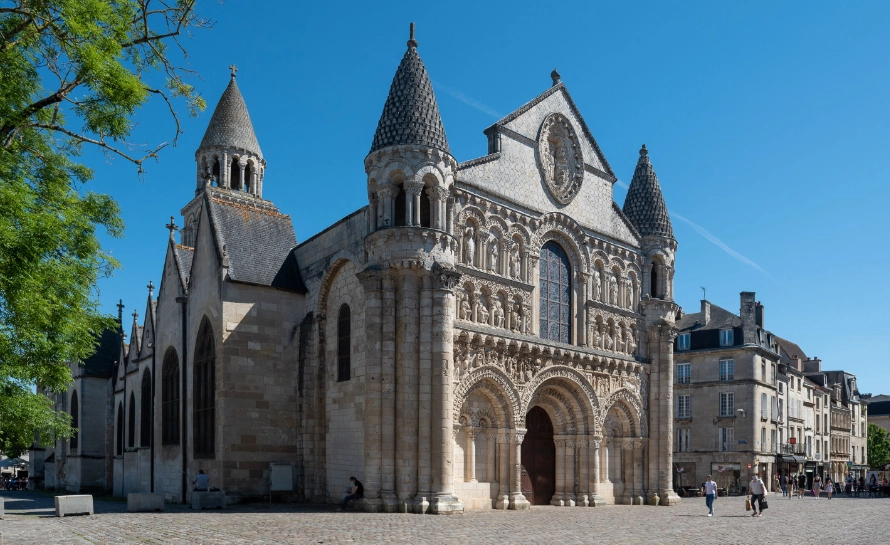
Notre-Dame la Grande
If you only have time for one church, make it Notre‑Dame la Grande. It’s the one you’ve probably seen in photos without realising where it was. The front is a full stone tapestry of 12th‑century carving: saints, prophets, tiny faces, draped robes. When you stand in the square, your eyes just keep catching new details. It’s very hard not to point and say “look at that” every thirty seconds.
In the Middle Ages it was painted in bright colours. Nowadays, on summer evenings, they project those colours back onto the façade in a light show. It’s completely wonderful, suddenly you see how unapologetically colourful medieval churches would have been.
Right now the interior is mostly closed for restoration, but honestly the outside is the main event. Even if you just sit on the edge of the fountain opposite with a coffee and stare at it for ten minutes, you’ll get a new memory you won’t forget.
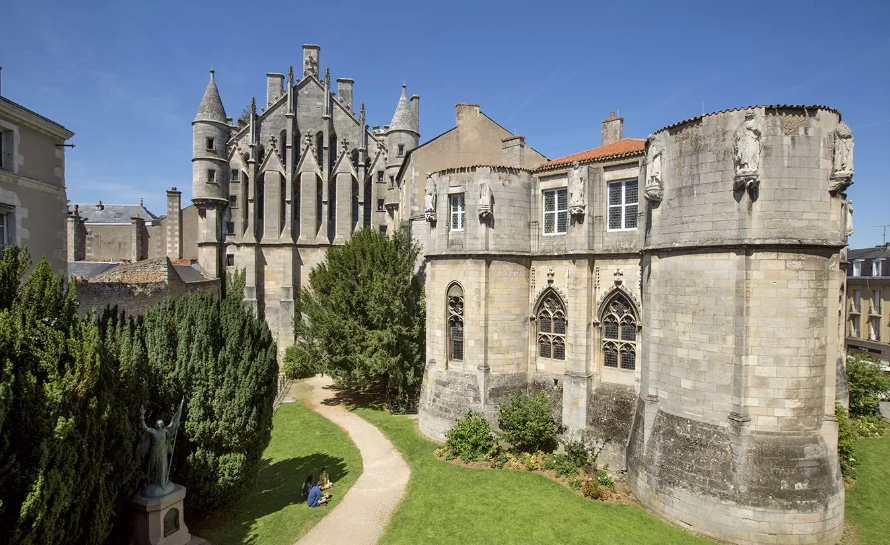
Palais des Comtes de Poitou-Ducs d’Aquitaine
If you head up to the highest point in the old town you reach the former palace of the Counts of Poitou and Dukes of Aquitaine which is Eleanor’s palace. It’s not a neat finished château, but instead it’s more like a complex of towers and halls that has grown and been repurposed. My favourite part is the huge hall called the “Salle des Pas Perdus”, which means the Hall of Lost Footsteps and was built in Eleanor’s time. It’s long enough that your footsteps really do echo away from you.
For centuries, right up until 2019, this was the courthouse. So you have this medieval ceremonial hall where judges, lawyers, and defendants have been trudging in and out for hundreds of years. It’s now in the process of becoming a cultural space, which feels like a nice next step, less sentencing, more exhibitions.
If you like standing in places and thinking “Eleanor walked through here, and so did a nervous defendant in 1973,” you’ll enjoy it. And if you want to go deeper into her story while you are in the city, there is an Eleanor of Aquitaine‑themed walking tour of Poitiers that ties the palace to other spots from her life and makes the history feel real.
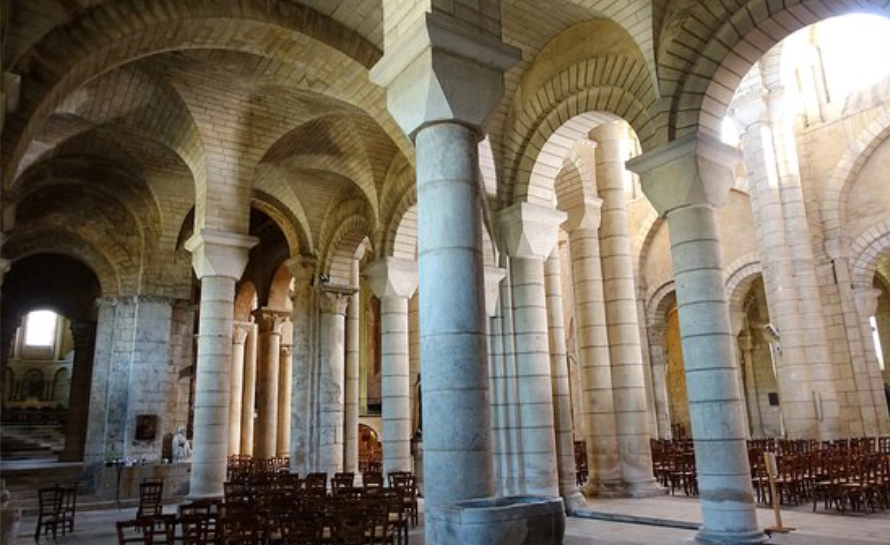
Église Saint-Hilaire-le-Grand
This 11th‑century church was built over the tomb of Saint Hilaire, Poitiers’ first bishop, who died in 367. It was consecrated in 1049 and today forms part of the UNESCO‑listed Santiago de Compostela pilgrimage route.
When you step inside, the architecture feels slightly unusual, almost like a stone forest: hefty columns line the nave, and a network of narrow side aisles spreads out around them. Those side aisles were added to handle the flow of pilgrims heading for Compostela. The choir and its ring of chapels at the east end are pure 11th‑century Romanesque and are one of the reasons the church has that UNESCO status.
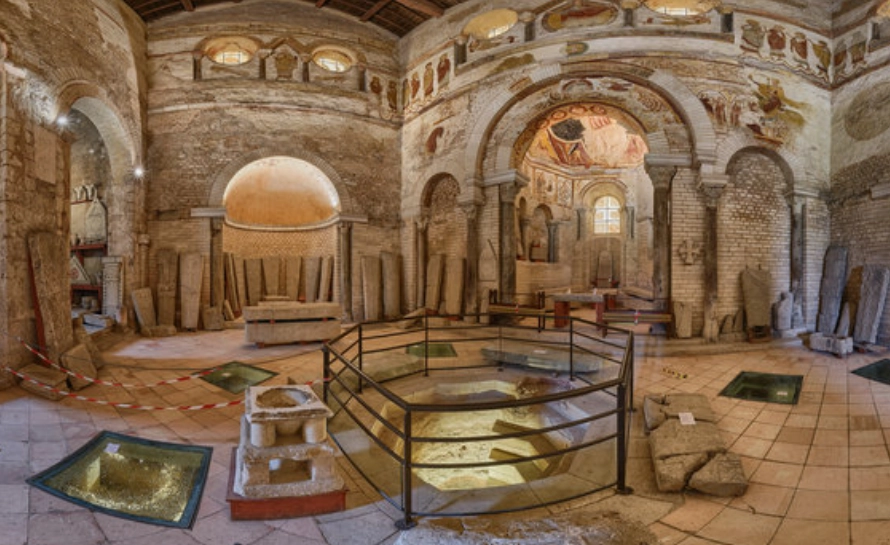
Baptistère Saint-Jean
This small, squat building is older than most of what we call “medieval.” It dates from the 4th century, around 360 AD, and is considered one of the oldest Christian buildings in France. Saint Hilaire probably commissioned it as a baptistery. The central section uses Roman walls, later adapted in the 6th century to include a sunken pool where converts could be fully immersed. Baptism, in those days, meant stepping down into the water, not a light sprinkling.
In the 1830s the whole building nearly disappeared under one of Napoleon III’s urban schemes, but local people raised money to save it. It is tiny, modest, and absolutely unmissable if you care about early Christianity in France.
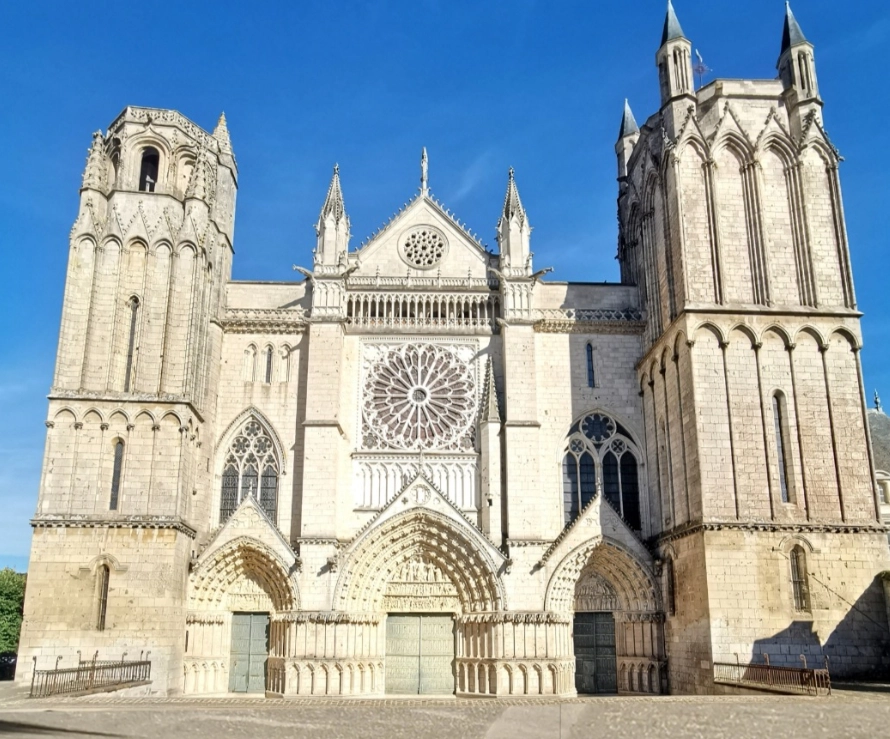
Cathédrale Saint-Pierre
The cathedral Saint‑Pierre is a different feeling entirely. You walk in and instead of the usual tall nave and small aisles, it opens like a huge stone hall, the nave and aisles are almost the same height, so you get this big, wide volume of space.
Eleanor of Aquitaine and Henry II started it in 1162 as their statement piece. The bit that always gets me is the glass. A lot of the windows in the choir and transepts are original 12th-13th century, which is rare. Behind the altar there’s a huge Crucifixion window from around 1165 where right at the bottom, two small figures represent Eleanor and Henry. It’s one of the very few times you get to see her more or less as her contemporaries did. I love that she’s literally built into the light of the place.
If you look back at the west front from outside, you’ll notice it doesn’t sit entirely straight. Eight hundred years of very heavy stone sliding very slowly into soft limestone will do that. Somehow the slight wonk makes it feel more human.
Church of Sainte-Radegonde
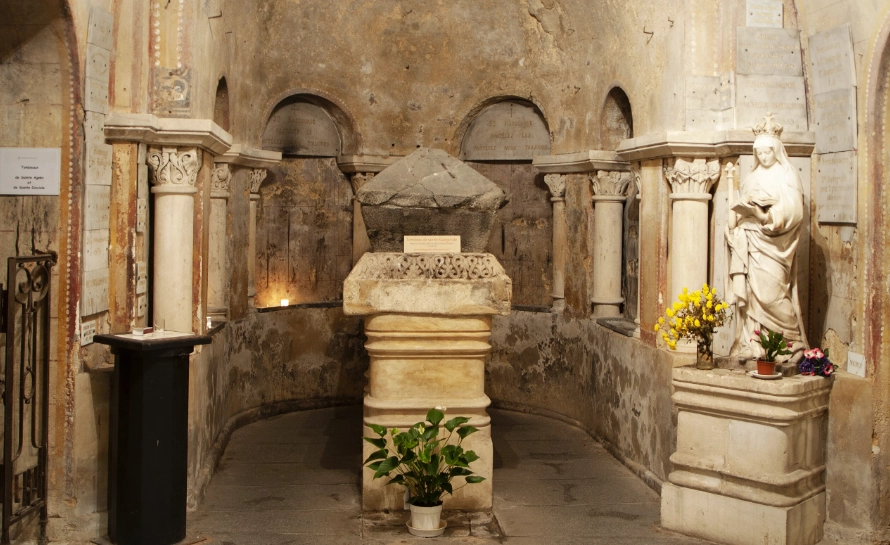
Sainte‑Radegonde is attached to the story of a 6th‑century queen who left her king, came to Poitiers, and founded an abbey. She’s buried here. The current church is mostly 11th–13th century, Romanesque at one end and Gothic at the other, but the part that stays with you is the crypt. Her tomb is there, surrounded by centuries of little thank‑you plaques and offerings. You get a strong sense of people coming back here, generation after generation, to ask for help and say thank you.
Musée Sainte-Croix
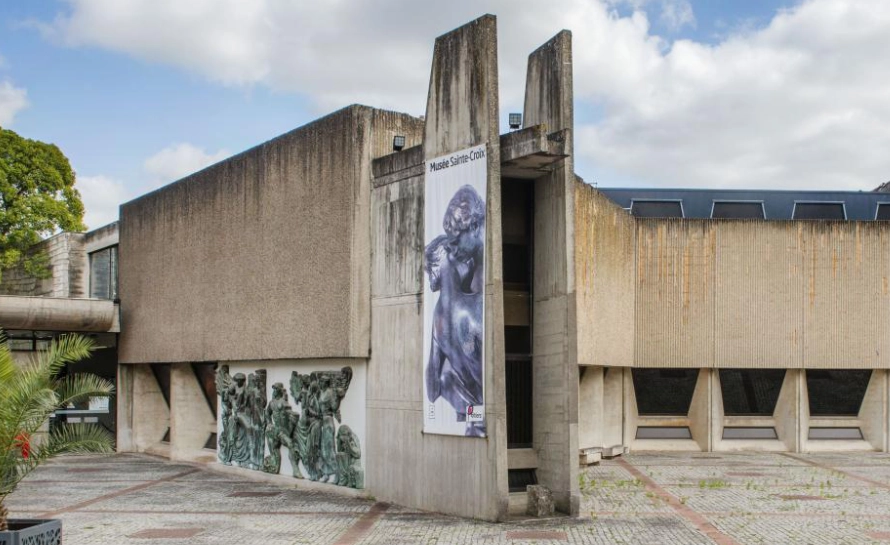
The main museum Sainte‑Croix is a 1970s concrete brutalism building that France seems rather fond of. Inside, there’s a very good archaeology collection that reminds you Poitiers was a thriving Roman town before all the churches arrived: statues, mosaics, glass, the usual fragments that suddenly make the Roman layer very real.
The thing I think is really worth it though is the sculptures, especially the pieces by Camille Claudel. She studied in Poitiers before heading to Paris and that whole complicated story with Rodin. Her work has this sharpness and emotional weight that jumps out even if you don’t know anything about her. It’s a museum where you can do a quick, selective visit and come out feeling like you’ve seen something new and memorable.
Green pockets: where the city breathes
Parc de Blossac
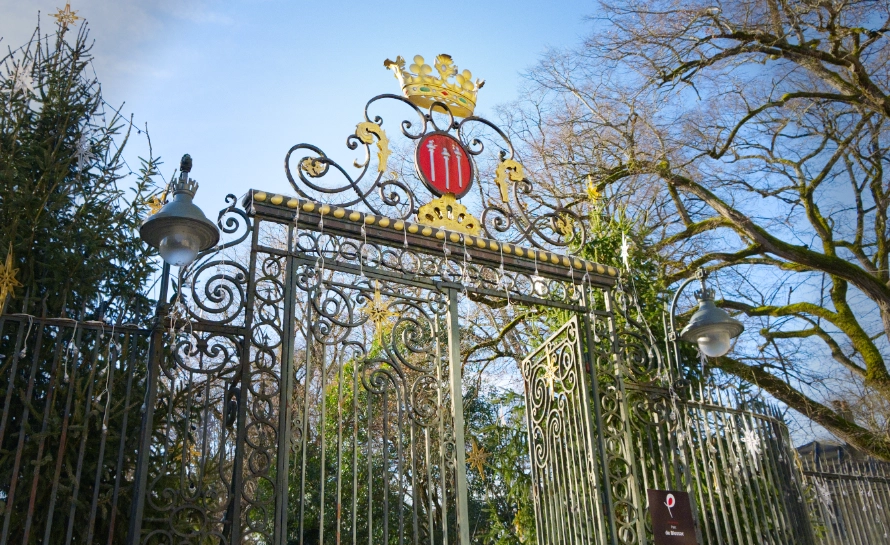
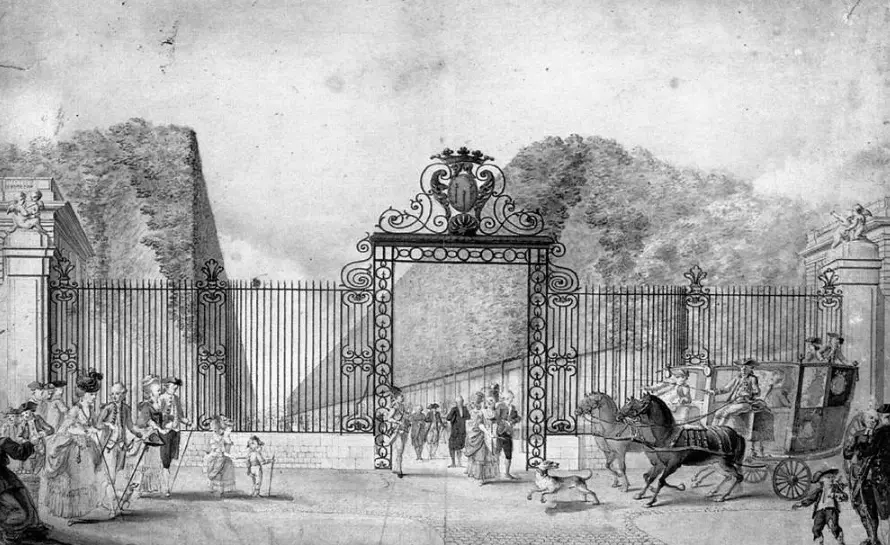
Parc de Blossac sits on the western edge of town where the ramparts used to be. It’s laid out as a formal 18th‑century French garden: straight paths, clipped hedges and symmetrical beds. On paper it sounds stiff, but in reality it’s full of life, families in the playground, students revising on benches and older couples doing their daily lap. There’s a terrace with a gentle view over the river valley and even a small free “zoo” with assorted birds and rabbits. Nothing exotic, but if you’re like me you’ll end up standing there watching the ducks for longer than you meant to.
Parc Floral de la Roseraie
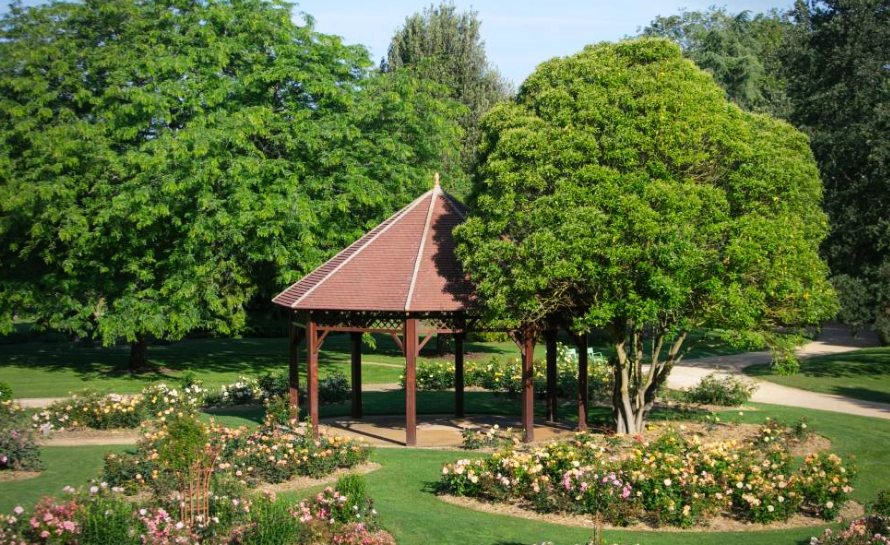
On the eastern side you’ve got the Parc Floral de la Roseraie, which is exactly what it sounds like: a floral park heavy on roses, built in the 1970s. If you go in late spring or early summer it’s a wall of colour and scent. Beyond the rose beds there are wilder corners, a little maze, bits of woodland, a pond where ducks drift between water lilies. It’s very much a local place; you get people walking dogs, kids on scooters, that sort of thing.
Jardin des Plantes
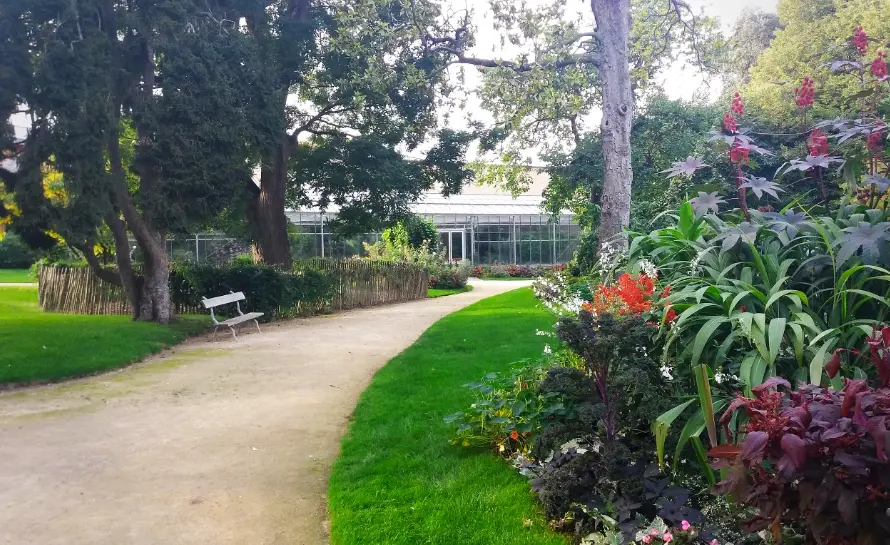
Then there’s the Jardin des Plantes, the old botanical garden. It started life in 1621 as a teaching garden for medical students and shifted around town a few times before settling where it is now. It’s not huge, but it has that slightly old‑fashioned charm, winding paths, a small waterfall, a pond, big trees, beds of labelled medicinal plants and herbs, and a compact tropical greenhouse. It’s a nice place to sit if you need a pause between churches.
Chocolate, umbrellas, and other small joys
Poitiers also has some extremely satisfying “small” things that are worth building into your day.
La maison Fink
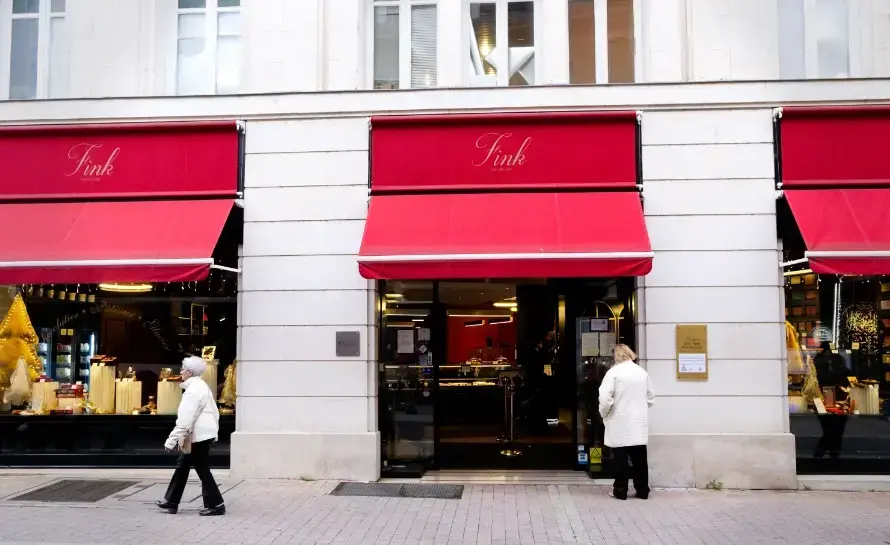
Maison Fink is one of them. It’s a chocolate and pâtisserie shop that’s been operating since 1828. There’s something very grounding about eating a chocolate in a place where people have been doing basically the same thing for nearly two centuries. The current owner started there as an apprentice, left for Paris, then came back and bought the shop. Everything is made on site – chocolates, macarons, tarts, ice cream. If you need an excuse to sit down, the tea room in the original shop near Notre‑Dame la Grande is a very good one.
Fabrique De Parapluies François
Then there’s the François umbrella workshop. I know “umbrella factory” doesn’t sound wildly exciting, but this one is different. It’s been in the same family since 1882 and is one of the last proper umbrella makers in France. They make umbrellas that don’t instantly fold inside out in a gust of wind: carbon or fibreglass ribs, solid wooden handles, fitted to your height if you want. You can pop into the workshop on Grand’Rue and watch them being assembled. It’s strangely calming, and you come out slightly annoyed at every flimsy umbrella you’ve ever bought.
Cimetière de la Pierre Levée
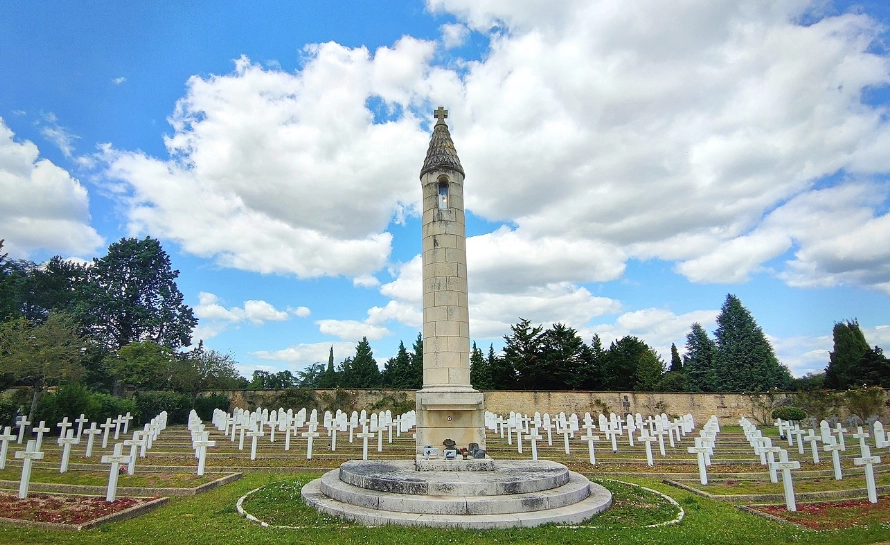
If you’re up for something a bit quieter, the Cimetière de la Pierre Levée is an interesting detour. It’s the city’s largest cemetery, calm and leafy, but the real star sits just outside the walls: a Neolithic dolmen, a huge stone table that’s been there since around 3000 BC. Rabelais wrote about it, which I love, the idea that people in the 16th century were already walking past this thing and wondering about it, just like we do.
Lantern of the dead
Inside the cemetery there are French and German World War I graves and a modern “lantern of the dead”, a stone column with a lamp at the top, modelled on medieval originals and kept lit. It’s not the sort of place you put at the top of a tourist list, but if you like places where time layers up thickly, it’s worth an hour.
Free to visit, though it’s a functioning cemetery, so treat it with appropriate respect.
If you enjoy that feeling of time piling up in one place, these are very interesting spots. Poitiers also pops up at various points in French political history, from the Revolution onward, and there is even a Napoleon‑focused tour for anyone who likes following that particular thread through French cities.
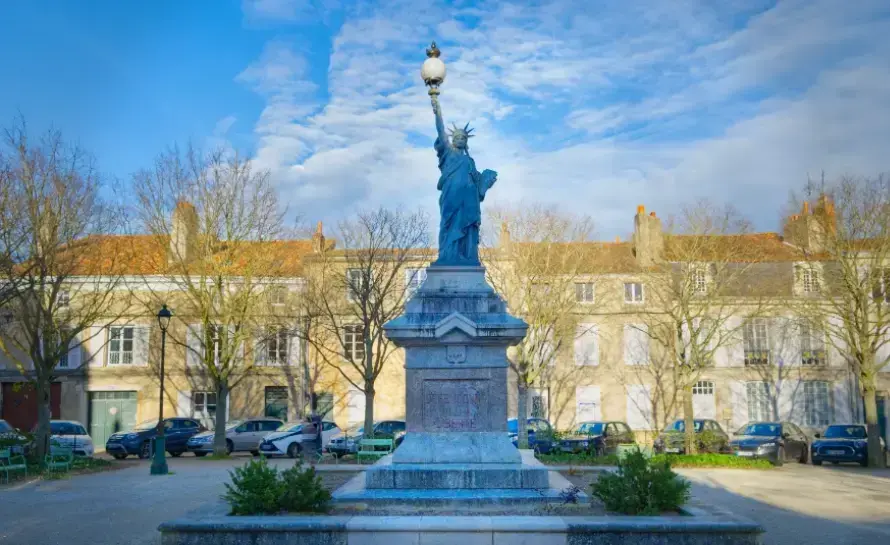
Statue of Liberty France
You won’t believe it but, there is a tiny Statue of Liberty in Poitiers. It stands in Place de la Liberté, which used to be Place du Pilori, the pillory square. For centuries this is where people were shamed, and during the Revolution it’s where the guillotine stood. In 1822 a general called Berton was executed here for plotting against the king; his last words were “Vive la Liberté!” and the square eventually took that name.
The small bronze Liberty statue stands in the middle and arrived in 1903. On the base there’s a line from Montesquieu: “When the innocence of citizens is not assured, liberty is not either.” It was a pointed comment on the Dreyfus Affair at the time. Today it’s very easy to walk past without noticing the inscription, but if you stop and read it, and remember what used to happen on that spot, the whole square suddenly feels much heavier.

Markets and what to eat
Because this is France, we have to talk about the market. On Saturdays, Place du Maréchal Leclerc fills with stalls: vegetables, fruit, cheese, meat, flowers. It’s not some curated “market experience” for tourists, it’s where people actually shop. If you go, make sure to get there early as by eight the market is already going, and by lunchtime most of it is winding down.
For everyday things, the covered Marché Notre‑Dame near Notre‑Dame la Grande is perfect. It’s a 19th‑century iron‑and‑glass hall with regular stalls for cheese, charcuterie, bread, and the usual fresh produce. If you only ever see French markets in small holiday towns, it’s quite nice to watch one that’s clearly feeding a real city.
Food‑wise, there are a few local things it’s worth looking for:
- Farci poitevin is a green terrine made from leafy vegetables, herbs, and pork, sliced and eaten with bread.
- Tourteau fromagé is a light fresh‑cheese cake with a dramatic blackened top. It looks burnt but inside it’s fluffy and gently sweet.
- Broyé du Poitou, a large, round, very buttery biscuit that you don’t slice but break in the middle of the table so everyone gets a shard.
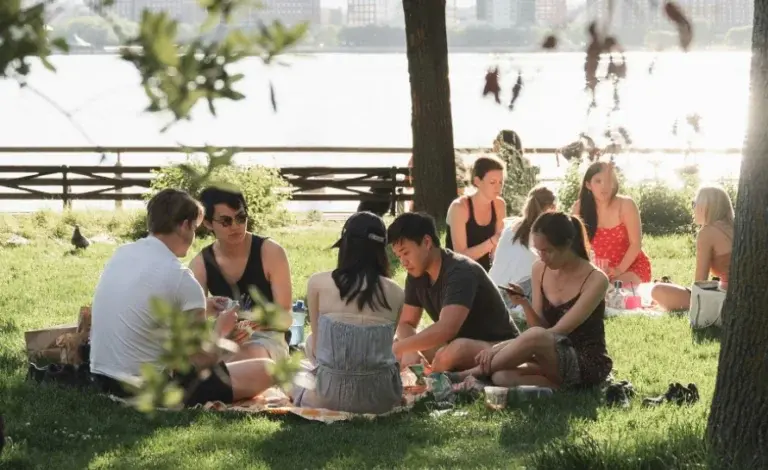
Buy a piece of tourteau fromagé and a coffee, sit somewhere between a church and a park, and just watch Poitiers go by for a bit. You’ll see students, families, dogs, the odd priest, and a surprising number of people who seem in no particular hurry. It’s a good reminder that “historic” places don’t have to feel stiff.
If you like cities that feel lived‑in rather than polished, with proper history but also somewhere to sit in the sun with a pastry, Poitiers is very much worth a couple of days. I’m slightly biased because I like it so much, but honestly, go. Walk, wander, get lost once or twice, and you’ll see why I keep finding excuses to go back.
If you prefer a bit of structure for your first visit, a guided walking tour of Poitiers can be a nice way to get your bearings. You cover the main churches, a few quieter corners you might miss on your own, and then you are free to come back later to the places you liked most.
What to see and do in Poitiers, France
- Notre-Dame la Grande
Masterpiece of Romanesque architecture with an extraordinarily carved façade. Closed for restoration until 2027 but façade visible. Virtual tour available at Tourist Office. - Baptistère Saint-Jean
One of France’s oldest Christian buildings, dating from the 4th century. Original octagonal baptismal pool, Merovingian frescoes, and carved sarcophagi. Small but remarkable. 20-30 minutes, €3 entry. - Cathédrale Saint-Pierre
Massive Angevin Gothic cathedral begun by Eleanor of Aquitaine in 1162. Exceptional 12th-13th century stained glass including the Crucifixion window. Medieval choir stalls and recently discovered wall paintings. Free entry. - Palais des Ducs d’Aquitaine
Eleanor of Aquitaine’s palace with the vast Salle des Pas Perdus (50m long). Joan of Arc was examined here. Guided tours only, book ahead. 45 minutes, €8. - Église Saint-Hilaire-le-Grand
11th-century UNESCO church with unusual multi-domed architecture. Built over Saint Hilaire’s tomb, part of the Santiago pilgrimage route. 4th-century crypt. Often empty and atmospheric. Free. - Musée Sainte-Croix
City museum with extensive Gallo-Roman archaeology, fine art collection, and Camille Claudel sculptures. Brutalist 1970s building. 1-2 hours, €5 (free first Sunday). - Medieval Streets
Wander Rue de la Regratterie, Rue de la Chaîne, and streets around the cathedral. Half-timbered houses, cobbled lanes, medieval atmosphere. Free, take your time. - Place de la Liberté
Historic square with 1903 replica of the Statue of Liberty. Former site of the pillory and guillotine. Good cafés for people-watching. - Futuroscope
Massive multimedia theme park 10km north. IMAX, 4D rides, technology-focused shows. Brilliant for children and tech enthusiasts. Full day needed, €45 entry.
Practical information for visitors
- Getting there
Poitiers is 90 minutes from Paris by TGV from Paris Montparnasse. The station’s about 20 minutes’ walk from the centre, or take bus line 1.
If you’re driving from the UK, it’s about 4.5 hours from Calais, mostly motorway. Poitiers-Biard airport is 15 minutes away but small with limited connections. You’re better off flying to Bordeaux (120km) or Tours (90km) and getting the train. - Getting around
The centre’s compact and walkable. You won’t need buses unless staying outside the centre or visiting Futuroscope. Vitalis bus network: €1.90 single tickets, day passes available. Line 1 connects the station to the centre. Line E goes to Futuroscope. Multi-storey car parks around the centre. Street parking free on Sundays. - Accommodation
Stay in Vieux Poitiers or near Place du Maréchal Leclerc for easy access to everything. Hotels range from €60-150 per night for mid-range options. Book ahead for weekends and summer. Futuroscope has themed hotels if you’re visiting the park, convenient but you’ll miss the medieval city atmosphere.