 July 4, 2026
Disclosure: This post may contain affiliate links which provide us a small commission when used for purchase. Please read my disclosure policy for more information. I am grateful for your support!
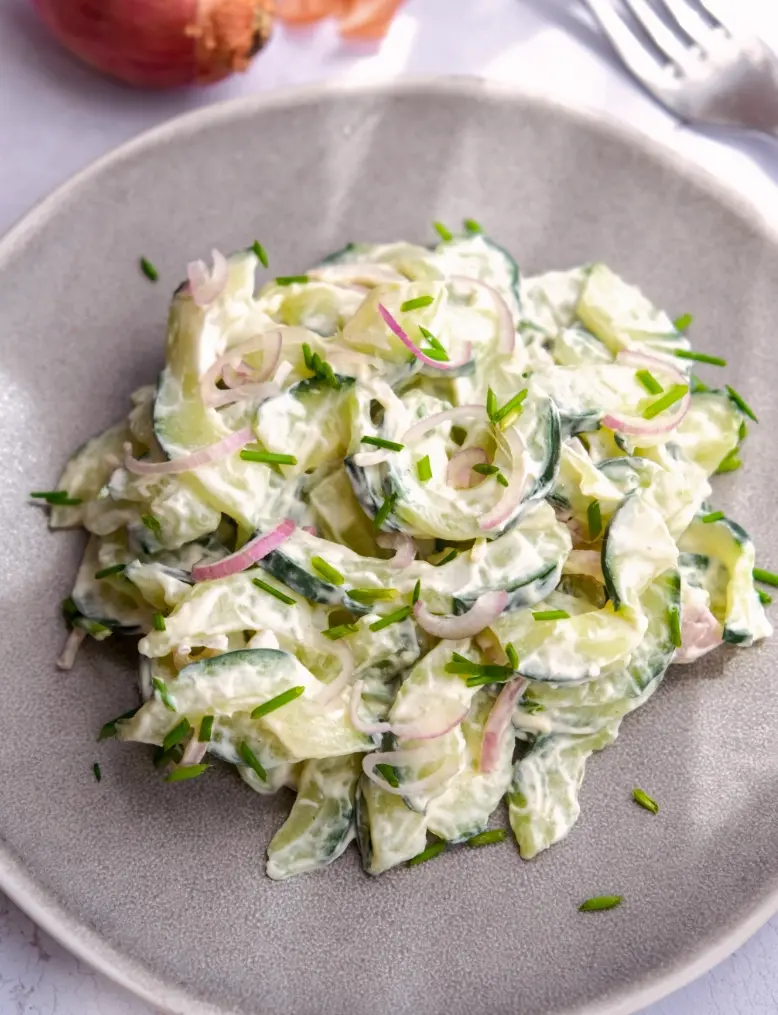
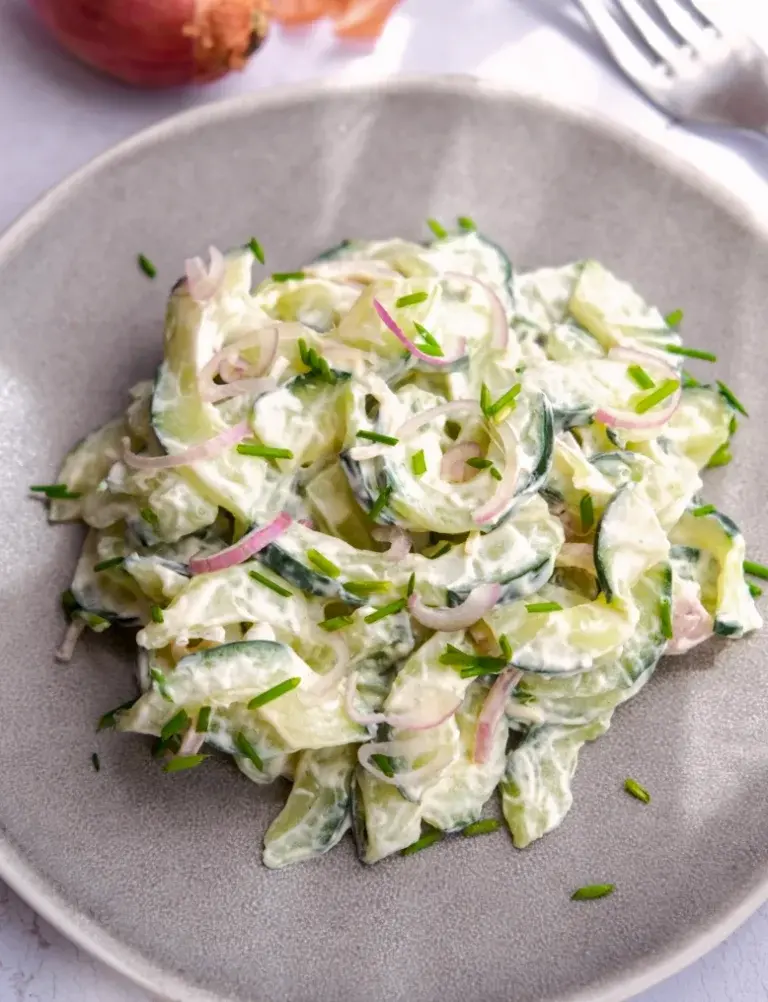
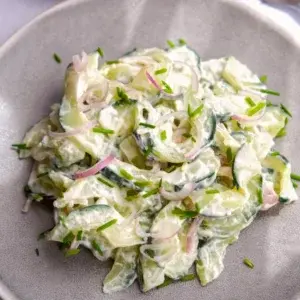
When the summer gets hot, I need refreshing salad like this creamy cucumber salad to cool down. Cucumbers have that quality that does just the trick. I make this one a lot as it is super easy and it goes with about everything, even just a fresh baguette on its own.
The ingredient list is short: crème fraîche, chives, a little Dijon mustard, a little vinegar, and as a French person, the chances of you having all this in your kitchen is high. It’s and obvious mix to make and people here really never have to think about it.
Table of Contents
Where cucumber salad comes from
This creamy cucumber salad not a recipe that comes with a grand history or a famous origin story. It’s just what French families make in summer when cucumbers are in season, the weather is warm, and nobody wants to spend long in the kitchen. You’ll find some version of this cucumber salad in virtually every French home.
France has been growing cucumbers since the 9th century, when Charlemagne had them cultivated on his estates. Louis XIV was a particular enthusiast and had them grown under glass at Versailles, which pushed cucumber firmly into fashionable cooking. It was also around the 17th century that the word “cornichon” (pickle) first appeared in French, describing a young cucumber picked small and preserved in vinegar. The cucumber and the cornichon are actually the same species. One just gets picked earlier.
By 2022, world cucumber production had hit 94 million tonnes annually, with China alone accounting for 80% of global output. France is the fourth largest producer in the EU, harvesting around 170,000 tonnes a year.
The two cucumbers you’ll find in France
If you’ve ever been to a French market in summer, you’ve probably noticed two very different types of cucumber on the stalls.
English or European cucumber
This one is long, smooth, shiny, and almost seedless. This is the one you’ll find in virtually every supermarket across France and most of the world. It’s grown under glass, mild in flavour, and very easy to use. Over 80% of French cucumber production is now this variety.
Field cucumber or pickling cucumber
This one is shorter, stubbier, with a rougher, slightly bumpy skin and a darker, more matte green colour. It grows in open fields rather than greenhouses, has a more pronounced flavour, a slightly firmer texture, and a faint bitterness that some people love and others find too much. It needs peeling before eating, and the salting step before dressing is even more important with this variety.
Either works well in this recipe. The smooth one gives you a cleaner, milder result. The pickling one gives you more flavour, more character, and a bit more crunch.
Ingredients

- Cucumber – The star, obviously. Either type works (see above). Whichever you use, it gets salted first, which is the secret to this salad.
- Crème fraîche – The heart of the dressing. Thick, slightly tangy, and rich enough to stay stable against the vinegar and mustard without splitting or going runny. Use the full-fat version, because the fat is what holds it all together.
- Dijon mustard – Just a teaspoon, for a bit of sharpness and depth under the cream.
- White wine vinegar – The acidity that stops the whole thing feeling heavy. A little goes a long way.
- Shallot – Finely sliced, for a gentle bite. Milder and more elegant than raw onion.
- Chives – The classic herb here, fresh and finely snipped. Fresh only, never dried, because the freshness is half of what makes this salad taste alive.
- Salt – Does double duty: it draws the water out of the cucumber first, then seasons the finished salad with flaky salt. Go easy at the end, since the cucumber’s already had a dose.
How to make cucumber salad
1. Slice and salt the cucumber
Peel the cucumber, halve it lengthways, and scoop out the seedy middle with a teaspoon. Slice into thin half-moons, 2 to 3mm. Then salt them in a colander and leave them for 30 minutes. This is the step that makes or breaks this recipe. The salt pulls the excess water out of the cucumber, which is exactly the water that would otherwise leak into your dressing and turn the salad into a puddle.
2. Press and dry
Now take the cucumber by the handful and squeeze. Really squeeze, like you mean it. You want as much water out as possible, because this is what keeps the salad crunchy and the dressing thick. Pat the slices dry with kitchen paper and tip them into your serving bowl. They’ll look a bit sad and floppy at this stage, but that’s fine.
3. Make the dressing
Whisk the crème fraîche, Dijon and vinegar together until smooth, and add a bit of black pepper. Go easy on any extra salt here, because the cucumber’s already been salted and you can always add more at the end. Taste it. It should be sharp and creamy at the same time.
4. Dress and serve
Add the shallot to the cucumber, spoon over the dressing, and toss gently so everything’s coated. Scatter the chives over. Have a taste, tweak the seasoning if it needs it, and serve. It’s best fresh, but it’ll happily sit in the fridge for up to half an hour before serving, and thanks to the salting it won’t go watery on you.
Tools for this recipe
Check out my favorite kitchen essentials and cookware!
- Use a sharp knife to effortlessly slice your vegetables.
- I use my trusty, affordable French vegetable peeler for this recipe.
- And I use bamboo kitchen paper because it’s better for the planet!
Tips for success
- Obviously, don’t skip the salting: I know I keep saying it, but it’s the one thing that separates this from every watery cucumber salad you’ve had. Thirty minutes, squeeze hard, then dress. It’s really worth it.
- Use full-fat crème fraîche: The fat is what keeps the dressing stable and stops it splitting against the vinegar. Low-fat versions go thin and can curdle, and honestly the full-fat one just tastes creamier anyway!
- Fresh herbs will taste better: Dried chives or dried dill doesn’t do the same. The whole salad leans on that fresh green lift, so it has to be fresh.
- Taste before you add salt at the end: The cucumber’s already been salted once. Season the finished salad lightly and taste as you go.
- If you live in the UK, Waitrose has the original, one and only, Crème Fraîche d’Isigny Sainte Mére which is the best crème fraîche in France.
How to store it
- This one’s best eaten fresh, within an hour or two of dressing, while the cucumber’s are at their crunchiest. That said, because you’ve salted and drained it properly, it holds up far better than most. It’ll keep in the fridge in a stainless steel container, covered, for up to a day.
- The dressing will loosen a little as it sits, and the cucumber softens slightly, so it won’t be quite as sharp on day two. Still good, just a bit more mellow. Give it a quick stir and taste before serving leftovers, and add a pinch more vinegar or a few fresh chives to wake it back up again.
- I wouldn’t freeze it, for what it’s worth. Cucumber and crème fraîche both turn to mush once frozen and thawed. This is a make-it-and-eat-it dish.

More salads recipes to try
Variations
- You can use lemon instead of vinegar: swap the white wine vinegar for a squeeze of lemon and it goes bright and fresh. Lovely in high summer.
- Add garlic: a crushed clove stirred into the crème fraîche gives the dressing a bit more depth. Not traditional everywhere, but it taste delicious.
- Try mint instead of chives: Fresh mint takes it in a more Provençal direction. And it works beautifully with grilled fish.
- Use dill if you want to go more the northeastern way. In Alsace and the northeast, dill is the herb of choice, closer to the German and Central European tradition where dill and cucumber are inseparable.
- A pinch of sugar: some cooks add a little to soften the acidity. Try the salad without first, then decide.
FAQ
Why is my cucumber salad watery?
Because the cucumber wasn’t salted and drained first. Salt the slices, leave them 30 minutes, then squeeze out the water hard before dressing. This is the step most recipes skip, and it’s the whole reason French versions stay crisp and creamy instead of turning to soup.
Can I make cucumber salad ahead of time?
A little ahead, yes. It’s best within an hour or two of dressing, but because it’s been salted and drained it’ll keep in the fridge for up to a day. The dressing loosens and the cucumber softens slightly over time, so give leftovers a stir and maybe a fresh pinch of chives.
What can I use instead of crème fraîche?
Full-fat sour cream is the closest and most widely available swap. The flavour’s a touch sharper but the texture’s near enough. Greek yoghurt works too, though it’s tangier again. Whatever you use, go full-fat, because the fat holds the dressing together.
Should I peel the cucumber?
Up to you. Many French cooks peel it in alternating strips, leaving stripes of skin on, which looks nice and is a bit easier to digest. For the tougher field cucumber, peel it fully. For a smooth English one, it’s optional.


 Prep Time 10 minutes
  Total Time 40 minutes
  Servings 4
Description
Ingredients
- 1 cucumber
- 1 tsp salt for salting
- 150 gr crème fraîche épaisse
- 1 tsp Dijon mustard
- 1 tbsp white wine vinegar
- 1 shallot finely sliced
- 1 handful chives fresh and finely snipped
- salt and black pepper


Instructions
1. Slice and salt the cucumber
- Peel the cucumber, slice in half lengthways, and use a teaspoon to scoop out the seeds. Slice into thin half-moons, about 2 to 3mm thick. Place in a colander set over a bowl, sprinkle with fine salt, and toss well. Leave for 30 minutes, the salt will draw out the excess water.
2. Press and dry the cucumber
- Take the cucumber by the handful and squeeze firmly to press out as much water as possible. Pat dry with kitchen paper and transfer to a serving bowl.
3. Make the dressing
- In a small bowl, whisk together the crème fraîche, Dijon mustard, and white wine vinegar until smooth. Season with a little black pepper. Go easy on the salt, the cucumber has already been salted.
4. Dress and serve
- Add the shallot to the cucumber. Spoon over the crème fraîche dressing and toss gently to coat. Scatter over the chives. Taste, adjust the seasoning if needed, and serve immediately, or chill for up to 30 minutes before serving.
Notes
- Don’t skip the salting. Salting the cucumber and leaving it for 30 minutes is the step that makes the difference. Without it, the cucumber releases water into the dressing and you end up with a watery, diluted salad. The 30 minutes is worth it every time.
- If you can’t find crème fraîche, full-fat sour cream is the best substitute and widely available. Greek yoghurt works too but gives a slightly sharper result.
- For the cucumbers, peel one strip in two. Many French cooks peel the cucumber in alternating strips for easier digestion and a nicer visual. Entirely optional, but very French.
- Chives are the classic herb. Dill appears in regional versions, particularly in Alsace and the northeast. Both work well. Flat-leaf parsley is also used in some traditional recipes. Use what you have and what you like!
- Serve cold. This salad should be properly chilled. It works beautifully as a starter or alongside grilled fish, or on it’s own for lunch.
Share your feedback and spread the love!
If you try this recipe, I’d love to hear how it turns out! Leave a ★★★★★ rating and your thoughts in the comments, it helps fellow French foodies discover this recipe too. Snap a photo and tag @obviously.french on Instagram. Come talk about it in our Facebook group. And don’t forget to save this recipe to Pinterest so you’ll always have it handy for your next French-inspired meal!