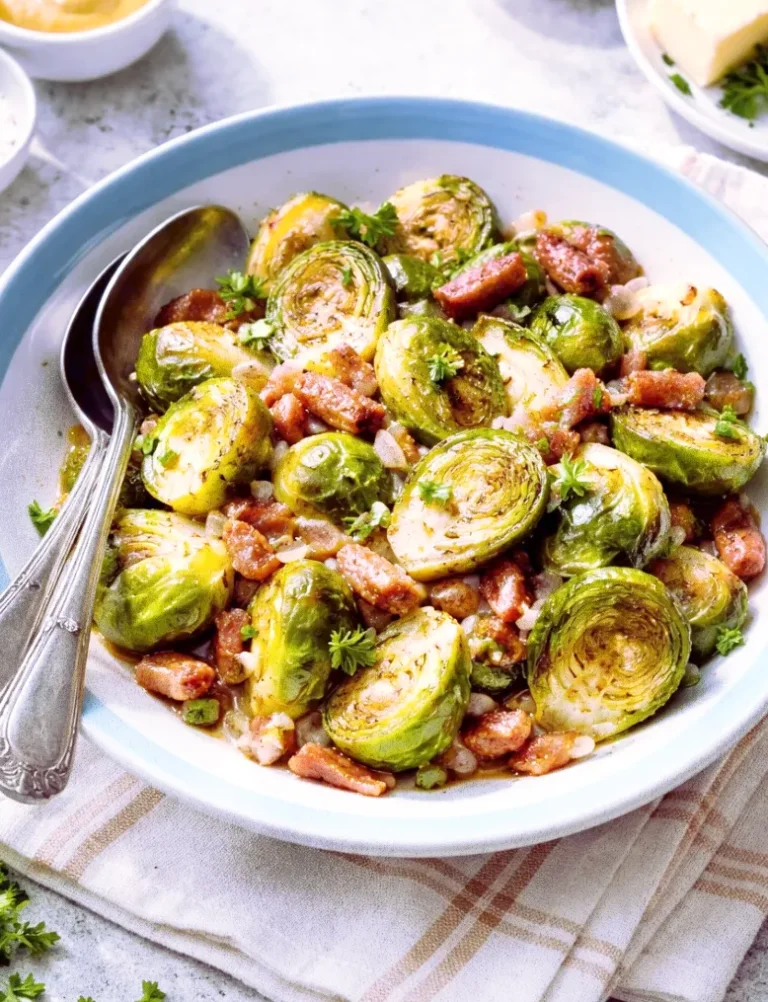
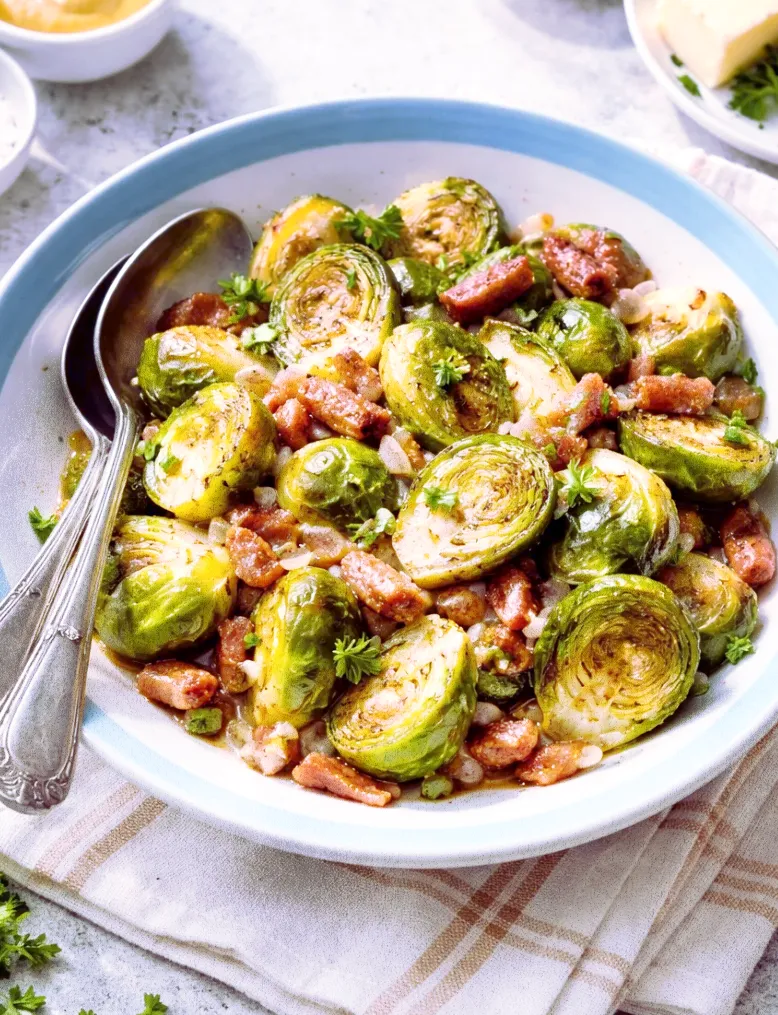
Brussels Sprouts with Lardons
 Prep Time 10 minutes
  Cook Time 20 minutes
  Total Time 30 minutes
  Servings 4
Ingredients
- 600 gr Brussels sprouts trimmed and halved
- 150 gr vegetarian smoked lardons
- 30 gr unsalted butter
- 1 shallot finely sliced
- 1 tsp Dijon mustard
- 1 handful flat-leaf parsley finely chopped
- salt and black pepper
Instructions
1. Blanch the Brussels sprouts
- Bring a large saucepan of generously salted water to a rolling boil. Add the halved Brussels sprouts and blanch for 4–5 minutes, they should be just tender when pierced with a knife but still have some resistance. You're not cooking them through here, just taking the raw edge off and removing any bitterness. Drain immediately into a colander and run cold water over them for a minute to stop the cooking. Spread them out on a clean tea towel and pat them as dry as you can. Moisture in the pan is the enemy of a good caramelised cut side.
2. Crisp the lardons
- Add half the butter and the olive oil to your frying pan over a medium-high heat. Once the butter is foaming, add the vegetarian lardons in a single layer and leave them to cook without stirring for 2–3 minutes until they're starting to colour and crisp on the outside. Give them a toss and cook for another minute. Remove them and set aside on a plate. They won't release any fat, so everything left in the pan is what you cooked them in, don't discard it.
3. Soften the shallot
- Turn the heat down to medium. The pan should still have butter and olive oil in it from the lardons. If it looks dry, add a small knob of butter. Add the sliced shallot and cook gently for 2–3 minutes, stirring, until soft and translucent. It should have no colour, you're just taking the sharp edge off it, not browning it.
4. Sauté the Brussels sprouts
- Turn the heat back up to medium-high and add the remaining butter. Once it's foaming, add the blanched Brussels sprouts cut side down in a single layer. Leave them completely undisturbed for 2–3 minutes so the flat sides have time to develop colour. This is the step most people skip, and it's the step that makes the difference. Once they're golden on the cut side, toss the pan, season well with salt and black pepper, and cook for another minute.
5. Finish and serve
- Return the lardons to the pan. Add the Dijon mustard and toss everything together over the heat for about 30 seconds until the mustard coats everything lightly. Remove from the heat, scatter over the flat-leaf parsley, and serve immediately. This is a dish that doesn't wait well, Brussels sprouts with lardons are best eaten straight from the pan.
Notes
- Don’t skip the blanching step. Cooking Brussels sprouts from raw in a frying pan means they’ll brown on the outside before they’re cooked through. Blanching gives you control.
- Dry the sprouts thoroughly before they go in the pan. Any water left on them will steam rather than fry, and you’ll lose the caramelised cut sides.
- The olive oil alongside the butter stops the butter burning at the higher heat needed for the sprouts. Don’t skip it.
- The Dijon is a finish, not a sauce. One teaspoon coats everything lightly and adds a gentle sharpness that balances the richness of the butter. More than that and it takes over.
About this recipe
Brussels sprouts have a reputation problem that the French never really had. In France, choux de Bruxelles has been a perfectly respectable winter vegetable for centuries. Cooked properly, served simply, eaten without any complaint. The boiled-to-mush version that put generations of people off Brussels sprouts for life doesn’t really exist in the French culinary vocabulary. In France, you cook them until just tender and then you do something with them. This recipe for brussels sprouts with lardons is exactly that: a simple, honest technique that completely changes what the vegetable can be.
Where do Brussels sprouts actually come from?
Despite the name, the origins of Brussels sprouts are genuinely disputed. The most widely cited theory is that they were cultivated in the region around Brussels from at least the 13th century, which is where the name choux de Bruxelles comes from. By the 16th century, they were being grown across the Low Countries and northern France. The first clear written references to Brussels sprouts as a distinct cultivated vegetable appear in Belgian and French sources from the late 16th and early 17th centuries.
What gets less attention is how quickly they became embedded in French regional cooking, particularly in the northern and eastern regions where the climate suits brassicas (cabbages). Normandy, Picardy, Alsace, the Paris basin. By the 18th century, Brussels sprouts were a staple winter vegetable across much of northern France, and recipes combining them with pork fat and butter appear in French cookbooks from that period onwards.
The pairing with lardons is as old as the vegetable’s presence in French cooking. The French have a deep instinct for combining bitter vegetables with cured pork. It’s the same logic behind lardons with green beans, lardons with lentils (lentilles du Puy), lardons with chicory. The salt and savouriness softens the bitterness of the brassica, and the whole thing becomes something considerably more interesting than the vegetable on its own. My husband and I are pescatarian, so we use plant-based lardons and honestly, they’re delicious. You’re adding fat through butter instead, and the technique shifts slightly, but the flavour logic is identical.
Cooking Brussels sprouts the French way
The key difference between French choux de Bruxelles and the soggy boiled versions most people grew up with is what happens after the blanching. In France, Brussel sprouts don’t stop at the saucepan. They go straight into a hot pan with butter.
In France, Brussels sprouts are almost always blanched first, briefly in salted boiling water, and then finished in butter in a hot pan. This is the technique that makes fried brussels sprouts worth eating. It gives you control over the texture and opens up the possibility of getting colour on the cut sides, which is where most of the flavour comes from.
Fried brussels sprouts done this way are a genuinely different thing from boiled ones. The caramelised cut side adds a slight nuttiness. The lardons bring salt and texture. The butter ties everything together. A touch of Dijon at the end adds a sharpness that stops the dish feeling heavy.
This is the version you’ll find in French home kitchens in winter. It’s not a fancy dish and it’s not meant to be. It’s a properly cooked vegetable side that makes the most of what Brussels sprouts actually are: a robust, slightly bitter, deeply savoury Brussel sprouts that responds well to heat and fat.
Why the blanch-then-sauté method matters
The technique behind this brussels sprouts with lardons recipe is one of the most useful in French home cooking, and once you understand it, you’ll use it constantly. Green beans, broccoli, asparagus. The principle is always the same: boiling water removes bitterness and cooks the vegetable through, the hot pan adds flavour and texture. The two steps together give you something that neither alone can deliver.
One thing worth knowing: Brussels sprouts are at their best in late autumn and winter, after the first frost. Cold temperatures convert some of the starches in the sprout to sugars, which gives them a slightly sweeter, nuttier flavour. If you’re buying them and they’re available on the stalk, buy them on the stalk. They stay fresh longer and tend to have better flavour than pre-packed bags.
The Dijon connection
The teaspoon of Dijon mustard at the end of this brussels sprouts with lardons recipe is a small thing that makes a noticeable difference. Dijon mustard has been produced in Burgundy since the 13th century, and it has been used as a finishing element in French cooking for just as long. It’s sharper and more pungent than most mustards, with an immediate heat that fades quickly rather than lingering. In a dish this rich, that sharpness does real work. It lifts everything without announcing itself.
If you’ve only ever had Brussels sprouts boiled, this recipe is worth making just to understand what the vegetable can actually be. They’re a good one. The French knew that all along.
Share your feedback and spread the love!
If you try this recipe, I’d love to hear how it turns out! Leave a ★★★★★ rating and your thoughts in the comments, it helps fellow French foodies discover this recipe too. Snap a photo and tag me @obviously.french on Instagram if you’re sharing your bake or cooking online. Don’t forget to save this recipe to Pinterest so you’ll always have it handy for your next French-inspired meal!
Disclosure: Just so you know, this post contains sponsored content and/or affiliate links, If you make a purchase through these links, I may receive a small commission. Doesn’t cost you anything extra. I only link to things that are actually worth your time. All opinions are my own!