 March 29, 2026
Disclosure: This post may contain affiliate links which provide us a small commission when used for purchase. Please read my disclosure policy for more information. I am grateful for your support!
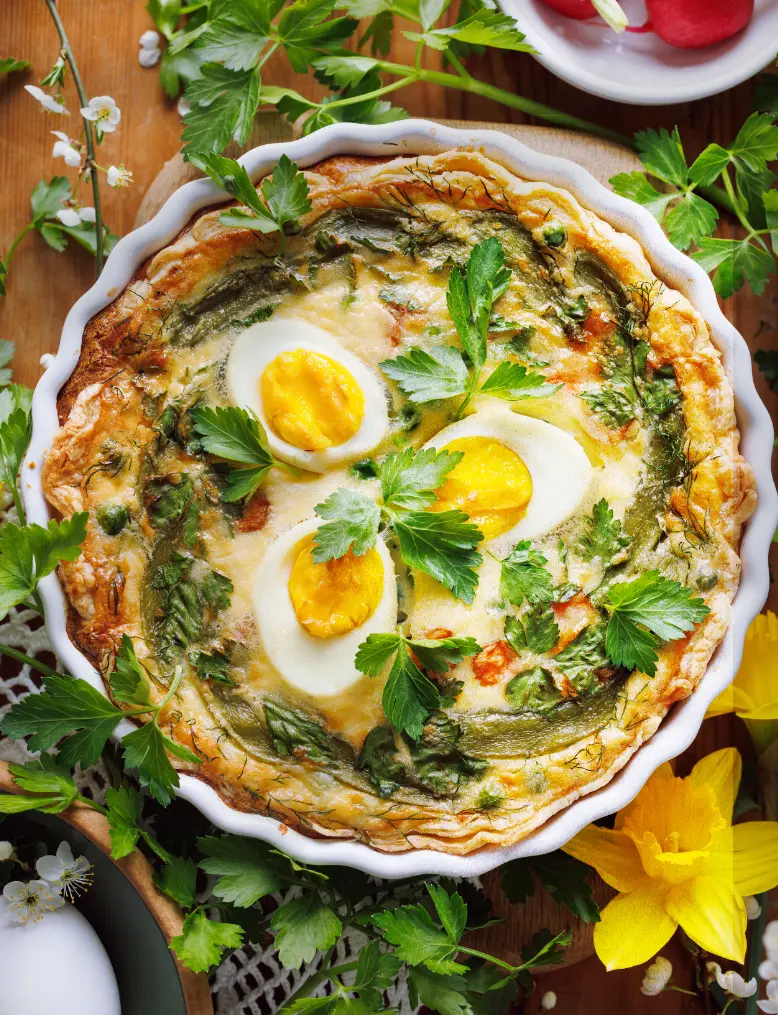
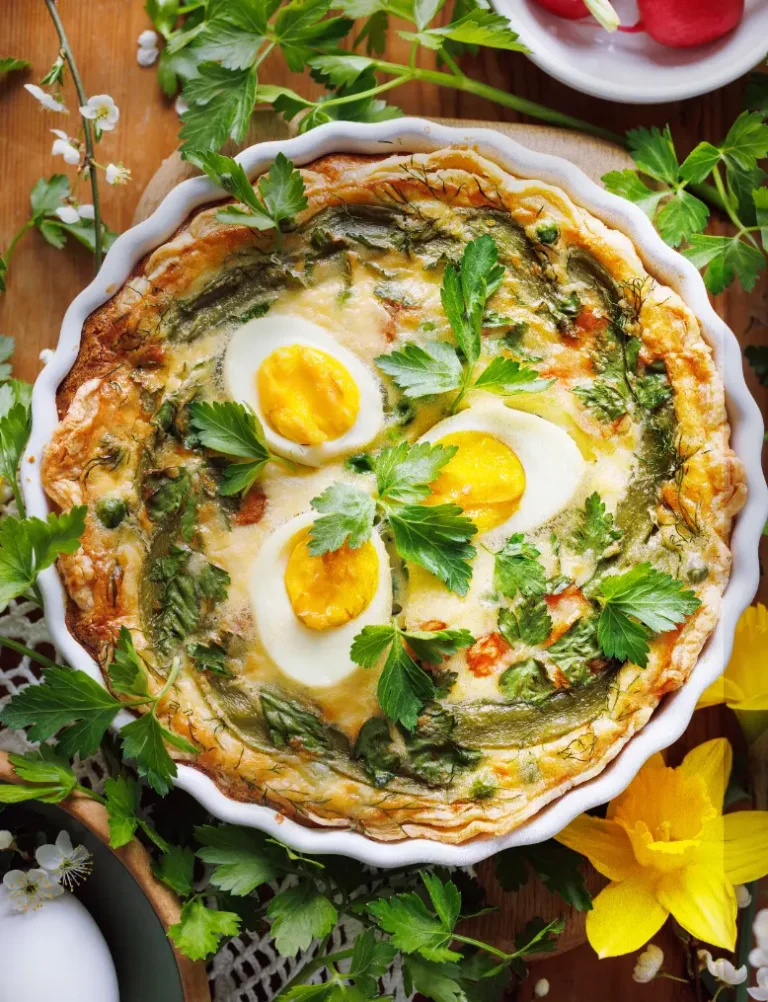
When Easter comes and there are guests round the table, this Easter quiche is a beautiful centrepiece. By now you’ll know I love a quiche, from the classic quiche Lorraine to the little mini quiches with salmon and all the variations in between. They’re easy, for lunches and suppers, and just as happy at a celebration like this one.
Now, lamb is usually the centre of attention in France come Easter. But we’re vegetarian, so we lean on eggs instead, which feels right because in French tradition eggs stand for renewal and the arrival of spring, so a quiche crowned with halved eggs and spring asparagus is about as on-theme as it gets!
Table of Contents
Where easter quiche comes from
An Easter quiche is really a spring dressing-up of the classic French quiche, which comes from Lorraine in the northeast of France. The full story is one I tell over on my quiche Lorraine recipe, so I won’t repeat it all here.
What makes this one an Easter quiche is the seasoning of the calendar rather than any strict tradition. Green asparagus comes into season in France right around Easter, eggs are everywhere and symbolic of spring, and the whole quiche lands as a light, celebratory main for a table. It’s the same reliable custard-in-pastry method but this time celebrating spring.
Ingredients
- Pâte brisée (shortcrust pastry) – The crisp, savoury shortcrust base.
- Green asparagus – In season at Easter, brighter and grassier than white. Blanched briefly so it keeps its bite and colour.
- Smoked (vegetarian) lardons – For the smoky extra depth.
- Eggs – The custard, and the symbolic Easter topping. Some go in the filling, a few hard-boiled and halved on top.
- Crème fraîche and milk – The body of the custard. Crème fraîche for richness, a little milk to loosen it to a silky set.
- Gruyère – For a savoury, nutty note through the custard. Comté works just as well.
- Fresh herbs – Parsley and dill scattered over at the end, for freshness and a spring look.
How to make easter quiche
1. Blind bake the pastry
Line your dish with the chilled shortcrust pastry, then blind bake it with baking beans until dry and lightly golden. This is optional: a custard filling is wet, and an unbaked base under it goes soggy sometimes. A blind-baked shell is what gives you that crisp, sturdy bottom.
2. Prep the asparagus and lardons
Snap the woody ends off the asparagus and blanch the spears briefly, just 2 to 3 minutes, so they keep their bite and bright colour, then drain and pat dry. They’ll finish cooking in the oven, so undercook them here, or they’ll go mushy in the quiche. Crisp the smoked lardons in a dry pan and set aside.
3. Make the custard
Whisk the eggs with the crème fraîche and milk, season with pepper (go easy on salt, the lardons and cheese bring plenty), and stir in most of the grated Gruyère. That’s the filling. Keep it smooth, not frothy.
4.Assemble and bake
Scatter the lardons over the base, lay the asparagus out, pour the custard over, and scatter the last of the cheese. Nestle the halved hard-boiled eggs on top, cut-side up, so they sit proud for that Easter look. Bake until the custard is just set with the faintest wobble in the centre and the top’s golden. Let it settle for ten minutes before slicing, then scatter with fresh herbs.
Tools for this recipe
Check out my favorite kitchen essentials and cookware!
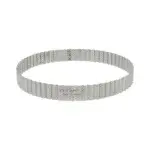
- Use a 24cm perforated tart ring or fluted tart ring to get clean edges and a crisp, evenly baked base.
- I use my heavy wooden rolling pin to roll the pastry to an even 3mm.
- Use baking beans to blind bake the case so it doesn’t slump or bubble.
Tips for success
- Blind bake the base: a quiche filling is wet, and an unbaked base can go soggy at the bottom. Blind baking until dry and golden guarantees a crisp bottom.
- Blanch the asparagus, don’t cook it through: two to three minutes so it keeps its bite and colour, then straight into cold water. It finishes cooking in the oven; go in soft and it turns to mush.
- Use smoked lardons, not plain: the smoke is what gives the filling its depth and balances the rich custard.
- Don’t overbake the custard: pull it while the centre still has the faintest wobble. It sets as it cools, and a fully-set-in-the-oven quiche turns rubbery and can split.
- Serve it warm, not hot: a quiche is best warm or at room temperature, when the flavours settle and it slices cleanly. That also makes it perfect for a relaxed Easter table where timings are loose.
How to store it
- An Easter quiche keeps beautifully, which is half of why it’s such a good dish for a busy day. It’s genuinely as good at room temperature as warm, so you can make it ahead and not fuss over timings while the children are hunting eggs!
- Keep it covered in the fridge for up to 3 days. Bring it back to room temperature, or warm it gently in a low oven for 10 minutes to re-crisp the pastry, rather than the microwave, which softens the base. It also makes excellent next-day lunches, cold or warm.
- It freezes well too, whole or in slices. Cool completely, wrap well, and freeze for up to a month. Thaw in the fridge and reheat in a low oven, so the pastry crisps back up rather than going soggy.

More recipes to try
Variations
- Add more spring veg: peas, broad beans, baby leeks or spinach all suit the season and the asparagus. Don’t overload it, though, or the custard can’t set.
- Swap the cheese: Comté instead of Gruyère, or a little soft goat’s cheese dotted over the top for a sharper, spring-appropriate tang.
- Individual quiches: make small ones in 8cm tart rings for a brunch spread, the same filling, a shorter bake.
- Different herbs: chives, tarragon or chervil in place of (or alongside) the dill, all very French and very spring.
FAQ
What makes a quiche an Easter quiche?
It’s a spring version of the classic French quiche, built around ingredients in season at Easter, green asparagus, fresh herbs, and eggs (which symbolise renewal and spring in French tradition), often topped with halved hard-boiled eggs. It’s an elegant vegetarian-friendly centrepiece when lamb isn’t wanted.
Can I make an Easter quiche ahead of time?
Yes, it’s ideal for it. Quiche is as good at room temperature as warm, so make it a few hours ahead and serve when everyone’s ready. It also keeps 3 days in the fridge and freezes for a month, reheat in a low oven to keep the pastry crisp.
How do I stop the asparagus going soggy in the quiche?
Blanch it only briefly, 2 to 3 minutes, then cool it in cold water and pat it dry. It finishes cooking in the oven, so if it goes in already soft it turns mushy. You want it just tender with a little bite.



 Prep Time 30 minutes
  Cook Time 55 minutes
  Total Time 1 hour 55 minutes
  Servings 6
Description
Ingredients
For the pâte brisée
- 250 gr plain flour
- 125 gr unsalted butter cold, cut into small cubes
- 1 pinch salt
- 50 ml water add gradually
- 1 egg yolk =20 g
For the filling
- 200 gr vegetarian lardons smoked
- 300 gr green asparagus
- 4 eggs
- 200 ml crème fraîche
- 100 ml whole milk
- 80 gr Gruyère cheese
- salt and black pepper
For the top
- 3 eggs hard-boiled and halved lengthways
- 1 handful flat-leaf parsley
- 3 sprigs dill
Equipment

Instructions
1. Make the pâte brisée / shortcrust pastry
- Follow the shortcrust pastry method: rub the cold butter into the flour and salt until sandy, add the egg yolk and cold water, and bring together into a disc without overworking. Wrap and chill for at least 30 minutes.
2. Blind bake
- Heat the oven to 190°C (170°C fan). Roll the pastry to about 3mm and line the fluted dish, pressing into the edges. Trim, prick the base, line with parchment and baking beans. Blind bake 15 minutes, remove beans and parchment, and bake a further 5 minutes until dry and lightly golden. Reduce oven to 180°C (160°C fan).
3. Prepare the asparagus and lardons
- Snap the woody ends off the asparagus and peel the lower third. Blanch in salted boiling water for 2 to 3 minutes, then drain and plunge into cold water. Drain and pat dry. Crisp the lardons in a dry pan for 5 minutes.
5. Make the custard
- Whisk the eggs, crème fraîche and milk until smooth. Season with pepper and a little salt. Stir in most of the Gruyère, keeping some back.
6. Assemble
- Scatter the lardons over the base. Arrange the asparagus like spokes. Pour the custard over, right to the top. Scatter the remaining Gruyère. Nestle the halved eggs on top, cut-side up.
7. Bake
- Bake for 35 to 40 minutes, until just set with the faintest wobble in the centre and golden on top. Cover the edges loosely with foil if browning too fast.
8. Garnish and serve
- Cool 10 minutes to settle. Scatter with parsley and dill just before serving. Serve warm or at room temperature.
Notes
- Blind baking will help keeps the base crisp under the wet filling.
- Blanch the asparagus briefly, still with bite, since it finishes cooking in the oven.
- Use smoked lardons (or smoked vegetarian bacon); the smokiness balances the rich custard.
- Don’t overbake: pull it with a faint wobble in the centre; it sets as it cools.
- Gruyère is the classic; Comté works just as well.
Share your feedback and spread the love!
If you try this recipe, I’d love to hear how it turns out! Leave a ★★★★★ rating and your thoughts in the comments, it helps fellow French foodies discover this recipe too. Snap a photo and tag @obviously.french on Instagram. Come talk about it in our Facebook group. And don’t forget to save this recipe to Pinterest so you’ll always have it handy for your next French-inspired meal!