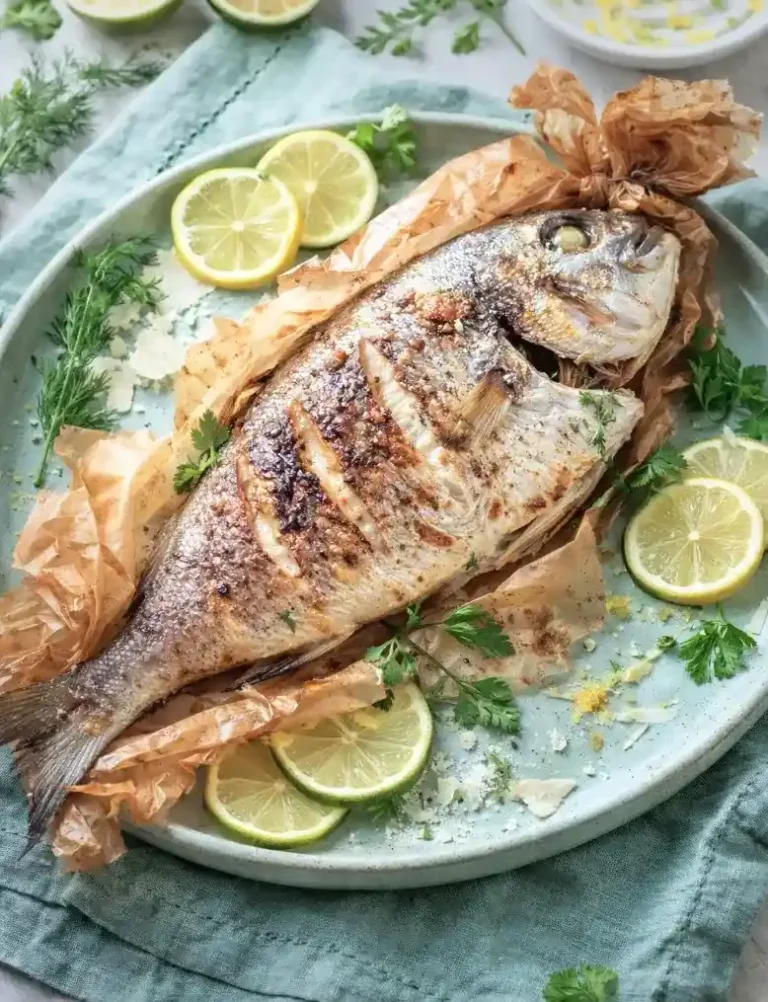
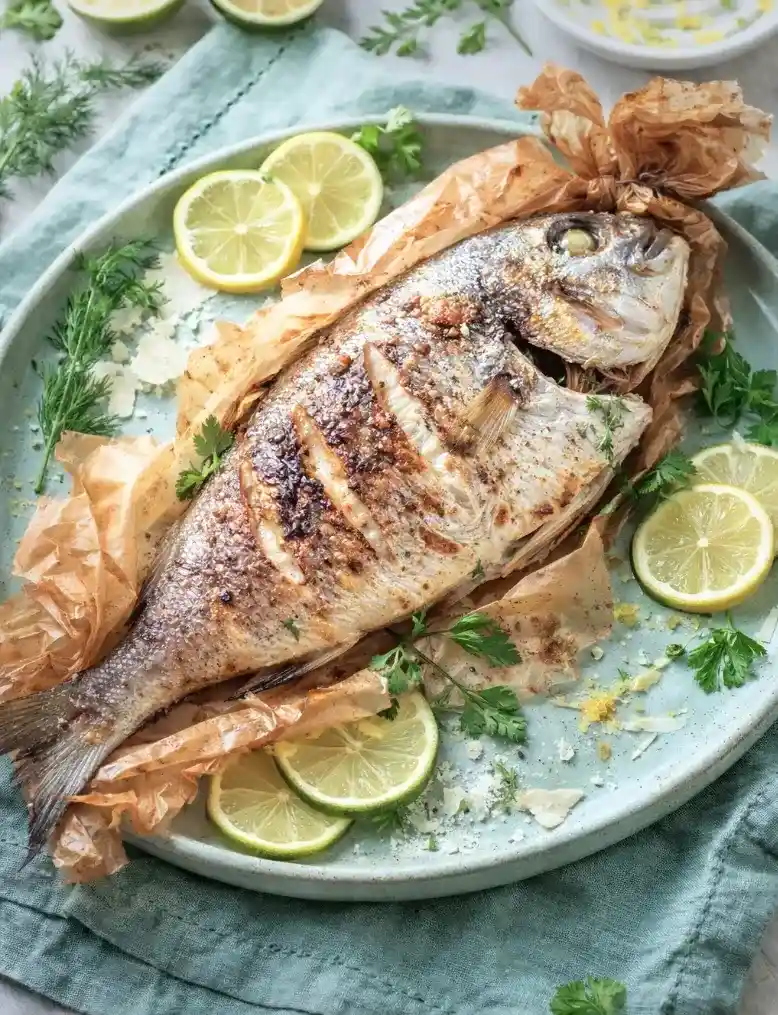
Roasted Sea Bream
 Prep Time 10 minutes
  Cook Time 35 minutes
  Total Time 45 minutes
  Servings 2
Ingredients
Instructions
1. Prep the fish
- Heat your oven to 200°C (180°C fan). Rinse the fish under cold water and pat it completely dry with kitchen paper, properly dry, inside and out. This matters for getting the skin crispy.
2. Season inside and out
- Make three diagonal slashes on each side of the fish, cutting through the skin and about 1cm into the flesh. This helps it cook evenly and lets the flavours in. Season the cavity generously with salt and pepper.
3. Stuff the fish
- Slice half the lemon into thin rounds. Stuff the cavity with the lemon slices, a few sprigs of thyme and parsley, and the sliced garlic. Don't overstuff it, you want the fish to close naturally.
4. Season the outside
- Rub the outside of the fish all over with olive oil. Season generously with salt and pepper, more than you think. Scatter a few more herb sprigs on top and tuck some into the slashes if you like.
5. Roast
- Line a baking tray with parchment paper if you're using it. Place the fish on the tray and roast for 25-30 minutes. A 600g fish needs about 25 minutes; an 800g one needs closer to 30. The skin should be golden and crispy, and the flesh should be opaque and flake easily when you test it with a knife.
- 6. Rest and serveLet the fish rest for 5 minutes. Transfer it to a serving platter (use a large fish slice or double spatulas to support the middle, it'll break if you're not careful). Drizzle with a bit more olive oil, squeeze over the remaining lemon half, scatter with fresh parsley, and serve with lemon wedges on the side.
7. How to serve it
- You can fillet it at the table if you're feeling confident: run a knife down the backbone, lift the top fillet off, pull out the backbone, and you're left with two neat fillets. Or just dig in with forks and let everyone help themselves, much less hassle, and it's how they do it in France anyway.
Notes
- Daurade or sea bream is the classic choice, but sea bass works brilliantly too. Ask for “royal sea bream” or “gilthead bream” if your fishmonger looks blank.
- The fish should smell of the sea, not fishy. Eyes should be clear and bright, gills should be red, and the flesh should be firm when you press it.
- A 600-800g fish feeds two people generously. If you’re feeding four, get two fish rather than one massive one, they’ll cook more evenly.
- The drier the skin, the crispier it’ll be. Pat it thoroughly with kitchen paper, even give it 20 minutes uncovered in the fridge if you’ve got time.
- How to tell when it’s done? The flesh should be opaque all the way through (check near the backbone where it’s thickest), and it should flake easily. The eyes will turn white and pop out slightly.
- You can serve this fish with boiled new potatoes with parsley and butter, a green salad, some good bread to mop up the juices. Maybe roasted cherry tomatoes or sautéed courgettes. You want sides that don’t compete.
- Flake any leftovers and toss them through pasta with olive oil, chilli, garlic, and lemon. Or make fish cakes. Cold roast fish is excellent in a salad too.
About this recipe
There is a particular kind of meal that appears on tables all along the French Mediterranean coast that looks like it took real effort and takes almost none. Roasted sea bream is that meal. A whole fish, a hot oven, lemon, herbs, good olive oil. Thirty minutes later you put something on the table that looks like you have been cooking all afternoon. The French have been doing this for so long it barely registers as cooking to them. To everyone else, it looks like a complete production. That gap is where this recipe lives.
Why whole sea bream
Sea bream, “daurade royale” to give it its proper French name, is one of the most prized fish along the French coastline. Wild dorade is still caught off the French Mediterranean coast and commands serious prices at market. Farmed sea bream is widely available and works beautifully in this recipe. The flesh is firm, sweet, and stays remarkably moist when cooked correctly, which is partly why it became the fish of choice from Marseille to Menton.
The method behind roast sea bream recipe
The principle of this cooking method is ancient. Whole fish roasted with aromatics has been standard Mediterranean cooking for centuries. The Romans were doing it, and they were probably not the first. The logic is sound: bones and skin protect the delicate flesh from drying out, while the cavity filled with lemon and herbs perfumes the meat from the inside as it cooks. You are essentially steaming the fish in its own moisture, scented with citrus and fresh herbs, while the outside gets the direct heat it needs to turn the skin crispy.
The slashes cut into the skin before roasting serve two purposes. They help the fish cook evenly all the way through, and they let the salt, oil, and herbs penetrate the flesh rather than sitting on the surface. Do not skip them.
Cooking fish on the bone is considerably more forgiving than cooking fillets. The skeleton conducts heat evenly and the skin creates a barrier that stops the flesh drying out even if your timing is slightly off. A fillet of sea bream roasted requires constant attention. A whole roast whole sea bream forgives you a five-minute distraction with barely any consequences. That is why the French cook it this way.
Getting the roasted sea bream right
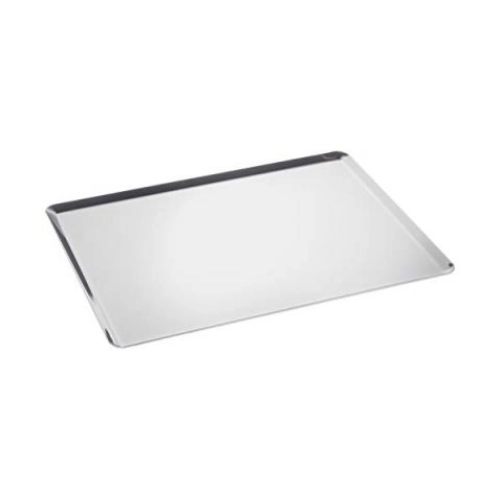
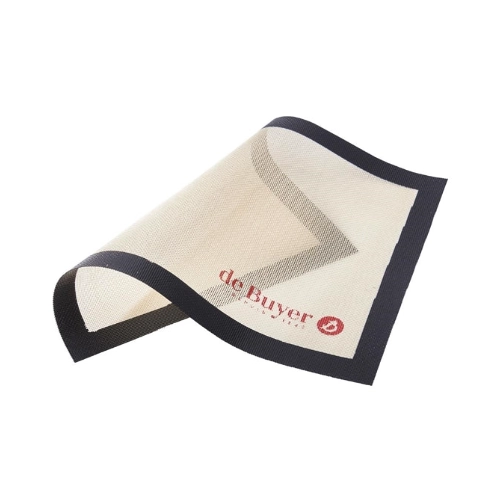
For a proper oven baked sea bream, the baking surface matters more than most people realise. You need even heat distribution across the whole tray, and you need the fish to sit on a surface it will release from cleanly once cooked. A thin baking tray conducts heat unevenly, which means parts of the fish cook faster than others and the skin sticks at the edges where the heat is most concentrated.
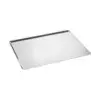
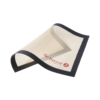
I use the De Buyer stainless steel baking tray for this. It distributes heat evenly across the entire surface, which means the sea bream roasted on it cooks consistently from head to tail rather than catching at the edges. Underneath the fish I lay a De Buyer baking mat, which gives the skin something non-stick to rest on through the oven heat without preventing the direct contact that makes it crispy. The fish lifts off cleanly every time, skin intact, without half of it staying behind on the tray. De Buyer has been making professional French kitchen equipment since 1830, and for a recipe where the presentation matters as much as the cooking, the right kit makes a real difference.
Serving whole fish the French way
The French are not remotely squeamish about whole fish. In a French household this would be put on the table and everyone would help themselves. No filleting in advance unless you are in a restaurant with white tablecloths. The cheeks are the best part of the fish, incidentally. If you know, you know.
If the head genuinely bothers you, ask your fishmonger to remove it, though you will lose a little flavour. And yes, the eyes go milky when cooked. Just look at the crispy skin instead.
Serve the sea bream roasted on a warm platter with lemon wedges and a handful of fresh herbs scattered around it. Open something cold and white. Tell nobody how straightforward it was.
Share your feedback and spread the love!
If you try this recipe, I’d love to hear how it turns out! Leave a ★★★★★ rating and your thoughts in the comments, it helps fellow French foodies discover this recipe too. Snap a photo and tag me @obviously.french on Instagram if you’re sharing your bake or cooking online. Don’t forget to save this recipe to Pinterest so you’ll always have it handy for your next French-inspired meal!
Disclosure: Just so you know, this post contains sponsored content and/or affiliate links, If you make a purchase through these links, I may receive a small commission. Doesn’t cost you anything extra. I only link to things that are actually worth your time. All opinions are my own!