 September 10, 2025
Disclosure: This post may contain affiliate links which provide us a small commission when used for purchase. Please read my disclosure policy for more information. I am grateful for your support!
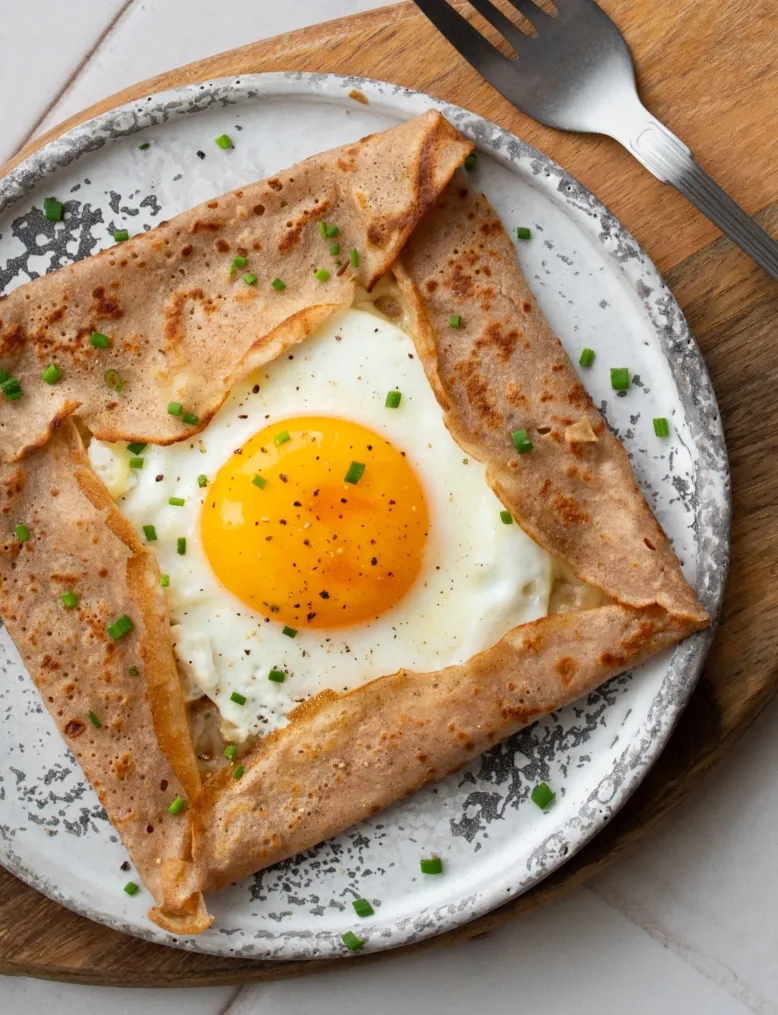
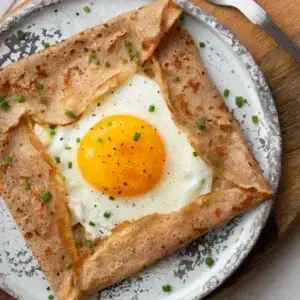
I didn’t grow up in the north, but we ate these savoury pancakes at home more often than in crêperies. Saturday lunches with the kitchen smelling of buckwheat and butter, and always the same filling: ham, Emmental, egg. My mother made them without any fuss and without a recipe, the way you do when something is simply part of your normal week. These days I use vegetarian ham, but I still cook the egg the same way, cracked straight onto the galette as it finishes in the pan, the white just set and the yolk still soft (just like how boil my eggs jammy)!
Table of Contents
Where savoury pancakes come from
Buckwheat came from Asia and arrived to France in the 12th century. It didn’t take over though: it was only really cultivated across Brittany from the 15th and 16th centuries, and it took hold because it’s a tough, undemanding plant. Brittany’s thin, acidic soil was hopeless for wheat and ideal for buckwheat, which needs no fertiliser and crops in barely three months.
So for centuries buckwheat pancakes were what Breton farmers actually lived on, eaten plain like bread, torn by hand or dunked into soup to thicken it. And they were made by women: by 1850 there were 130 galettières recorded in Rennes, and by 1900 nearly 400, roughly one maker for every 150 inhabitants, in a trade that was almost entirely female!
The fillings we know came much later. The first commercial crêperies opened in Quimper and Rennes in the 1920s, and this recipe, the galette complète with ham, grated Emmental and an egg cooked directly on the galette, became the classic.
Galette or crêpe, what’s the difference?
They come from the same region but they’re really not the same thing. A crêpe is made with wheat flour, milk, and eggs, delicate and lacy, and usually served sweet, or flambéed Grand Marnier for crêpes Suzette. You find them everywhere in France.
A galette is its more serious sibling. Buckwheat flour, water and salt, sometimes with an egg, giving a darker, earthier pancake with crisp edges that belongs firmly on the savoury side. Buckwheat has a toasted-hazelnut flavour wheat never reaches, and it’s naturally gluten-free.
Ingredients
- Buckwheat flour — the whole character of the dish: nutty, earthy and naturally gluten-free.
- Water — not milk. Water gives the thin, crisp, lacy galette; milk softens it towards a crêpe.
- Egg (in the batter) — the Basse-Bretagne style, giving a slightly more supple galette that’s easier to fold without cracking.
- Butter — a little in the batter for flavour, and more in the pan, which is what crisps the edges.
- Vegetarian ham — the classic filling in its modern form. Any good plant-based slice works.
- Gruyère or Emmental — grated, so it melts evenly under the lid rather than sitting in lumps.
- Eggs (for the filling) — cracked straight onto the galette, the defining feature of a complète.
- Chives and black pepper — the finish. Sharp and fresh against all that melted cheese.
- Baby spinach (optional) — wilts in seconds under the lid and adds something green.
How to make savoury pancakes
1. Make the batter and let it rest
Put the buckwheat flour and salt in a large bowl, crack in the egg, and whisk with about half the water until completely smooth. Then add the rest of the water gradually, followed by the melted butter. Lumps at this stage never fully disappear, so get it smooth before you loosen it. Cover and rest for at least an hour.
2. Get the pan properly hot
Heat your crêpe pan over medium-high and grease it lightly with butter. It needs to be hot enough that the batter sizzles the instant it lands, which is what gives you crisp lacy edges rather than a pale, floppy pancake. And accept that the first one is always a write-off.
3. Ladle and swirl
Whisk the batter again, since buckwheat settles fast, then ladle it in and swirl immediately to coat the pan thinly. Hesitate and it sets before it spreads. Thin is what you want here, this isn’t a fluffy pancake.
4. Fill it once the top is set
When the surface looks dry and the edges start lifting, lay on the ham and spinach if you’re using it. Crack the egg into the middle, season with pepper, and scatter the grated cheese around it, leaving the yolk visible.
5. Put a lid on, and let it do the work
Cover the pan for a minute or two. The trapped steam sets the egg white and melts the cheese without overcooking the base, which is the whole trick. If your pan has no lid, fry the eggs separately and slide them on at the end.
6. Fold into a square and serve hot
Fold the four edges in over the filling so you get a neat square with the yolk showing. Another minute if you like the yolk set, or straight onto the plate for a runny one. Chives on top, and eat it immediately.

Tools for this recipe
Check out my favorite kitchen essentials and cookware!
- Use a flat cast iron crêpe pan rather than a deep frying pan, since even heat with no hot spots is what gives you crisp edges and a properly thin galette. The traditional Breton tool is a bilig, a flat cast iron griddle dating back to at least the 15th century.
- Use a ladle to get a consistent amount of batter into the pan each time, since eyeballing it gives you thick ones and thin ones.
- Use a spatula thin enough to lift and fold the edges without tearing the buckwheat pancakes.
Tips for success
- Whisk the batter every few galettes: buckwheat settles to the bottom of the bowl faster than wheat flour, so the last buckwheat pancake come out watery unless you stir it back together each time.
- If the batter tears when you swirl, it’s too thick: loosen with a splash of water. If it pools and won’t spread thin, the pan isn’t hot enough.
- Grate the cheese finely: coarse cheese doesn’t melt in the minute you have under the lid, and you end up with cold lumps around a set egg.
- Keep finished galettes warm on a plate over a pan of simmering water: stacking them in a low oven works too, but they soften. Serve as you go if you can.
- Don’t overfill: a galette folded around too much filling won’t hold its square, and the edges won’t crisp against the pan.
- Buckwheat flour goes rancid faster than wheat flour: buy it in smaller quantities and keep it somewhere cool and dark, since stale buckwheat tastes bitter.
How to store it
- In the fridge: Cooked plain galettes keep 2 to 3 days, stacked with greaseproof paper between them and wrapped well. Reheat briefly in a dry pan. Filled galettes don’t keep, since the egg and the crisp edges both suffer.
- The batter: Keeps 2 days covered in a container the fridge and genuinely improves overnight. Whisk it well before using, as it separates.
- In the freezer: Plain galettes freeze beautifully for up to 2 months, layered with paper. Reheat straight from frozen in a hot dry pan for about a minute a side, which is the best reason to make a big batch of batter.

More egg recipes to try
Variations
- Smoked salmon and crème fraîche: with a squeeze of lemon and plenty of dill. Cold filling on a hot galette, and another classic.
- Goat’s cheese, walnuts and honey: the cheese melts, the walnuts stay crunchy, and a thread of honey makes it sweet and savoury at once.
- Mushrooms with thyme and garlic: cooked down first and piled on with a little crème fraîche, which is proper autumn food.
- Ratatouille galette: a spoonful of leftover ratatouille with an egg on top, which is a genuinely good use for what’s in the fridge.
- The traditional Haute-Bretagne version: no egg in the batter at all, just buckwheat, water and salt. Thinner, crisper and more austere, and closer to what Breton farmers actually ate.
- Sweet, with salted butter caramel: buckwheat and caramel is a very Breton combination, though a wheat crêpe is the more usual base.
FAQ
What’s the difference between a galette and a crêpe?
A galette is made with buckwheat flour and water, darker, earthier and crisp-edged, and served savoury. A crêpe is wheat flour and milk, softer and usually sweet.
Are buckwheat pancakes gluten-free?
Buckwheat itself is naturally gluten-free, despite the name. Check your flour hasn’t been milled alongside wheat if you’re cooking for someone coeliac, and note this recipe uses egg in the batter.
Why does my batter need to rest?
Buckwheat absorbs water more slowly than wheat flour. Resting lets it hydrate fully, so the batter spreads thinly and cooks with those lacy crisp edges. An hour minimum, overnight is better.
What is a galette complète?
The classic filling: ham, grated Emmental and an egg cooked directly on the galette, then folded into a square with the yolk showing.
What are the best savory pancake fillings?
Beyond the classic ham, cheese and egg: smoked salmon with crème fraîche, goat’s cheese with walnuts, mushrooms with thyme, or spinach with a fried egg.


 Prep Time 15 minutes
  Cook Time 25 minutes
  Total Time 1 hour 40 minutes
  Servings 4
Description
Ingredients
For the galette batter
- 250 gr buckwheat flour
- 1 egg
- 500 ml water cold
- 20 g unsalted butter plus extra for the pan
- 1 pinch salt
For the filling
- 4 slices plant based ham
- 120 gr Gruyère cheese or Emmental
- 4 egg
- black pepper freshly ground
- 1 handful chives
- 120 gr baby spinach optional






Instructions
1. Prepare the batter
- Put the buckwheat flour and salt into a large bowl. Crack in the egg, then whisk with roughly half the water until smooth. Add the remaining water gradually, then the melted butter, and whisk well. Cover and rest for at least 1 hour, or overnight in the fridge.
2. Cook the galettes
- Heat the pan over medium-high and grease lightly with butter. Give the batter a quick whisk, then ladle a generous amount into the pan and swirl immediately until evenly coated.
3. Fill your galette
- Once the top looks set and the edges begin to lift, lay on 2 slices of vegetarian ham and a little spinach if using. Crack an egg into the middle, season with black pepper, and scatter over the grated cheese, leaving the yolk showing. Cover with a lid: the trapped steam sets the white and melts the cheese. If you have no lid, fry the eggs separately and slide them on top.
4. Fold your galette
- Fold the edges in to make a neat square with the yolk visible. Leave another minute if you like the yolk set, or plate up straight away for a runny centre.
5. Serve
- Repeat with the remaining batter and filling. Serve immediately, piping hot, with chives scattered over.
Notes
- Resting the batter makes a real difference. It gives the flour time to hydrate, which is what gives you those lacy edges.
- Whisk the batter again between galettes, as buckwheat settles quickly.
- The first galette is always a bit suspect. A well-heated pan and a confident swirl will get you there.
- This batter makes more galettes than the filling covers, so you’ll have spares. They freeze well.
Share your feedback and spread the love!
If you try this recipe, I’d love to hear how it turns out! Leave a ★★★★★ rating and your thoughts in the comments, it helps fellow French foodies discover this recipe too. Snap a photo and tag @obviously.french on Instagram. Come talk about it in our Facebook group. And don’t forget to save this recipe to Pinterest so you’ll always have it handy for your next French-inspired meal!