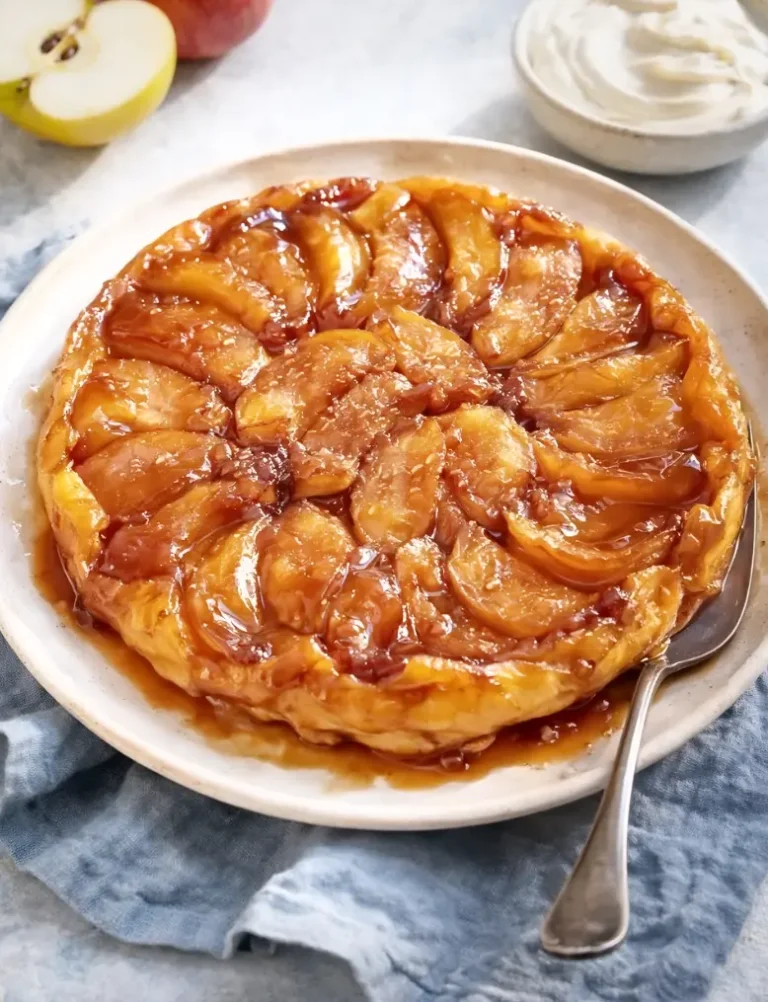
Tarte Tatin
 Prep Time 30 minutes
  Cook Time 55 minutes
  Total Time 1 hour 55 minutes
  Servings 6
Ingredients
For the pâte brisée
- 200 gr plain flour
- 100 gr unsalted butter
- 25 gr caster sugar
- 1 pinch salt
- 1 egg
- 1-2 tsp cold water if needed
For the filling
- 1.4 kg Reine des Reinettes apples firm, slightly tart varieties only
- 130 gr unsalted butter
- 150 gr caster sugar
- 1 sheet all-butter puff pastry kept cold until needed
To serve
- crème fraîche to serve
Equipment
Instructions
1. Make the pâte brisée
- Put the flour, sugar, and salt in a large bowl and mix briefly. Add the cold butter cubes and rub them into the flour with your fingertips, working quickly so the butter stays cold, until the mixture resembles coarse breadcrumbs with a few pea-sized lumps still visible, those lumps are what give the pastry its texture. Make a well in the centre, add the egg, and mix with a fork until it just starts to come together. If it's too dry to form a dough, add cold water a teaspoon at a time. Work it as little as possible. Overworked pastry turns tough.Shape into a flat disc, wrap in cling film, and refrigerate for at least 30 minutes. Cold pastry is easier to roll and holds its shape better in the oven.
2. Prepare the apples
- Peel, quarter, and core the apples. You want firm, slightly acidic varieties, the acidity balances the caramel and holds up through the long cooking. Cut quarters in half again if the apples are large. Set aside.
3. Start the caramel and apples together
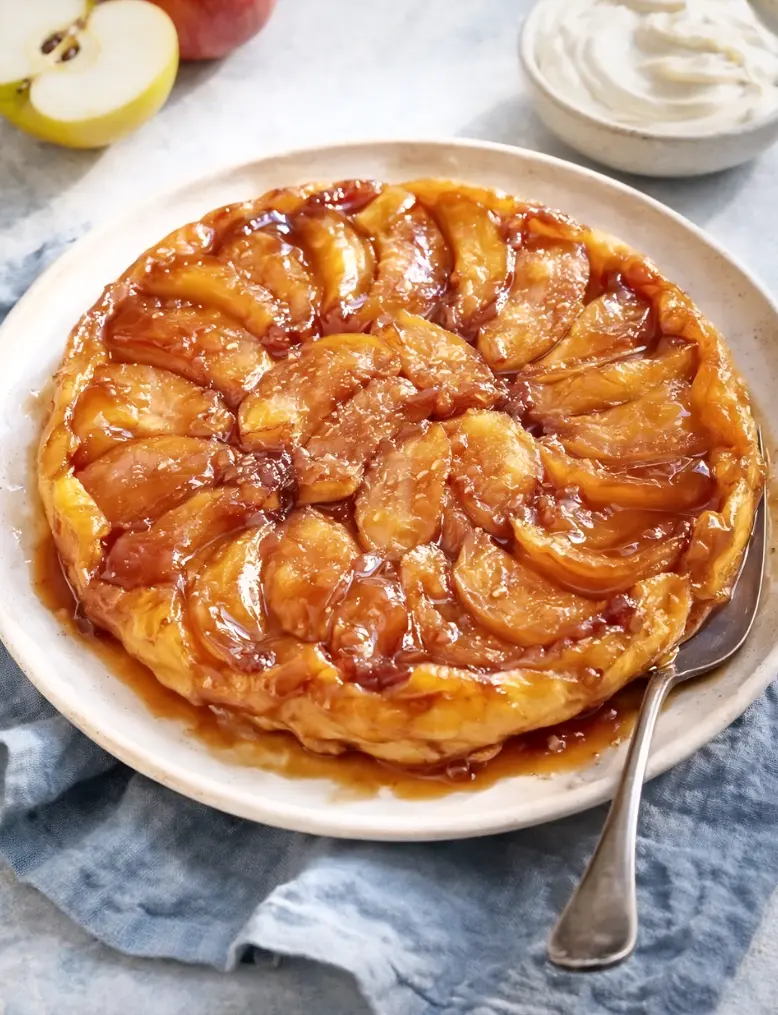
- Place your ovenproof pan over a medium-low heat. Add the butter and let it melt gently. Add the sugar in an even layer over the butter, don't stir, just let it begin to dissolve. After a few minutes, when the mixture starts to turn golden at the edges, arrange the apple pieces tightly in the pan, curved side down, packed as snugly as possible. They will look like far too many. They're not.
4. Cook low and slow on the hob
- This is the step most recipes rush, and it's the most important one. Cook the apples over a medium-low heat for 35–40 minutes, without stirring. Tilt the pan occasionally to check the caramel underneath, you want it bubbling, gradually deepening from golden to a rich, dark amber. The apples will shrink considerably, soften, and begin to take on colour. By the end they should be deeply golden, very tender, and sitting in a thick, dark caramel. If the caramel looks pale and thin after 20 minutes, nudge the heat up slightly. Be patient, this stage cannot be hurried.Preheat your oven to 200°C / 180°C fan while the apples are cooking.
5. Roll the pastry
- On a lightly floured surface, roll the chilled pastry "pâte brisée" into a circle slightly larger than your pan, about 2–3cm of overhang all round. Work quickly so the pastry stays cold. If it cracks at the edges, press it back together with your fingers.
6. Top the apples
- Take the pan off the heat. Lay the pastry circle carefully over the hot apples and tuck the edges down inside the pan, between the apples and the pan sides. This folded-under pastry becomes part of the base once the tart is flipped and gives you more to eat. Prick the pastry a few times with a fork to let steam escape.
7. Bake
- Transfer to the oven and bake for 25–30 minutes until the pastry is a deep, even golden brown and cooked through. Press it gently in the centre, it should feel firm and dry, not soft or doughy. The caramel will be bubbling up around the edges. A pale pastry means it needs more time.
8. The flip
- Leave the tarte tatin to rest in the pan for exactly 10 minutes after coming out of the oven, no longer, or the caramel sets and the apples stick. Place a large, deep plate or board firmly over the pan. Hold both together with both hands, using a kitchen cloth or oven gloves. Flip in one confident, decisive movement. Set down and lift the pan off slowly. If any apples have shifted, press them back into place with a spoon. The caramel will be extremely hot, keep hands away from any that runs off the edge.Serve warm, not piping hot, with crème fraîche alongside.
Notes
- Apple variety is everything. The Reine des Reinettes is the traditional Solognot apple, firm, slightly sharp, and it holds its shape beautifully through long cooking. Boskoop is also excellent. Avoid Gala and Braeburn, too juicy, they make the caramel watery. Avoid Bramley, turns to mush. Avoid Granny Smith, too firm and too sour.
- The recipe is genuinely four ingredients. No vanilla, no cinnamon, no lemon. The Confrérie des Lichonneux, the brotherhood that has defended the authentic recipe since 1979, is quite clear on this. The apple and caramel flavour should stand entirely on their own.
- On pastry: the traditional Solognot recipe uses pâte brisée (shortcrust), and the Confrérie considers puff pastry an inauthentic substitution. Practically speaking, puff pastry is what most French home cooks use today and it gives you a lighter, more dramatic result. Both are good. If you want to be truly traditional, use shortcrust.
- The caramel must be genuinely dark. A timid, pale caramel tastes of sugar. A deep amber caramel tastes of something worth eating. Take it further than feels comfortable, right to the edge of dark without burning.
- The flip works best at exactly 10 minutes of resting time. Too early and the tart falls apart. Too late and it sticks. Set a timer.
- Tarte tatin is best eaten warm on the day it’s made. It can be gently reheated in a low oven (150°C) for 10 minutes, but the pastry loses some of its crispness.
About this recipe
The apple tarte tatin has an unusual story. Stéphanie Tatin was born in 1838 and her sister Caroline in 1847. Together they ran the Hôtel Tatin in Lamotte-Beuvron, a small market town in the Sologne region of the Loire Valley, sitting directly opposite the railway station. The hotel did good business with hunters. The Sologne forests attracted wealthy Parisians south on the train during the shooting season, and Stéphanie’s tarte tatin was already a local favourite before the accident, or oversight, or stroke of genius, that made it famous.
The origin story
The tatin tarte story has several versions. In the most common telling, Stéphanie was overwhelmed during a busy service, put the apples in the pan with butter and sugar but forgot the pastry, and improvised by adding it on top and returning the whole thing to the oven. When she turned it out, the caramelised apples were on top and the hunters loved it.
The Confrérie des Lichonneux, a brotherhood founded in 1979 whose name derives from the Solognot word for gourmand, considers this story largely invented. Their argument is that the Tatin sisters simply made famous a traditional upside-down apple tatin already common in the region. Which is probably closer to the truth.
What is certain is that the apple tarte tatin stayed local for decades. The first published recipe appeared in 1921, written by a Solognot poet named Paul Besnard and found in the exercise book of a local schoolteacher named Marie Souchon, to whom Stéphanie had apparently given the recipe. It specifies a copper mould, a charcoal fire with heat above and below, and apples described simply as “dures,” hard, firm varieties.
The original tatin recipe from Besnard reads like this: butter pressed firmly into the copper mould, a thick layer of sugar, apples packed in as many layers as the mould will hold, more sugar on top, then pastry rolled as thin as possible, about one millimetre, laid over the top and trimmed to the edge.
How the tarte tatin reached the world
It was the food writer Curnonsky, known as the Prince of Gastronomes, who brought the tart to Paris in 1926, presenting it as the “tarte des demoiselles Tatin” and introducing it to the city’s restaurants and food press. From there the apple tatin spread, eventually appearing on bistro menus from London to New York, on the menus of three-starred restaurants, and in the recipe books of every serious French cook.
The Hôtel Tatin still stands in Lamotte-Beuvron, now called the Maison Tatin, and still serves the tarte every day. The recipe has been passed down orally from cook to cook since Stéphanie’s time. The current chef doesn’t share it. In 2019, a tarte tatin weighing 308 kilos and 2.5 metres in diameter was made in Lamotte-Beuvron for the Guinness Book of Records. The town takes its dessert seriously.
The Confrérie des Lichonneux meets annually, defends the original recipe vigorously, and will tell you that the tatin tarte requires exactly four ingredients: apples, butter, sugar, and pastry. They are not wrong. Every addition is a compromise, and the original needs none.
The right pan for tarte tatin
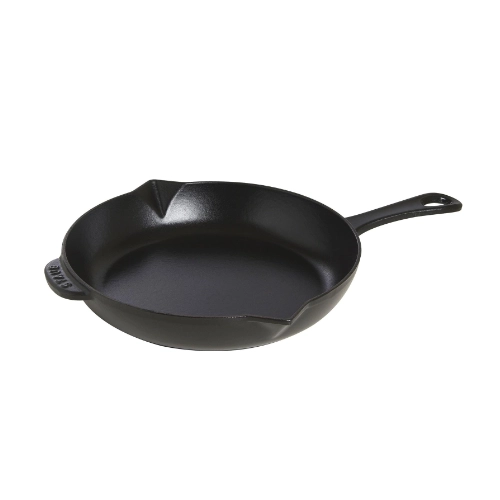
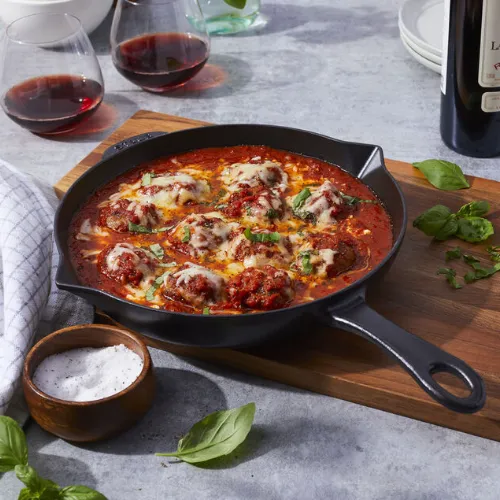
The apple tarte tatin is cooked entirely in one pan, which means the pan choice matters more than it does for most recipes. The caramel forms in the pan, the apples cook in the caramel, and the whole thing flips out of the same pan at the end. A pan that distributes heat unevenly gives you patchy caramel. A pan that doesn’t retain heat well causes the caramel to cool and seize before the apples have softened properly.
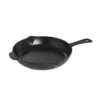
I use the Staub cast iron skillet for this. Cast iron conducts heat evenly across the entire base, which means the caramel colours uniformly rather than burning in the centre and staying pale at the edges. The heat retention keeps the caramel at a steady temperature throughout the apple cooking stage, and the weight of the pan presses the apples gently as they soften. The Staub’s black enamel interior gives you excellent caramelisation without sticking, and the handle makes the flip at the end manageable. For a dish where the caramel is everything, this is the right tool.
The apples
Firm, slightly tart apples are the right choice for an apple tatin. They hold their shape through the long cooking process without collapsing into the caramel. Cox, Braeburn, Granny Smith, or Reinette all work well. Golden Delicious, the French default for many apple desserts, is softer and less acidic, which makes the finished tarte sweeter and less complex. The original recipe specified hard apples for a reason.
Pack the apples tightly. They shrink considerably during cooking and a loosely packed tatin looks sparse when it comes out. What seems like too many apples going in will be exactly the right amount coming out.
Share your feedback and spread the love!
If you try this recipe, I’d love to hear how it turns out! Leave a ★★★★★ rating and your thoughts in the comments, it helps fellow French foodies discover this recipe too. Snap a photo and tag me @obviously.french on Instagram if you’re sharing your bake or cooking online. Don’t forget to save this recipe to Pinterest so you’ll always have it handy for your next French-inspired meal!
Disclosure: Just so you know, this post contains sponsored content and/or affiliate links, If you make a purchase through these links, I may receive a small commission. Doesn’t cost you anything extra. I only link to things that are actually worth your time. All opinions are my own!