Enamel Cast Iron Pots and Pans: Staub vs Le Creuset Guide

Enamel cast iron pots and pans are a fixture of French kitchens, and after a lot of reading and comparing, I’ve chosen the two pieces for my own: a Staub 26cm cocotte for soups and slow braises, and a 28cm Staub Chistera sauteuse (a braiser in English) for everyday cooking and gratins. Both Staub, and both made in France!
They’re expensive, there’s no hiding that, so before spending that kind of money on something that should last a lifetime, I wanted to know exactly what I was paying for. This guide is everything I found out: where enamelled cast iron (or enameled, if you’re in the US) comes from, what it’s good at, how Staub and Le Creuset differ, and how to look after a pot so you can hand it down to your children one day.
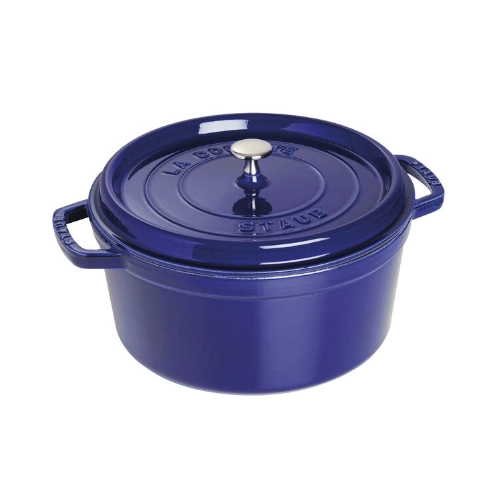

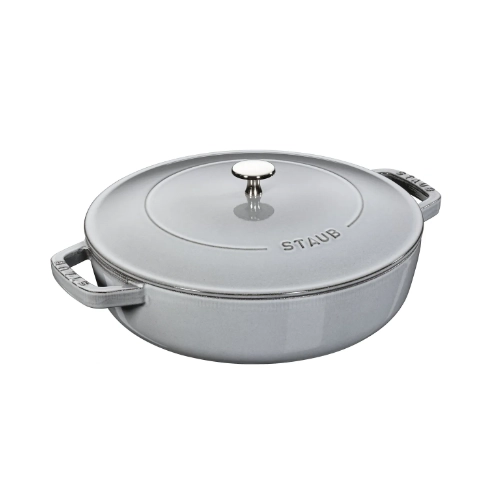
Table of Contents

A short history of cast iron cookware
Cast iron cookware has been around much longer than most people realise. Iron was being cast in China as early as the 5th century BCE, and by the Han dynasty, around 2,000 years ago, cast iron cooking pots were in everyday use. People loved them for exactly the same reasons we do today: they hold heat beautifully and last practically forever.
The technique eventually spread to Europe. In 1707, an Englishman called Abraham Darby patented a way of casting iron pots in sand moulds, which made them cheaper and more consistent to produce. Cast iron pots found their way into ordinary homes across Europe, and the Dutch oven, or cocotte as we call it in France, became a kitchen essential.
Le Creuset: the first enamelled cocotte
Fast-forward to 1925 and the village of Fresnoy-le-Grand, in the Aisne in northern France. Two Belgian industrialists, Armand Desaegher, a casting specialist, and Octave Aubecq, an enamelling expert, met at the Brussels Fair and decided to combine their skills. They set up a foundry in Fresnoy-le-Grand and made their first cocotte that same year.
They chose a fiery orange inspired by the glow of molten cast iron. It’s called Volcanique in France, Volcanic in the UK and Flame in the US, and it’s still made today. Le Creuset, which means “the crucible”, celebrated its 100th birthday in 2025, and its cast iron is still made in that same foundry. Each piece is cast in its own sand mould, which is broken once the iron has set, so every cocotte is slightly unique.
Staub: the Alsace cocotte
Staub is the younger of the two, founded in 1974 in Alsace, a region known for its hearty, slow-cooked dishes. Francis Staub, the grandson of a cookware merchant, designed his first cocotte in an old artillery factory in Turckheim, near Colmar.
His best-known idea is the lid. Staub lids have little spikes, or picots, on the underside, which collect the steam as it condenses and let it drip back down over the food. That’s why Staub calls its cocottes self-basting.
Paul Bocuse, the famous three-star chef from Lyon, was a long-time Staub fan, and you’ll see Staub cocottes in a lot of French restaurant kitchens. In 2008, Staub was bought by the Zwilling group, but it still works as its own brand, and its cast iron is still made in France, at the Staub foundry in Merville, in the north.

A little bit of France in your inbox
Once a month, I’ll write to you with recipes, French cheeses, a few tips and little stories from the neighbourhood. And you’ll get my Mother Sauces e-book free, straight away!

Why enamel cast iron pots and pans are different
Pick up a cast iron casserole after a thin steel pot and you’ll feel the difference straight away. Cast iron’s great talent is heat: it takes a while to warm up, but once it’s hot it stays hot, and it spreads that heat evenly across the base and up the sides.
What the cast iron gives you
- Even browning: When you’re slowly cooking onions for a French onion soup, you don’t end up with one burnt patch and another pale one.
- Steady heat: When you add wine or stock, the pot recovers quickly instead of dropping to lukewarm.
- Food that stays hot at the table: Put a cocotte on a trivet and it will keep a stew warm through a long, chatty supper.
What the enamel gives you
- No rust: unlike bare cast iron, so you don’t need to worry about moisture.
- No seasoning: as the pot arrives ready to use.
- Easy cleaning: with a surface you can wash with a soft sponge and a little washing-up liquid.
- No reaction with acidic food: so tomatoes, wine and lemon don’t affect the metal or the taste.

What an enamelled cast iron Dutch oven is good at
Slow cooking and braises
This is where a cocotte really earns its place. A stew likes three things: steady heat, a heavy lid and time, and a cocotte gives you all three. Once the pot is up to temperature, you can turn the heat right down and let the iron do the work, so a Mushroom Bourguignon simmers gently without ever boiling hard. (Why enamel cast iron works)
The heavy, close-fitting lids make a real difference too. Steam condenses on the underside and drips back into the pot, which keeps everything moist. Staub’s spikes spread the drops over the food, while Le Creuset’s smooth lid sends more of the moisture back down the sides. Either way, you get that “cooked slowly all afternoon” flavour without having to keep checking.
Bread, gratins and oven cooking
Plenty of people buy a cocotte for stews and end up baking bread in it more than anything else! The closed pot traps the steam from the dough, which gives you a thick, crackly crust, and the heavy base browns the bottom of the loaf properly. (Cast iron for baking)
Gratins such as Tartiflette and Brandade de Morue love cast iron too. The edges brown beautifully, and you can start your onions or béchamel on the hob, then slide the same pot straight into the oven. Fewer dishes to wash, and the pot looks lovely in the middle of the table.
Everyday cooking
The romantic image is all slow braises and Sunday lunches, but a cocotte is just as useful midweek, for a pumpkin soup, a risotto or a big batch of tomato sauce to portion and freeze.
Because enamelled cast iron doesn’t react with acidic ingredients, you can simmer wine, tomatoes, lemon and vinegar in it without any metallic taste. You can also keep leftovers in the same pot in the fridge once they’ve cooled, which is handy if you like cooking once and eating twice.

Staub vs Le Creuset: how they differ
People often talk about Staub and Le Creuset as rivals, but they’re really two French cousins with slightly different personalities. Both make excellent pots, so it mostly comes down to how you like to cook.
Staub vs Le Creuset
| Staub | Le Creuset | |
|---|---|---|
| Founded | 1974, Turckheim (Alsace) | 1925, Fresnoy-le-Grand (Aisne) |
| Made in | France (Merville) | France (Fresnoy-le-Grand) |
| Interior | Matte black enamel | Smooth, pale sand-coloured enamel |
| Exterior | Glossy, deep, saturated colours | Glossy, brighter colours, often with a gradient |
| Lid | Flatter, with self-basting spikes | Smooth underside, domed |
| Oven-safe | Up to 250°C (480°F) | Up to 260°C (500°F) |
| Weight | Heavier | A little lighter |
| Guarantee | Lifetime | Lifetime |
*Both are cast in single-use sand moulds, so every piece is slightly unique.
Weight and handles
Staub cocottes have slightly thicker walls, so they feel heavier and very steady on the hob. The handles sit close to the pot, which saves space in the oven but can feel a bit snug with thick oven gloves.
Le Creuset is generally a little lighter than the same size from Staub, which helps when you’re lifting a full pot out of the oven. Its side handles are wider and more open, so there’s room for bulky gloves. If lifting heavy cookware is hard for you, that’s worth keeping in mind.
Lids and moisture
Both pots cook beautifully. Staub’s thicker walls and dark interior hold on to heat, which is great for browning, so medium or low heat is usually plenty. The matte black enamel also hides stains well.
Le Creuset’s pale interior makes it much easier to see what’s happening at the bottom of the pot, so you can tell when onions are turning golden or when a sauce is about to catch. On the other hand, it shows stains more over the years.
Heat and the interior colour
Both pots cook beautifully. Staub’s thicker walls and dark interior hold on to heat, which is great for browning, so medium or low heat is usually plenty. The matte black enamel also hides stains well.
Le Creuset’s pale interior makes it much easier to see what’s happening at the bottom of the pot, so you can tell when onions are turning golden or when a sauce is about to catch. On the other hand, it shows stains more over the years.

Is enamel cast iron worth the money?
There’s no way around it, a good cocotte is expensive. A 24cm round cocotte is about the size most people start with. In November 2026, that’s around £319 for a Le Creuset Signature in the UK (often less on sale) and around €309 for a Staub in France, while a 5.5 quart cocotte from either brand costs roughly $420 to $435 in the US. Prices change a lot with sales and colours, so check before you buy. So why do people keep saving up for one?
1. They last
Looked after well, a cast iron pot can outlast its owner. The enamel protects the iron from rust, and there’s no non-stick coating to peel away after a few years. There’s something rather lovely about cooking a Ratatouille in the same cocotte your grandmother used.
2. They’re consistent
Thin pots can warp, develop hot spots and scorch easily. Heavy cast iron stays flat, heats evenly and gives you the same result every time.
3. They do almost everything
A 24 to 28cm cocotte can make soup, stew, bread, gratins and even desserts. It works on gas, electric, ceramic and induction hobs, in the oven, and usually under the grill too.
And if you do the maths, a £300 (about $400) cocotte used twice a week for 30 years works out at around 10p per use, or about 13 cents. Not bad for something you could pass on to the next generation.
What about cheaper enamelled cast iron pots?
You don’t have to buy Staub or Le Creuset to cook well in enamelled cast iron, and plenty of cheaper pots do a very good job. If you’re looking at a less expensive one, here’s what’s worth checking:
- A thick, heavy base, for even heat.
- A lid that sits snugly, with no rocking.
- Smooth, even enamel inside, with no bubbles or rough patches.
- An oven-safe knob, as some plastic knobs only go up to around 190°C (375°F).
- A proper guarantee. With cheaper pots, the enamel is usually what wears out first.
You can also find good second-hand cocottes in France at vide-greniers and brocantes, and Le Creuset even holds a big clearance sale in Paris (in 2026 it was at the Espace Champerret in September, with around 50% off). If you buy second-hand, check the inside for chips and cracks in the enamel.

How to care for enamel cast iron pots and pans
The good news is that these pots don’t need babying, just a little common sense.
| Heat | Let the pot warm up gradually instead of turning the heat straight up to maximum. Never pour cold water into a hot pot, because sudden changes in temperature are the main enemy of enamel. |
| Utensils | Use wooden, silicone or plastic utensils to keep the inside looking its best. Staub’s matte black enamel copes better with metal, but gentle is always safer. |
| Cleaning | Warm water, a little washing-up liquid and a soft sponge are all you need. For stuck-on bits, leave the pot to soak for 20 minutes, then use a nylon brush. |
| Dishwasher | Both brands say their cast iron can go in the dishwasher, but both recommend washing by hand to keep the enamel glossy. |
| Staining | Pale interiors can discolour over time. A paste of bicarbonate of soda (baking soda) and water works well on light stains, and both brands sell their own cleaners too. |
| Storage | Store the lid slightly ajar or separately, so air can circulate. |

How to choose the right cast iron Dutch oven
They’re all lovely to cook with, so it’s really about what suits your kitchen and your household.
Size
20–22 cm
2.2 to 2.8 litres (about 2.5 to 3 quarts)
For 1–2 people, side dishes, small loaves.
24cm
3.8 to 4.2 litres (about 4 to 4.5 quarts)
Everyday cooking for 2 to 4 people
26 to 28cm
5.2 to 6.7 litres (about 5.5 to 7 quarts)
Families, batch cooking, bigger loaves
Remember that the weight goes up with the size, and a 24cm Staub already weighs about 4.7kg (10.4 lb) with its lid, so be honest about how much you like lifting.
Shape

Round
The best all-rounder, for stews, soups and bread.

Oval
Lovely for gratins, whole fish and long vegetables, and it sits nicely across a wider hob ring.

Low
Perfect for shallow braises, gratins and browning, and it doubles as a serving dish.
FAQ
Is enamel cast iron worth it?
If you cook a lot of soups, stews, gratins or bread, yes. A good enamel cast iron pot heats evenly, keeps food warm at the table, and can last for decades with basic care, so the cost per use ends up very low. If you only cook now and then, a cheaper enamelled cast iron pot will give you most of the benefits for much less.
Staub or Le Creuset: which is better?
Neither is better, they’re just different. Staub is heavier, with a matte black interior that hides stains and a spiked lid designed for slow, moist cooking. Le Creuset is a little lighter, with wider handles and a pale interior that makes it easier to see what’s cooking. Both are made in France and both come with a lifetime guarantee.
Can you use enamelled cast iron on induction?
Yes. Staub and Le Creuset cast iron works on every type of hob, including induction, gas, electric and ceramic. On induction, heat the pot gradually on a medium setting rather than at full power, and lift it rather than sliding it, so you don’t scratch a glass hob or the base of your pot.
Can enamelled cast iron go in the oven?
Yes, which is one of its biggest advantages. Le Creuset cast iron is oven-safe up to 260°C (500°F) and Staub up to 250°C (480°F). The limit often depends on the lid knob, so check yours, especially on older or cheaper pots, where some knobs are only safe up to around 190°C (375°F).
What should I do if the enamel chips?
A small chip on the outside is only cosmetic. If the enamel chips inside the pot, contact the brand, as both Staub and Le Creuset offer a lifetime guarantee on their cast iron. To avoid chips, don’t bang the pot, use wooden or silicone utensils, and never pour cold water into it while it’s hot.
What is the difference between a cocotte and a Dutch oven?
There isn’t one, really. Cocotte is the French word for a heavy pot with a tight lid, and Dutch oven is the American name for the same thing. In the UK you’ll often see it called a casserole dish. Staub and Le Creuset both call theirs cocottes in France.
Over to you
You don’t need to buy every piece at once, and I certainly won’t! Start with the one you’ll use every week, usually a round 24 or 26cm cocotte, and add a sauté pan or an oval dish later if you find you need them. Over the years, a good enamelled cast iron pot pays for itself many times over.
Do you already have a Staub or a Le Creuset, or one you inherited from a parent or grandparent? Tell me in the comments what you cook in it most. I’d love to know which one you’d choose first.
This post may contain affiliate links. If you buy through them I earn a small commission at no extra cost to you, and it helps keep this blog running. Please read my disclosure policy for more information. I am grateful for your support.