Pissaladière Niçoise
 August 22, 2025
Disclosure: This post may contain affiliate links which provide us a small commission when used for purchase. Please read my disclosure policy for more information. I am grateful for your support!
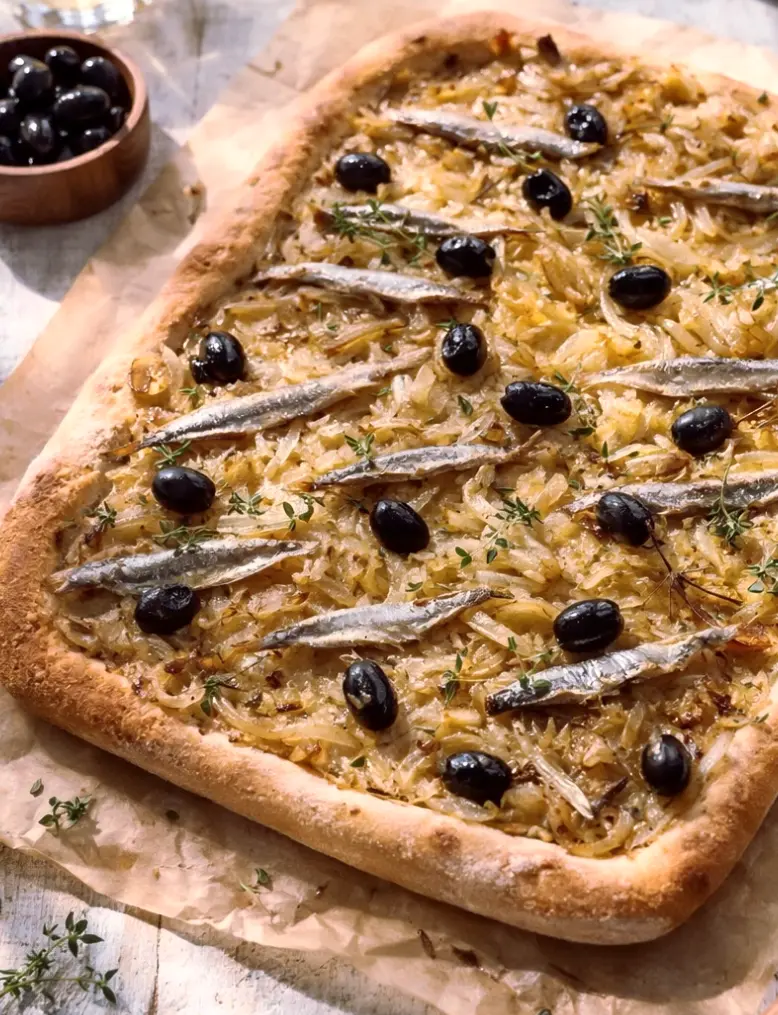
Pissaladière is probably the dish I grew up eating most outside the house. In Nice it’s everywhere: bakeries, markets, the street stalls at the Cours Saleya. You buy a square warm, wrapped in paper, and eat it with a with a glass of Provencal rosé. It’s so embedded in daily life there that you stop noticing it until you’re somewhere else and suddenly miss it enormously. That’s pissaladière for me.
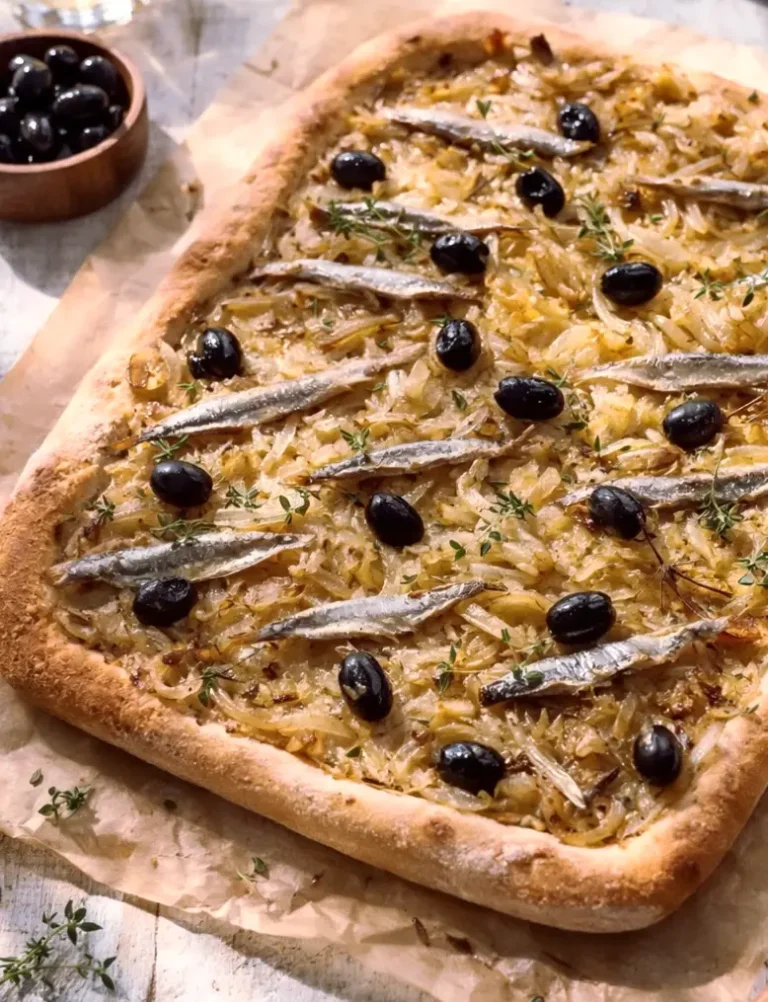
People call it an onion pizza and I understand why, but it’s really its own thing. There’s no tomato, no cheese, and the onions are actually the main ingredient. The anchovies and olives season it and give it that unmistakable savouriness, and it wouldn’t taste the same without them. You have to try it to understand what I’m talking about!
Table of Contents
Where pissaladière comes from
The name comes from pissalat, and pissalat comes from the Niçard peis salat, salted fish. It was an ancient Niçois condiment made from poutine, the tiny fry of sardines and anchovies, fermented and seasoned with thyme, bay, cloves and pepper, then mixed with olive oil and spread onto a bread base before the onions went on. So in the original there were no anchovy fillets at all. Just that savoury paste, and onions.
Pissaladière is ancient. The word pisalat is recorded in Nice as early as 1539, and the dish’s written traces run through the 19th century under the name pissalat à la niçoise. Today it is one of the true icons of Nice, sitting alongside salade Niçoise, fougasse, and pan bagnat!
Ingredients
- Onions — White or yellow, and you genuinely need 1.5kg, since they lose most of their volume as they cook down.
- Anchovy fillets — the seasoning and the savoury backbone, standing in for the pissalat. In France I’d look for Anchois de Collioure, which have a long artisanal salting tradition and turn up on lists of Europe’s best preserved anchovies. Outside France, Spanish Cantabrian anchovies from the Bay of Biscay are excellent, where the fish are large, fatty and hand-processed with real care. Look for ones matured in salt for eight to twelve months
- Black olives — traditionally the small black caillettes of Nice. Something firm and briny rather than soft and bland.
- Yeasted dough — soft and bread-like rather than crisp and thin. It’s a bread base, not a pizza base, and it should be pillowy under the onions.
- Olive oil — for the dough and, generously, for cooking the onions down. It’s what stops them catching over that long slow hour and a half.
- Garlic and bay — cooked whole with the onions and lifted out at the end, perfuming them without leaving anything to chew on.
- Herbes de Provence — stirred in and left there, since it’s dried and crumbled. It gives the onions that southern backbone of thyme, rosemary and savory running underneath.
How to make pissaladière
1. Make the dough and let it prove
Dissolve the yeast in lukewarm water and leave it five to ten minutes until foamy. Combine flour and salt, add the yeast and olive oil, and knead for ten minutes until silky and elastic. Prove in an oiled covered bowl for an hour until doubled. Short on time? A good ready-made bread or pizza dough is fine, the kitchen police won’t come knocking.
2. Start the onions at the same time
Slice all 1.5kg and get them into a wide pan with plenty of olive oil, the whole garlic cloves, thyme, bay and herbes de Provence. Season with pepper but go easy on the salt, since the anchovies will bring a great deal later on.
3. Cook them low and slow for at least ninety minutes
This is the part you cannot rush. Keep the heat genuinely low and stir now and then. Hurry them over higher heat and you get something pale and sharp instead of sweet and golden. They’re ready when they’ve collapsed into a soft jammy tangle you could almost mash with a fork. Fish out the garlic, thyme and bay.
4. Shape the dough and let it rest again
Knock the dough back and roll it into a rectangle roughly 30x40cm, then lay it on a greased tray. Cover with a damp tea towel and leave twenty minutes while you prepare the toppings. That second rest is what gives you the slightly pillowy crust rather than a flat, tight one.
5. Assemble, right to the edges
Spread the onions evenly across the whole surface, leaving no bare border, since exposed dough will dry out. Lay the anchovies over the top in a lattice or diamond pattern and set an olive in each diamond. Traditional is simple and geometric, but do as you like.
6. Bake hot until the edges are golden
210°C for about twenty minutes, until the edges are golden and crisp. Let it cool to just above room temperature before slicing, which lets everything settle and makes it far easier to cut into neat squares.
Tools for this recipe
Check out my favorite kitchen essentials and cookware!
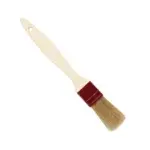
- Use a heavy baking tray that conducts heat evenly, so you get a properly crisp base rather than a pale, soft one.
- Use a perforated baking mat with it, which lets the base cook from below instead of steaming, and it’s the combination I swear by for any dough.
- Use a rolling pin to get the dough into an even rectangle, because thin patches burn while thick ones stay raw.
Tips for success
- Slice the onions evenly and not too thin: wispy slices disintegrate into mush over ninety minutes, while evenly cut medium slices keep just enough texture to be worth eating.
- Don’t salt the onions too much: the anchovies bring a lot of salt, and onions reduced by three-quarters concentrate whatever you added at the start.
- If the onions catch, add a splash of water: scrape the base and carry on. Those browned bits dissolve back in and add flavour rather than ruining it.
- Cook the onions a day ahead: they keep perfectly in a covered container the fridge and it turns a three-hour project into a one-hour one.
How to store it
- At room temperature: Good for a whole afternoon, and genuinely better an hour or two after baking than straight from the oven. This is what makes it such good picnic and apéro food.
- In the fridge: Keeps 2 to 3 days covered, and it’s arguably better the next day once the flavours have settled into each other. Eat it cold, or warm it briefly in a low oven to revive the base.
- In the freezer: Freezes well baked and cooled, for up to a month, wrapped tightly. Reheat from frozen in a moderate oven until hot through. The cooked onions also freeze beautifully on their own, so it’s worth making a double batch of those.
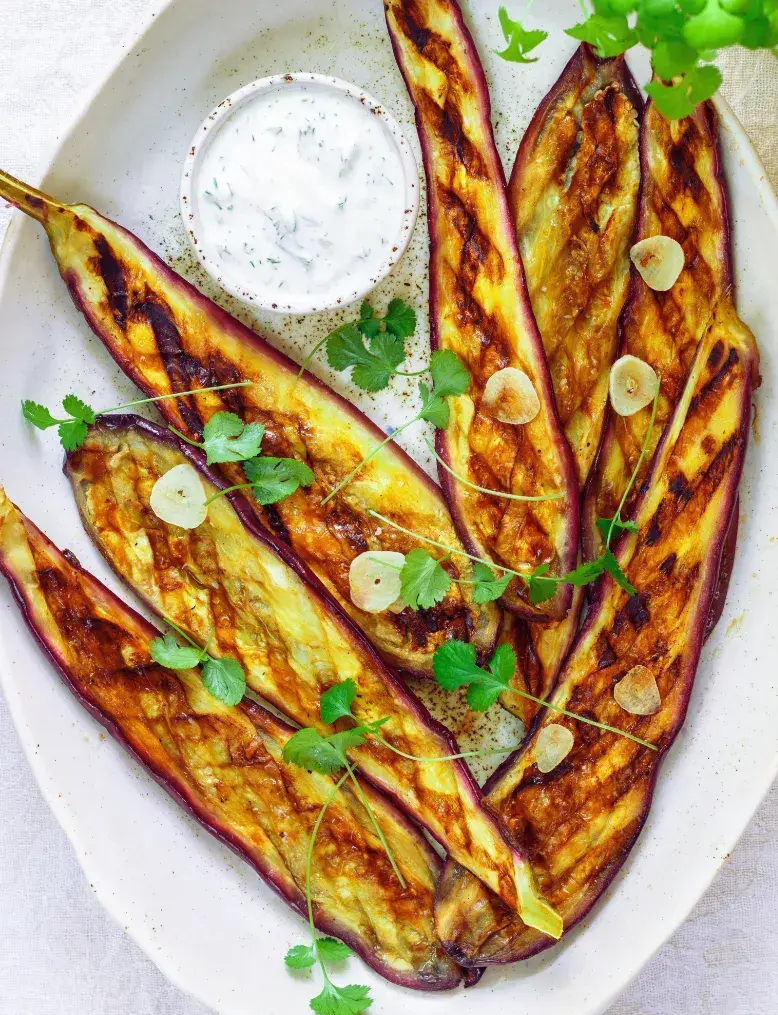
More Southern recipes to try
Variations
- Anchovy paste under the onions: the practical version of the original pissalat, and something plenty of locals do. A thin smear before the onions gives you a deeper umami background.
- Without anchovies: leave them out and add extra olives, capers and a little more thyme. It’s no longer strictly a pissaladière, but it’s what the tarte de Menton does and it’s very good.
- On puff pastry: a quicker weeknight version, crisper and lighter than the bread base. Not traditional, but very tasty too!
- With a few caramelised tomatoes: this takes you across the border towards the Ligurian piscialandrea and the Mentonnais pichade, both of which use tomato.
- As apéro bites: cut into small squares or thin strips rather than slices, which is exactly how it’s sold from stalls in Nice.
FAQ
Is pissaladière the same as pizza?
No. It’s a yeasted dough baked with toppings, but there’s no tomato and no cheese, and the onions are the main ingredient rather than a topping. The base is soft and bread-like rather than thin and crisp.
What onions are best for a pissaladière recipe?
White or yellow onions, sliced evenly and not too thin. You need about 1.5kg for one tart, since they reduce dramatically over the long slow cook.
Can you make pissaladière without anchovies?
You can, though it stops being a true pissaladière, since the anchovies replace the pissalat that gave the dish its name. Add extra olives, capers and thyme to keep the savoury edge.
How long do the onions really need?
At least an hour and a half over genuinely low heat. Rushing them gives you pale, sharp onions instead of the sweet jammy tangle the whole dish depends on.
Can pissaladière be made ahead?
Yes, it’s designed for it. Cook the onions a day ahead, or bake the whole thing and serve it at room temperature. It keeps 2 to 3 days and is often better the next day.


 Prep Time 20 minutes
  Cook Time 1 hour 50 minutes
  Total Time 3 hours 30 minutes
  Servings 6
Description
Ingredients
For the dough
- 250 gr plain flour
- 6 gr baker's yeast
- 1 tbsp olive oil
- 1 tsp salt
- 150 ml water lukewarm
For the topping
- 1,5 kg onion white or yellow
- 4 tbsp olive oil
- 2 cloves garlic
- 14 anchovy fillets salted in oil
- 25 black olives
- 1/2 tsp Herbes de Provence
- 1 bay leaf
- 4 sprigs thyme
- black pepper freshly ground
Equipment

Instructions
1. Prepare the dough
- Dissolve the yeast in the lukewarm water and leave for 5–10 minutes until bubbly and foamy. Combine the flour and salt in a large bowl, add the yeast mixture and olive oil, and mix until a shaggy dough forms. Knead on a lightly floured surface for about 10 minutes until silky and elastic. Place in a lightly oiled bowl, cover, and prove somewhere warm for about 1 hour, until doubled. Short on time? A good ready-made bread or pizza dough works fine.
2. Caramelise the onions
- While the dough rises, heat the olive oil over low heat in a large frying pan. Add the sliced onions, whole garlic cloves, thyme, bay leaf and herbes de Provence. Season with pepper but go easy on the salt, as the anchovies bring plenty. Cook very gently for at least 1 hour 30 minutes, stirring now and then, until the onions collapse into a soft golden tangle. Remove the garlic, thyme and bay.
3. Shape and rest the dough
- Knock the dough back and roll it into a rectangle about 30x40cm. Lay it on a greased baking tray or baking mat. Cover with a damp tea towel and rest for 20 minutes while you prepare the toppings.
4. Assemble
- Spread the onions evenly over the dough, right to the edges. Lay the anchovy fillets over the top in a lattice or diamond pattern, and set an olive in each diamond.
5. Bake
- Bake at 210°C (190°C fan) for about 20 minutes, until the edges are golden and crisp. Let it cool to just above room temperature before slicing.
Notes
- If anchovies are too intense for you, rinse and dry them, or use fewer. Some locals spread a thin layer of anchovy paste on the dough before the onions for deeper umami.
- The onions can be cooked a day ahead and kept in the fridge, which makes this far more manageable.
- Pissaladière keeps beautifully and is excellent at room temperature or cold, so it’s a good make-ahead for picnics and parties.
Share your feedback and spread the love!
If you try this recipe, I’d love to hear how it turns out! Leave a ★★★★★ rating and your thoughts in the comments, it helps fellow French foodies discover this recipe too. Snap a photo and tag @obviously.french on Instagram. Come talk about it in our Facebook group. And don’t forget to save this recipe to Pinterest so you’ll always have it handy for your next French-inspired meal!