 January 8, 2026
Disclosure: This post may contain affiliate links which provide us a small commission when used for purchase. Please read my disclosure policy for more information. I am grateful for your support!
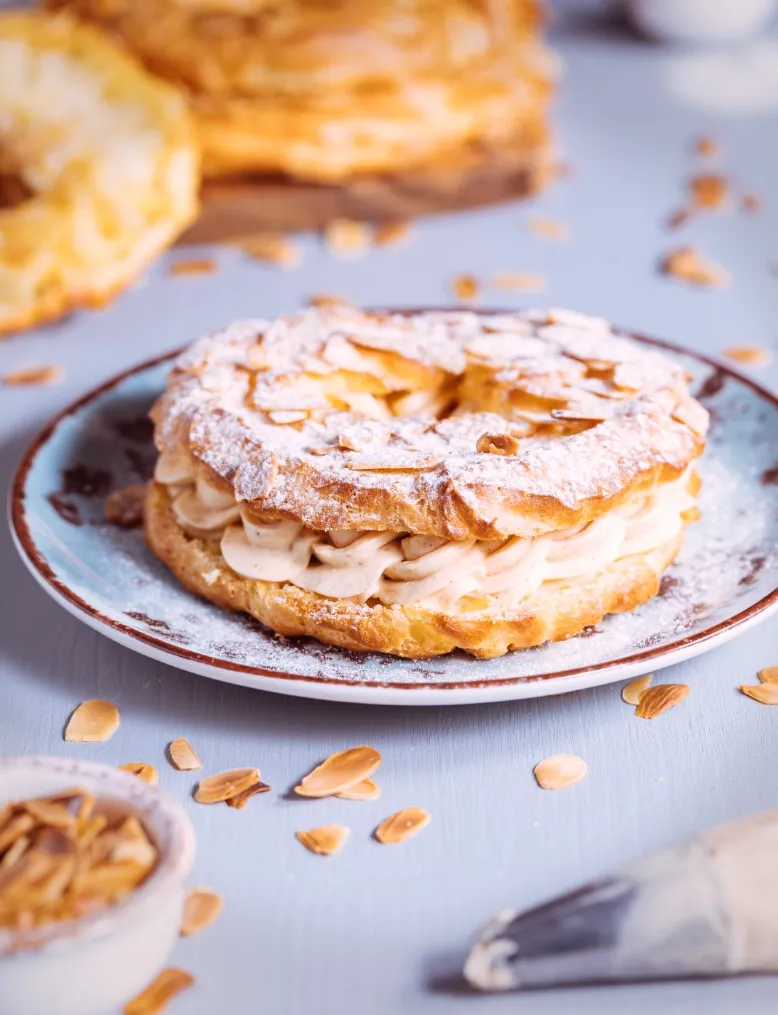
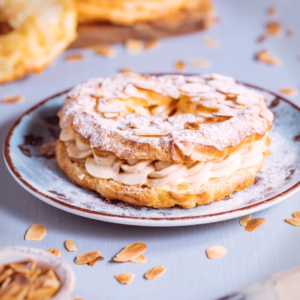
I didn’t order one of these in a bakery until I was over thirty. I know, I should be ashamed. I simply didn’t know. It was a friend who turned up with one of those flat square boxes full of different pastries, and the Paris-Brest was far and away my favourite.
I won’t pretend this one’s quick. It takes effort and some dedication, more for the praline than the choux pastry, which is genuinely straightforward and the same pastry you use for chouquettes, profiteroles and éclairs. The praline needs a bit of patience. But then, who gets to say they made their own Paris-Brest from scratch? You will, shortly.
Table of Contents
Where Paris-Brest comes from
This story is one of great marketing and sport. It was created in 1910 by Louis Durand, a pâtissier in Maisons-Laffitte, a town sitting directly on the route of the Paris-Brest-Paris cycling race. And it wasn’t even his idea: the race’s founder, the journalist Pierre Giffard, asked Durand to invent a pastry to help promote his event. That race, begun in 1891, was a 1,200km monster from Paris to Brest on the Brittany coast and back, and Durand was clever enough to shape his pastry like a bicycle wheel in its honour, which I find completely charming.
There’s a practical joke buried in it too: a Paris-Brest is enormously calorific, and the riders adored it for exactly that reason, it’s perfect fuel for 1,200km in the saddle. Legend has it finishers were handed them as they crossed the line.
The original professional race ran until 1951, and the route lives on today as an amateur randonnée every four years, drawing cyclists from around the world. But the pastry has long outgrown the event that inspired it. Durand’s instinct turned out to be extraordinarily good, not bad for a local pâtissier trying to shift a few more cakes. And the family bakery Durand et Fils is still there in Maisons-Laffitte, run by his grandson, still making it to the original recipe.
Ingredients
- Choux pastry (milk, water, butter, flour, eggs) – The crisp ring. Same dough as éclairs and profiteroles, and genuinely the easy part of this recipe.
- Hazelnuts – For the praline. Toasted, then caramelised and blitzed to a paste. This is where the flavour lives.
- Caster sugar – For the caramel that becomes the praline, and in the pastry cream.
- Milk, egg yolks, cornflour – The crème pâtissière base of the mousseline.
- Butter – A lot of it, beaten into the cold pastry cream to make the mousseline silky and light. Room temperature is essential.
- Flaked almonds – Scattered on before baking, for crunch and the classic look.
- Icing sugar – To dust at the end.
How to make Paris-Brest pastry
1. Pipe and bake the choux ring
Make the choux (boil the liquids and butter, beat in the flour, dry it out, then beat in the eggs until it falls in a thick ribbon), pipe it in a ring following a traced template, brush with egg wash and scatter with flaked almonds. Bake hot, then lower the heat and bake on until deep golden and properly dry, then let it cool in the turned-off oven with the door ajar. The most common mistake is underbaking: it should be genuinely brown and feel light in the hand.
2. Make the praline
Toast the hazelnuts, caramelise the sugar to a deep amber, stir the hot nuts through, and pour it out to set. Then blitz it, past the powder stage, and keep going until it turns to a smooth, runny paste.
3. Make the pastry cream
Whisk the yolks, sugar and cornflour, pour on the hot milk, cook it back in the pan until thick and boiling, and let it boil a minute to cook out the cornflour. Cool it completely under clingfilm.
4. Mousseline and assemble
Beat the cold pastry cream smooth, then beat in the butter bit by bit, then the praline paste. Split the choux ring horizontally with a serrated knife, pipe the cream generously onto the bottom half (a star nozzle makes it look professional), put the lid back on, and dust with icing sugar.
Tools for this recipe
Check out my favorite kitchen essentials and cookware!
- Use a heat-resistant spatula to effortlessly mix the panade for the choux.
- Use a stand mixer to beat the butter into the pastry cream gradually, since the mousseline needs long, steady beating that’s exhausting by hand.
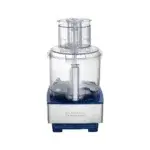
- Use a food processor to blitz the set praline into a smooth paste, which takes a good ten minutes.
- Use a piping bag with a plain nozzle for the ring and a star nozzle for the filling.
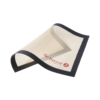
- Use a baking mat so the choux ring bakes evenly and lifts off cleanly.
Tips for success
- Don’t underbake the choux: this is the most common mistake. It should be deep golden brown, not blond, and feel light when you lift it. Underbaked choux collapses. Then cool it in the turned-off oven with the door ajar.
- Don’t give up on the praline: it goes to powder and stays there for ages before suddenly turning to paste. Ten minutes of processing, scraping down the sides. Just keep going.
- Everything at the same temperature for the mousseline: the pastry cream must be completely cold and the butter at room temperature. Mismatched temperatures are why mousseline splits.
- If it splits, keep beating: it looks curdled, then comes together. If it won’t, it’s too cold, so leave it out for 30 minutes and beat again.
- Don’t make it on a humid day: choux goes soggy in minutes in damp air, and it’s a lot of work to have it deflate on you.
How to store it
- A filled Paris-Brest is best eaten the day it’s made, ideally within a few hours, when the choux is still crisp against the cream. Like all choux, it softens as it sits, since the filling gradually works into the pastry.
- Assembled, it keeps in the fridge for a day. Bring it back to room temperature for 20 minutes before serving, since fridge-cold mousseline is firm and its flavour dulls.
- The clever route is components. The unfilled choux ring keeps in an airtight container for 2 days (crisp it in a hot oven for 5 minutes), or freezes for a month. The praline paste keeps for months in a jar in the fridge, so it’s always worth making extra. And the pastry cream keeps 2 days before you beat it into a mousseline. Then it’s just assembly on the day.
Variations
- Almond praline: use almonds instead of hazelnuts, or a mix.
- Add a crémeux centre: pipe a thin line of praline crémeux or a little salted caramel inside the mousseline for a modern pâtissier’s version.
- Individual Paris-Brests: pipe small rings, about 8cm, for individual portions. Same method, shorter bake, and rather smart for a dinner party!
- Less sugar: the sugar is structural in the praline (it is caramel) and it can’t be reduced there. You can pull the pastry cream’s sugar back by about a quarter, since the praline brings plenty of sweetness, and skip the icing sugar dusting. That’s about as far as it goes.
- Coffee or chocolate mousseline: add a little strong coffee or melted dark chocolate to the mousseline alongside (or instead of) some praline.
FAQ
What is a Paris-Brest?
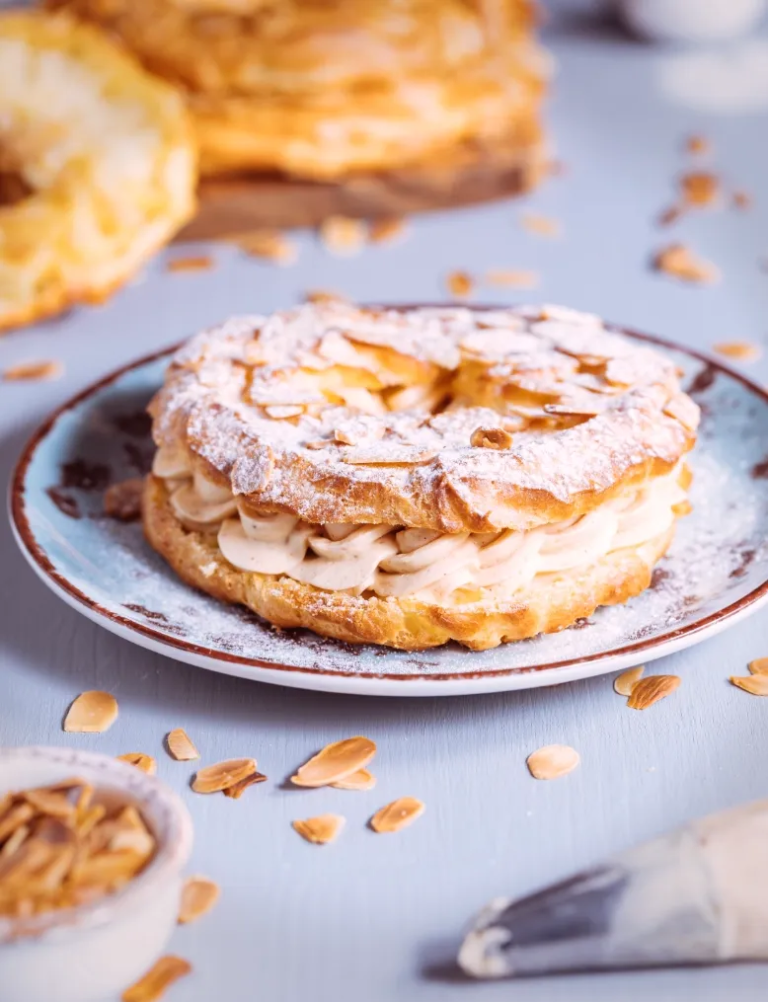
A Paris-Brest is a classic French pastry: a ring of choux pastry topped with flaked almonds, split horizontally and filled with praline mousseline (a pastry cream beaten with butter and caramelised hazelnut paste). It was created in 1910 to celebrate the Paris-Brest-Paris cycle race, and its ring shape represents a bicycle wheel.
Why is it called Paris-Brest?
It’s named after the Paris-Brest-Paris cycling race, a 1,200km event from Paris to Brest and back, first run in 1891. The pâtissier Louis Durand, whose shop lay on the route, created it in 1910 at the request of the race’s founder, and shaped it like a bicycle wheel in the race’s honour.
Why did my mousseline split?
Temperature. The pastry cream and butter need to be at the same room temperature. If the cream’s too cold, the butter won’t emulsify and it looks curdled. Keep beating first, it usually comes back. If not, leave it at room temperature for 30 minutes and beat it again.
Can I make Paris-Brest ahead of time?
Make the components ahead rather than the finished pastry. The choux ring keeps 2 days (or freezes a month), the praline paste keeps months in the fridge, and the pastry cream keeps 2 days. Assemble on the day, since filled choux softens within hours.
Can I buy praline paste instead of making it?
Yes, French specialist shops and some delis sell it, and it saves the longest part of the recipe. Homemade is noticeably better, though, fresher and more intense. If you do make it, make extra, since it keeps for months in a jar in the fridge.


 Prep Time 2 hours
  Cook Time 45 minutes
  Total Time 4 hours
  Servings 8
Description
Ingredients
For the choux pastry
- 125 ml water
- 125 ml whole milk
- 110 gr unsalted butter
- 1 tsp caster sugar
- 1/2 tsp salt
- 150 gr plain flour
- 5 egg room temperature
- 1 egg for egg wash
- 50 gr flaked almonds
- icing sugar for dusting
For the praline
- 150 gr hazelnuts blanched
- 150 gr caster sugar
- 4 tbsp water
For the praline mousseline cream
- 500 ml whole milk
- 6 egg yolks
- 100 gr caster sugar
- 50 gr corn starch
- 250 gr unsalted butter room temperature
- 200 gr praline paste from above
Equipment


Instructions
1. Draw your template
- Trace a 20cm circle on baking paper and flip it over so the pencil is underneath. Pipe following this guide.
2. Make the choux pastry
- Bring the water, milk, butter, sugar and salt to a rolling boil. Off the heat, tip in all the flour at once and stir hard until it forms a smooth ball that pulls from the sides, about 2 minutes. Return to medium heat for a minute, stirring, until a thin film forms on the pan base.
3. Add the eggs
- Transfer to the mixer with the paddle and cool 5 minutes. Beat the eggs in a jug and add gradually on medium speed. Stop when the mixture is glossy and falls from the paddle in a thick ribbon. You may not need all of them.
4. Pipe the ring
- Pipe a thick ring (about 5cm wide) following the template, then a second ring directly on top, and a third in the groove if you like. Brush gently with egg wash and scatter with flaked almonds.
5. Bake
- Heat the oven to 200°C. Bake 20 minutes, then reduce to 180°C and bake another 20 to 25 minutes, until deep golden brown and light in the hand. Turn the oven off, prop the door with a wooden spoon, and cool inside for 30 minutes.
6. Make the praline paste
- Toast the hazelnuts in a dry pan for about 5 minutes until golden and fragrant. Heat the sugar and water in a heavy pan, without stirring, until deep amber. Stir in the hot hazelnuts, then pour onto a lined tray and cool completely until hard. Break up and blitz in a processor, past the powder stage, for at least 10 minutes, until smooth and runny.
7. Make the pastry cream base
- Heat the milk until steaming. Whisk the yolks and sugar until pale, then whisk in the cornflour. Pour on the hot milk, whisking, return to the pan, and cook over medium heat, whisking, until thick and bubbling. Boil for a full minute to cook out the cornflour. Transfer to a bowl, press clingfilm on the surface, and cool completely.
8. Finish the mousseline
- Beat the cold pastry cream smooth with the paddle. With the mixer running, add the butter bit by bit. If it looks curdled, keep going. Add the praline paste and beat until smooth and pipeable.
9. Assemble
- Split the choux ring horizontally with a serrated knife. Pipe the mousseline generously onto the bottom half (star nozzle for a professional finish). Replace the top and dust with icing sugar.
Notes
- Praline paste keeps for months in a jar in the fridge. Make extra.
- The unfilled choux can be frozen. Refresh in a hot oven for 5 minutes.
- Mousseline is temperature-sensitive. If it splits, it’s usually too cold. Leave it at room temperature for 30 minutes and beat again.
- No food processor? You can buy praline paste from French specialty shops, but homemade is miles better.
- Weather matters. Don’t attempt this on a humid day. The choux will go soggy in minutes.
Share your feedback and spread the love!
If you try this recipe, I’d love to hear how it turns out! Leave a ★★★★★ rating and your thoughts in the comments, it helps fellow French foodies discover this recipe too. Snap a photo and tag @obviously.french on Instagram. Come talk about it in our Facebook group. And don’t forget to save this recipe to Pinterest so you’ll always have it handy for your next French-inspired meal!