Béchamel Sauce
 May 24, 2026
Disclosure: This post may contain affiliate links which provide us a small commission when used for purchase. Please read my disclosure policy for more information. I am grateful for your support!
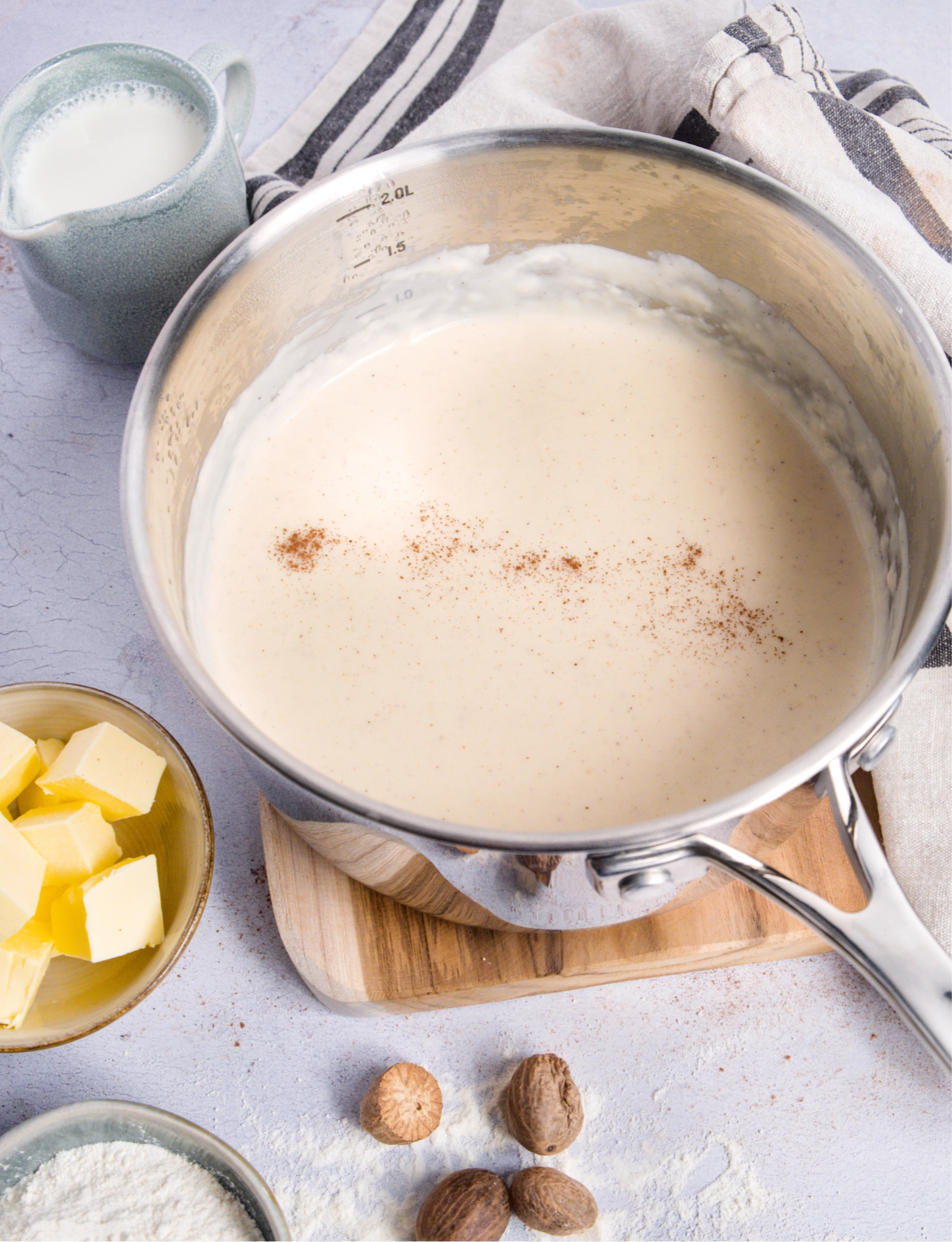
I knew how to make a béchamel sauce as a child, that’s how embedded it is in me! The ratio is super easy to remember, equal weights of butter and flour, then ten times that weight in milk. Once you’ve made it once or twice, it just becomes second nature.
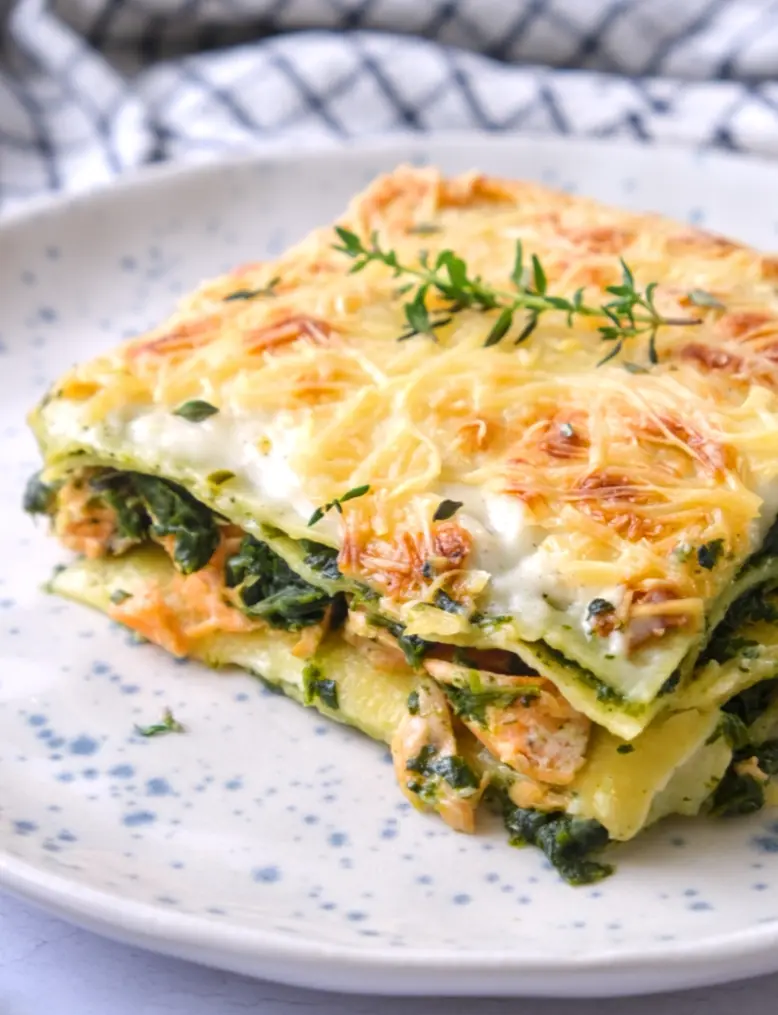
And this white sauce opens up an enormous amount of French cooking like lasagna, croque madame, soufflé, croquettes, they are all built on this one bechamel sauce. It holds together some of the most satisfying dishes in the whole French repertoire, and it only takes fifteen minutes to make!
Table of Contents
Where béchamel sauce comes from
The term “mother sauces” dates back to the early nineteenth century, when French chef Marie-Antoine Carême organised sauces into four foundational categories. Later, Auguste Escoffier refined and codified the list in Le Guide Culinaire, adding a fifth sauce. Those five sauces (béchamel, velouté, espagnole, hollandaise, and sauce tomate) stuck and remain the foundation of classical French cooking taught in culinary schools worldwide today.
The five French mother sauces
If you’d like to try making all five sauces at home, I’ve written up all the recipes for you. Subscribe to my newsletter and I’ll send them straight to your inbox!
The logic is elegant: master one base and the variations follow. From this one béchamel base you can build, for example, a sauce Soubise (béchamel enriched with slow-cooked puréed onions, lovely with vegetables and white meats) or a sauce Nantua (béchamel with crayfish butter, an elegant thing over grilled seafood).
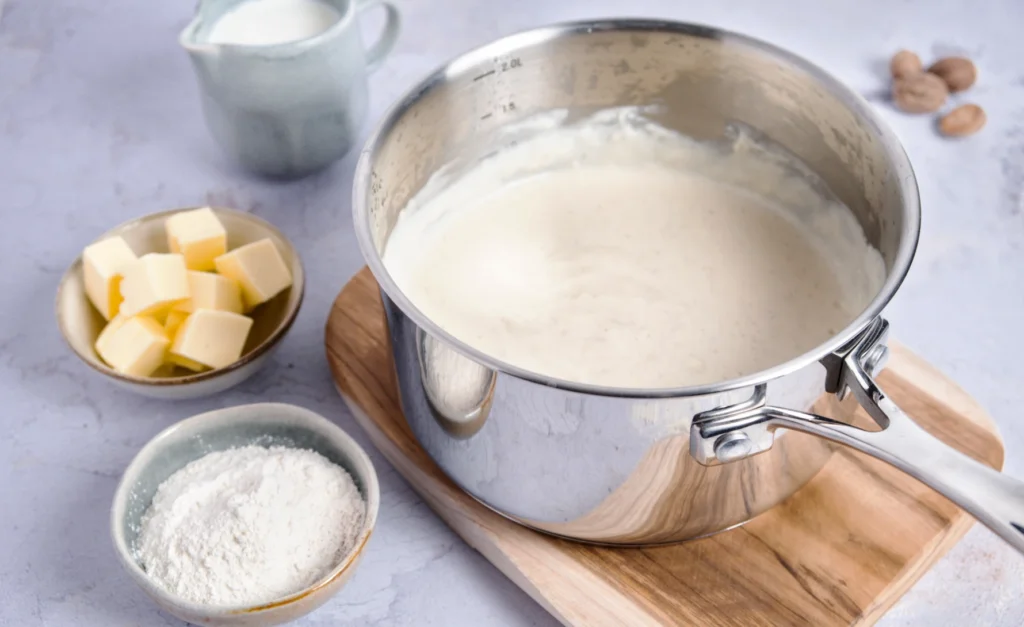
Ingredients
- Butter – Half of the roux, and equal in weight to the flour.
- Plain flour – The other half of the roux, and what thickens the sauce.
- Whole milk – Ten times the weight of the butter (or flour). Whole milk gives the richest, smoothest result.
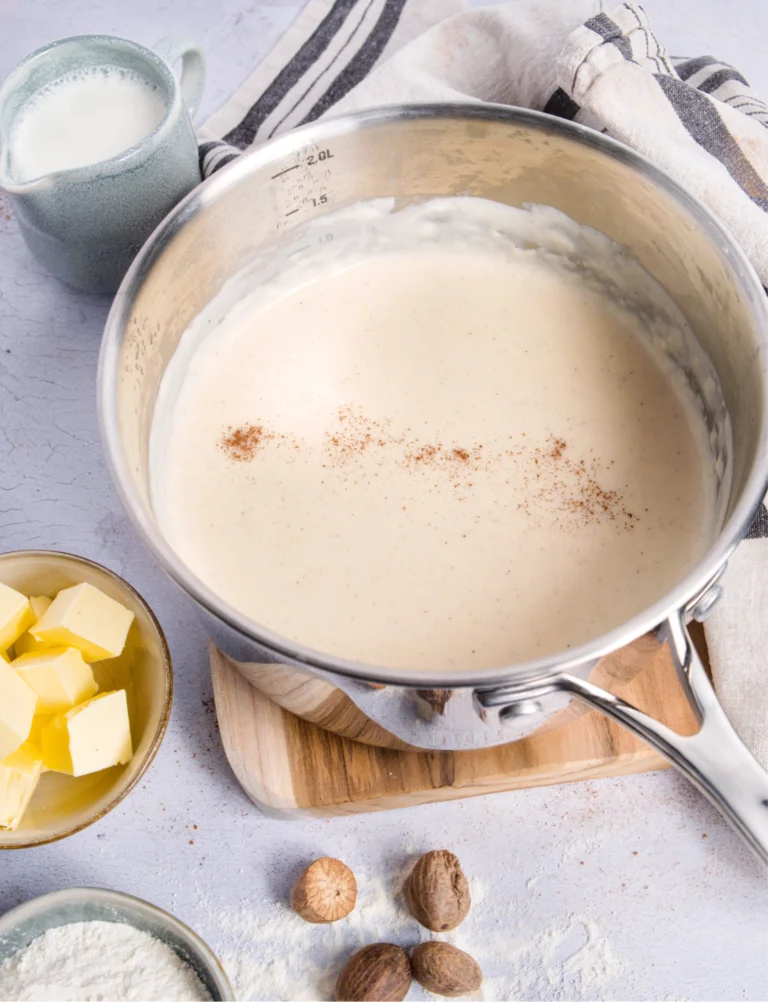
- Nutmeg – Freshly grated, and not optional if you want to do it the French way. It’s an essential part of a classic béchamel, not a garnish.
- White pepper – Traditional, so the sauce stays clean and pale without black specks. Black works too, it just shows visually.
- Salt – To season, at the end.
How to make béchamel sauce
1. Make the roux
Melt the butter gently, and once it’s melted and just foaming, tip in all the flour at once. Whisk hard until it’s a smooth, pale paste, then cook it for a minute or two, stirring with a heat-resistant spatula, to cook out the raw flour taste. You want it smelling faintly biscuity but not browning. A browned roux tastes lovely but it’s not a béchamel, so keep the heat gentle and the colour pale.
2. Add the milk
Take the saucepan off the heat, then add the milk in a slow, steady stream, stirring constantly and letting each addition come together before you add more. Adding it all at once is the classic route to lumps. Take real care with the first few splashes, since that’s where lumps form, then once it’s smooth and loose you can pour the rest in more freely. Warm milk here makes life much easier.
3. Cook until it thickens
Back onto medium-low heat, whisking continuously as it heats and thickens, about 5 to 8 minutes. Don’t wander off, because it catches on the base of the pan fast once it starts to thicken. It’s ready when it coats the back of a spoon and a finger drawn across leaves a clean line. Then off the heat, season with salt, white pepper and plenty of freshly grated nutmeg, and taste.

Tools for this recipe
Check out my favorite kitchen essentials and cookware!
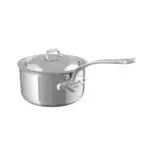
- Use a heavy saucepan (18cm) for a stable, even simmer of the bechamel.
- I use my trusty, durable whisk for this recipe.
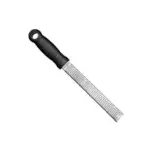
- I use a fine grater to grate the fresh nutmeg.
Tips for success
- Warm the milk first: cold milk added to a hot roux is the most common cause of lumps. Warm it gently in a separate pan, not boiling, just warm, and the sauce comes together far more smoothly.
- Whisk constantly, and don’t walk away: it catches on the bottom of the pan quickly, especially once it starts to thicken. Keep whisking and keep the heat medium-low.
- Nutmeg isn’t optional for a French bechamel: in classical French cooking, nutmeg is an essential part of a béchamel, not a garnish. Use it freshly grated if you can, since pre-ground has much less flavour.
- White pepper for a clean look: traditional béchamel uses white pepper so the sauce stays visually clean. Black pepper works perfectly well, it just leaves specks. Your call.
- Lumpy sauce? Don’t panic. Take it off the heat and whisk hard. If lumps still won’t go, pass it through a fine sieve and it’ll be perfectly smooth. Even French grandmothers have lumpy days.
How to store it
- Béchamel keeps well in the fridge for up to 3 days. The trick is to press a sheet of clingfilm directly onto the surface before it goes in, which stops a skin forming as it cools.
- To reheat, warm it gently over a low heat, whisking, and if it’s thickened up in the fridge (it will), just whisk in a splash of milk to loosen it back to the consistency you want. It won’t split or spoil, which is exactly why it’s such a useful thing to have on hand.
- I wouldn’t freeze a plain béchamel, since it can turn slightly grainy or split on thawing. Better to make it fresh, which given it’s a fifteen-minute job, is no hardship.
More recipes to try
Variations
- Sauce Mornay: stir grated Gruyère (and often Parmesan) into the finished béchamel for the classic cheese sauce. This is what goes over a croque madame or a cauliflower cheese.
- Sauce Soubise: fold in slow-cooked puréed onions for a sweet, mellow sauce that’s lovely with vegetables.
- Sauce Nantua: enrich it with crayfish butter for an elegant seafood sauce.
- Mustard sauce: a spoonful of Dijon mustard whisked in at the end makes a quick mustard sauce, brilliant with fish.
- Herb béchamel: infuse the milk first with a bay leaf, a clove-studded onion and a few peppercorns (a proper infused béchamel), then strain before making the roux, for a deeper, more perfumed sauce.
How to adjust for different uses
This bechamel recipe gives you a medium thickness, the all-purpose version that works for most dishes. The ratio is easy to adjust depending on what you’re making.
Thinner béchamel
For a thinner béchamel (soups, light sauces): reduce the butter and flour to 30g each, keep the milk at 500ml.
Thicker béchamel
For a thicker béchamel (croquettes, soufflé bases, gratins): increase the butter and flour to 70g each, keep the milk at 500ml.
The ratio to remember: equal weights of butter and flour, then ten times that weight in milk. Scale up or down as needed and the sauce will always work. That’s all you need to know to make your French Mother Sauce!
FAQ
What is béchamel sauce?
Béchamel is a classic French white sauce, one of the five mother sauces, made from a butter-and-flour roux whisked with milk and seasoned with nutmeg. It’s smooth, creamy and mild, and forms the base for countless dishes like lasagne, gratins, croque monsieur and cheese sauce.
What’s the ratio for béchamel?
Equal weights of butter and flour, then ten times that weight in milk. So 50g butter, 50g flour and 500ml milk gives a medium, all-purpose sauce. Use less butter and flour for a thinner sauce, more for a thicker one, keeping the milk the same.
Why is my béchamel lumpy?
Usually because the milk went in too fast, or cold milk hit a hot roux. Add the milk gradually off the heat, whisking constantly, and warm it first if you can. If lumps still form, take it off the heat and whisk hard, or pass it through a fine sieve.
Can I make béchamel ahead of time?
Yes. It keeps in the fridge for up to 3 days with clingfilm pressed onto the surface to stop a skin forming. Reheat gently, whisking in a splash of milk to loosen it. I wouldn’t freeze it, though, as it can go grainy.
Do I have to add nutmeg?
Traditionally, yes. Nutmeg is considered an essential part of a classic French béchamel, not just a garnish, it adds a warmth you’d miss without it. Use it freshly grated for the best flavour, and go easy, since it’s easy to overdo.
What’s the difference between béchamel and white sauce?
They’re essentially the same thing. “White sauce” is the plain English name for a milk sauce thickened with a roux. Béchamel is the French version, classically finished with nutmeg and white pepper, and counted among the five mother sauces.


 Prep Time 2 minutes
  Cook Time 12 minutes
  Total Time 14 minutes
  Servings 4
Description
Ingredients
- 50 gr unsalted butter
- 50 gr plain flour
- 500 ml whole milk
- 1 pinch salt
- 1 pinch white pepper
- 1 pinch nutmeg freshly grated
Equipment


Instructions
1. Make the roux
- Melt the butter in a medium saucepan over low-medium heat. Once melted and just foaming, add the flour all at once. Stir hard with a whisk or a heat-resistant spatula until you have a smooth, pale paste. Cook for 1 to 2 minutes, stirring constantly, to cook out the raw flour. It should smell faintly biscuity but not brown.
2. Add the milk
- Take the pan off the heat. Add the milk in a slow, steady stream, whisking constantly to work in each addition before adding more. Take your time with the first few splashes, then pour the rest more freely once it's smooth and loose.
3. Cook until thickened
- Return to medium-low heat. Whisk continuously as it heats and thickens, about 5 to 8 minutes. It's ready when it coats the back of a spoon and a finger drawn across leaves a clean line.
4. Season and serve
- Off the heat, season with salt, white pepper and freshly grated nutmeg. Taste and adjust. Use immediately, or press clingfilm onto the surface to stop a skin forming
Notes
- White pepper keeps the sauce visually clean; black works but leaves specks visually.
- Warm the milk first if you can as cold milk into a hot roux is the main cause of lumps.
- Whisk constantly and don’t walk away. It catches on the base quickly once it thickens.
- Nutmeg isn’t optional the French way. And freshly grated has far more flavour than pre-ground.
- Lumpy? Don’t panic. Whisk hard off the heat, or pass through a fine sieve.
- Keeps 3 days in the fridge with clingfilm on the surface. Reheat gently, whisking in a splash of milk to loosen.
Share your feedback and spread the love!
If you try this recipe, I’d love to hear how it turns out! Leave a ★★★★★ rating and your thoughts in the comments, it helps fellow French foodies discover this recipe too. Snap a photo and tag @obviously.french on Instagram. Come talk about it in our Facebook group. And don’t forget to save this recipe to Pinterest so you’ll always have it handy for your next French-inspired meal!