 September 18, 2025
Disclosure: This post may contain affiliate links which provide us a small commission when used for purchase. Please read my disclosure policy for more information. I am grateful for your support!
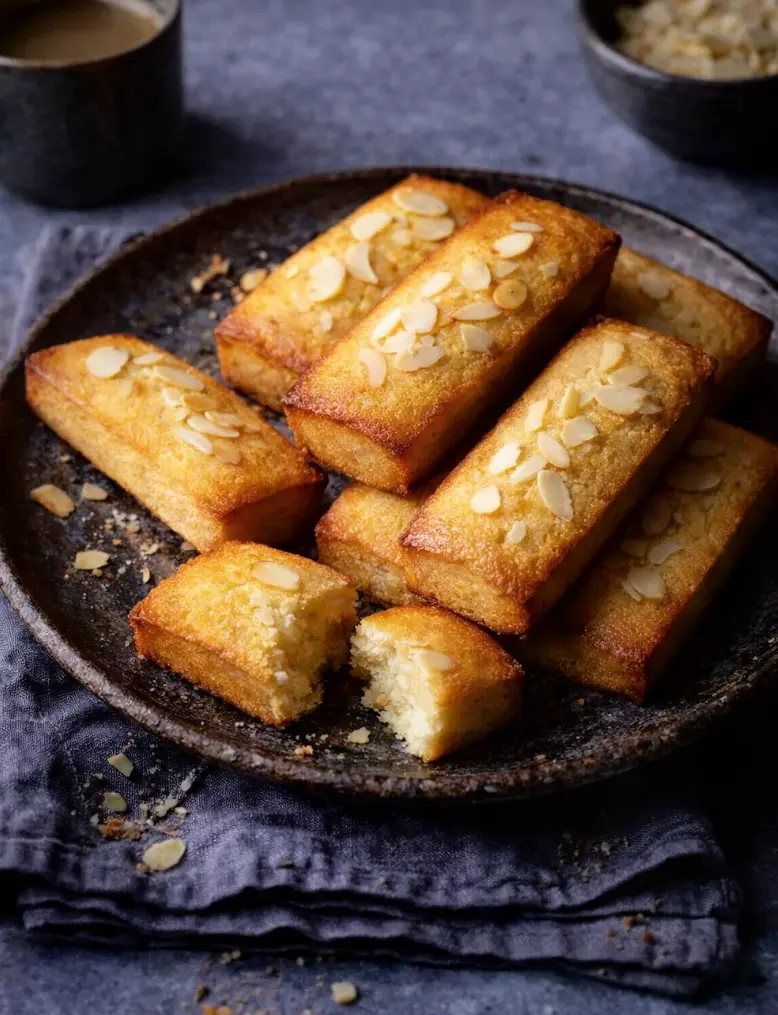
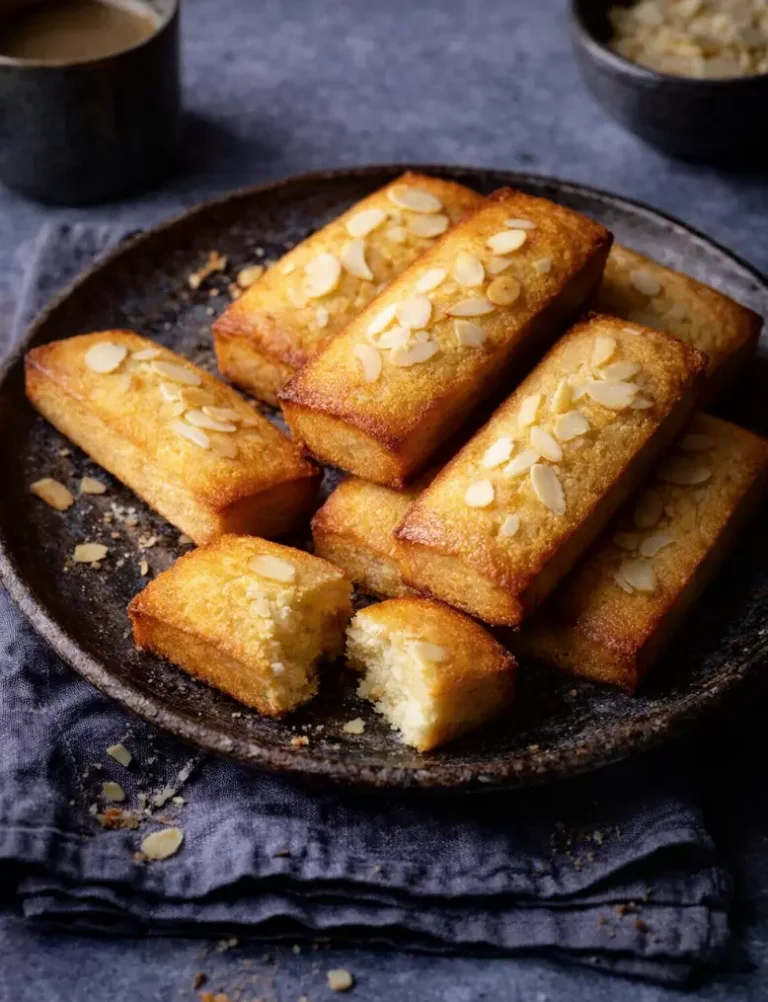
The first time I saw financiers was in a supermarket, and I wasn’t really sure what they were. I asked my neighbour about them and she smiled and handed me her recipe. Of course she had the recipe! I didn’t bother trying the shop-bought ones after that, I went straight into the kitchen and rolled my sleeves up. This financier pastry is surprisingly easy to make, you just need the right mould and then you’re set.
Table of Contents
Where financiers come from
The financier starts not in Paris but in a convent in Nancy, in Lorraine. In the 17th century the sisters of the Order of the Visitation were making small oval almond cakes from egg whites, ground almonds, sugar, flour and butter, and calling them visitandines after their order. The reason for all those egg whites is the good part: the nuns used the yolks as a binder for their paint, so the whites were what was left over. Some French bakeries still sell them under the old name, and in Normandy you’ll find them as friands.
Then almonds developed a public relations problem. Cyanide smells of bitter almonds, and in the poisoning-conscious centuries after the Renaissance people grew wary of anything almond-flavoured. Not an ideal association for a small cake you’re trying to sell, and almond pastries fell out of fashion for a very long time.
The story of their revival is the one everybody tells: around 1890 a pâtissier named Lasne, with a shop near the Bourse in Paris, brought them back for a clientele of stock traders who wanted something small and elegant they could eat quickly without dirtying their fingers. He swapped the oval for a rectangle resembling a gold ingot and renamed them financiers after his customers.
It’s a wonderful story and it does not survive checking. Lasne’s shop was on rue Saint-Denis, which isn’t near the Bourse at all, and a pâtissier of that name did trade there, but between roughly 1828 and 1850, decades before the date the legend gives. Another version credits the Swiss with the gold-bar mould entirely. So nobody really knows. The shape does look exactly like an ingot, the name does make sense, and the cake is delicious regardless.
Ingredients
- Ground almonds — the body and the flavour. Finely ground gives a smoother crumb; anything coarse makes the texture sandy.
- Butter — browned into beurre noisette, which is the single thing separating a financier from an ordinary almond cake.
- Egg whites — used unwhipped, which is deliberate. They bind everything and keep the centre dense and fudgy rather than light and spongy.
- Icing sugar — dissolves into the batter more smoothly than granulated and gives a finer crumb.
- Plain flour — just enough for structure. Financiers are mostly almond, and the flour is a supporting player.
- Almond or vanilla extract — a few drops to reinforce the almond or round it out. Optional, it lifts the finished cake.
- Flaked almonds — scattered on top for texture and a bit of toasted crunch.
- Salt — a pinch, which stops the whole thing tasting flatly sweet.
How to make financiers
1. Brown the butter
Medium heat, and watch for the foam to subside and the solids to turn golden while it smells of hazelnuts. Burnt butter is bitter and unusable, and it happens in seconds. Straight into a cold bowl to stop it.
2. Sift the dry ingredients together
Ground almonds, icing sugar, flour and salt. Sifting matters more than usual here because ground almonds clump, and lumps in this batter don’t disappear during baking.
3. Stir in the whites unwhipped
Straight from the shell, no whisking to froth. This is deliberate and it’s what gives the dense centre. Fold gently until just combined.
4. Add the cooled butter slowly
It needs to be cool enough not to cook the whites but still liquid. Pour it in gradually while stirring, so it emulsifies into the batter rather than sitting on top in a greasy layer.
5. Rest, then bake hot
At least an hour in the fridge, overnight if you can manage it. Then a hot oven, so the edges crisp and colour before the middle overcooks. That contrast between crisp edge and soft centre is the whole point, and it comes from heat and the right mould.
Tools for this recipe
Check out my favorite kitchen essentials and cookware!
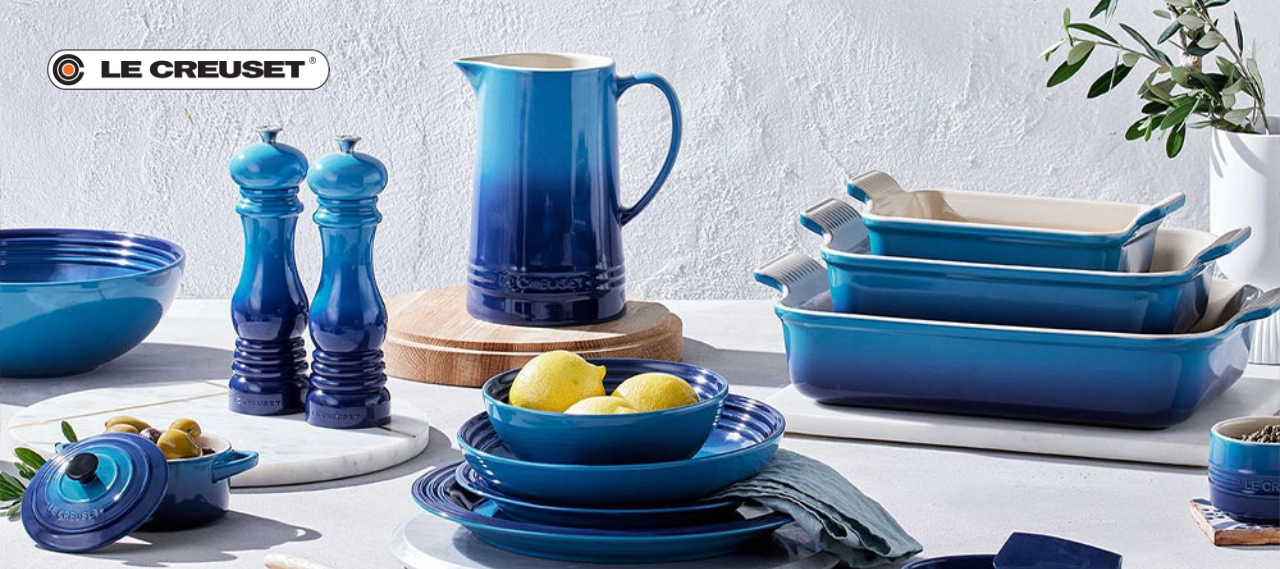
- Use a financier mould sized for the classic ingot shape, because the width-to-depth ratio is what gives you crisp edges and a soft centre rather than one or the other.
- Use a whisk to combine the batter smoothly without beating air into the whites.
- Use a piping bag to fill the moulds cleanly and evenly, which is much tidier than spooning a loose batter.
Tips for success
- Use a light-coloured pan for the butter. In a dark pan you can’t see the milk solids colouring, and by the time you can smell that it’s gone too far, it has. If you only have dark pans, tip a little onto a white plate to check the colour.
- Scrape every bit of the browned solids into the batter. Those toasted specks at the bottom of the pan are the flavour. Leaving them behind gives you melted butter with a nice smell and none of the depth.
- Weigh your egg whites rather than counting eggs. Eggs vary a lot, and this batter is a ratio. 140g is the target, which is roughly four whites but not reliably so.
- Rest the batter overnight if you can. It’s the least effortful improvement available: better crumb, cleaner flavour, and the batter holds its shape in the mould.
- Fill the moulds nearly to the top. Financiers don’t rise dramatically, so a half-filled mould gives you a thin, dry biscuit rather than a cake with a soft middle.
- Bake hot and take them out slightly early. They continue cooking in the hot mould after they come out, so pull them when the edges are golden and the centre is just set. Overbaked financiers go dry and lose the point.
- Grease the moulds properly, even non-stick ones. All that butter in the batter still catches, and a torn financier is a sad thing. Brush with soft butter and dust with a little flour for metal moulds.
How to store it
- At room temperature: In an glass airtight container for 2 to 3 days. They’re at their best on day one, when the edges are still crisp, and they soften as they sit. A few minutes in a warm oven revives them.
- In the freezer: They freeze very well, baked and cooled, for up to 3 months. Freeze them in a single layer first, then bag them, and thaw at room temperature or warm briefly from frozen. You can also freeze the raw batter, which is useful given it wants a long rest anyway.
- In the fridge: For the batter, not the baked cakes. The batter keeps 2 to 3 days covered in the fridge, so you can bake a few fresh whenever you want them, which is the best way to eat them.
More dessert recipes to try
Variations
- Pistachio: replace about a third of the ground almonds with pistachio flour, and top with chopped pistachios. Vivid green, and one of the classic French versions.
- Hazelnut: ground hazelnuts in place of some of the almonds doubles down on the nuttiness of the brown butter. The most natural pairing of the lot.
- Raspberry: press a single raspberry into the top of each before baking. The acidity cuts the richness and they look wonderful. Frozen berries work too.
- Citrus: lemon or orange zest in the batter, added with the dry ingredients so the oils disperse. Bright, and good in summer.
- Chocolate: a few dark chocolate chips, or a spoonful of cocoa powder replacing some of the flour. Less traditional, extremely popular with children.
- Less sugar: the sugar here is partly structural, it keeps the crumb moist and helps the edges caramelise and crisp, so it can’t be cut drastically. You can take 140g down to about 110g and still get a good result, slightly less crisp at the edge and more nutty. Below that they turn dry and pale rather than golden, so if you want something properly less sweet, use a tarter topping like raspberry rather than cutting further.
FAQ
What is a financier cake?
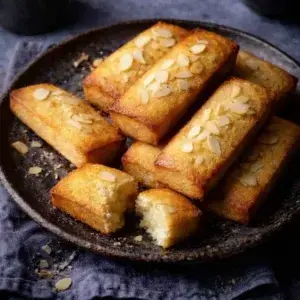
A small French almond cake made with ground almonds, egg whites, icing sugar and brown butter, baked in a rectangular mould. Crisp at the edges, dense and moist in the middle.
Why is it called a financier?
The usual story is that a Paris pâtissier named Lasne shaped them like gold ingots for his clients near the Bourse. The details don’t hold up to checking, but the name and the ingot shape stuck.
Do you whip the egg whites for financiers?
No. Unwhipped whites give the dense, fudgy centre that defines a financier. Whipping them makes a lighter, more sponge-like cake, which is a different thing.
Why is brown butter used in a brown butter financier?
Beurre noisette gives the nutty, caramelised depth that plain melted butter can’t. It’s the main source of flavour in a recipe with very few ingredients.
Can I make financiers without a financier mould?
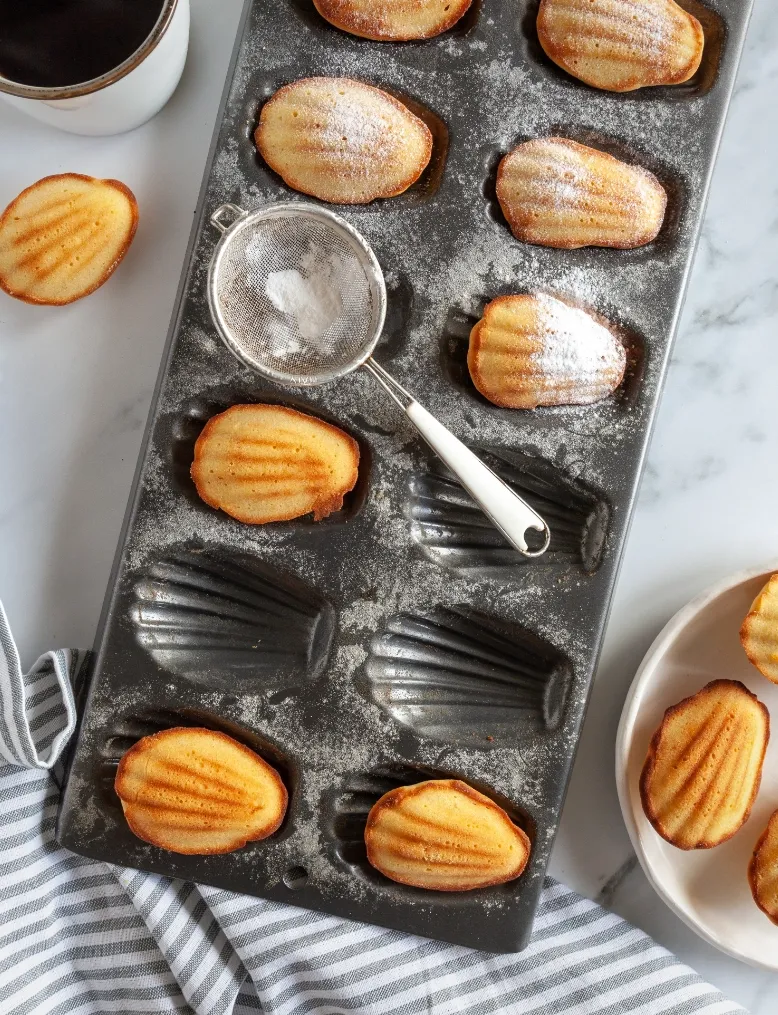
Yes, muffin or madeleine tins work. You’ll get a different ratio of crisp edge to soft centre, since the classic rectangular mould is sized specifically for that balance.


 Prep Time 15 minutes
  Cook Time 15 minutes
  Total Time 30 minutes
  Servings 18 financiers
Description
Ingredients
- 4 eggs only the egg whites, about 140gr
- 140 gr unsalted butter
- 120 gr ground almonds
- 140 gr icing sugar
- 50 gr plain flour
- 3 drops almond extract or vanilla extract
- flaked almonds for decoration
- 1 pinch salt
Equipment



Instructions
1. Brown the butter
- Melt the butter in a saucepan over medium heat. Once it foams, keep cooking for about 5 minutes until the milk solids turn golden and it smells nutty (beurre noisette). Pour immediately into a cold bowl to stop the cooking, and leave to cool.
2. Mix dry ingredients
- In a large bowl, sift together the ground almonds, icing sugar, flour and a pinch of salt.
3. Add the egg whites
- Add the egg whites unwhipped, straight from the shell. Fold gently into the dry ingredients with a spatula until evenly combined. Don't whisk them to a froth, unwhipped whites are what give financiers their dense centre.
4. Add browned butter and flavour
- Slowly pour in the cooled browned butter, stirring continuously until smooth, scraping in all the toasted solids. Stir in the extract.
5. Rest the batter
- Cover and refrigerate for at least 1 hour, preferably overnight. This gives a finer crumb, cleaner flavour, and a batter that holds its shape.
6. Preheat the oven
- Heat to 200°C (180°C fan). Grease the financier moulds and set them on a baking tray.
7. Fill the moulds
- Spoon or pipe the batter into the cavities, filling each nearly to the top. Scatter with flaked almonds.
8. Bake the financiers
- Bake in the middle of the oven for 13–15 minutes (about 10 minutes for mini financiers), until golden with crisp edges and just set in the centre.
9. Cool and serve
- Leave in the moulds for 5 minutes, then transfer to a wire rack. Good warm or cooled, ideally with a cup of coffee!
Notes
- Financiers are a wonderful way to use leftover egg whites, and the subtle nuttiness of the browned butter is key for authenticity.
- Variations include swapping some almond flour for hazelnut or pistachio flour, topping with fresh fruits or chocolate chips, or adding citrus zest for a modern twist.
- They freeze well and keep for several days if stored airtight at room temperature.
Share your feedback and spread the love!
If you try this recipe, I’d love to hear how it turns out! Leave a ★★★★★ rating and your thoughts in the comments, it helps fellow French foodies discover this recipe too. Snap a photo and tag @obviously.french on Instagram. Come talk about it in our Facebook group. And don’t forget to save this recipe to Pinterest so you’ll always have it handy for your next French-inspired meal!