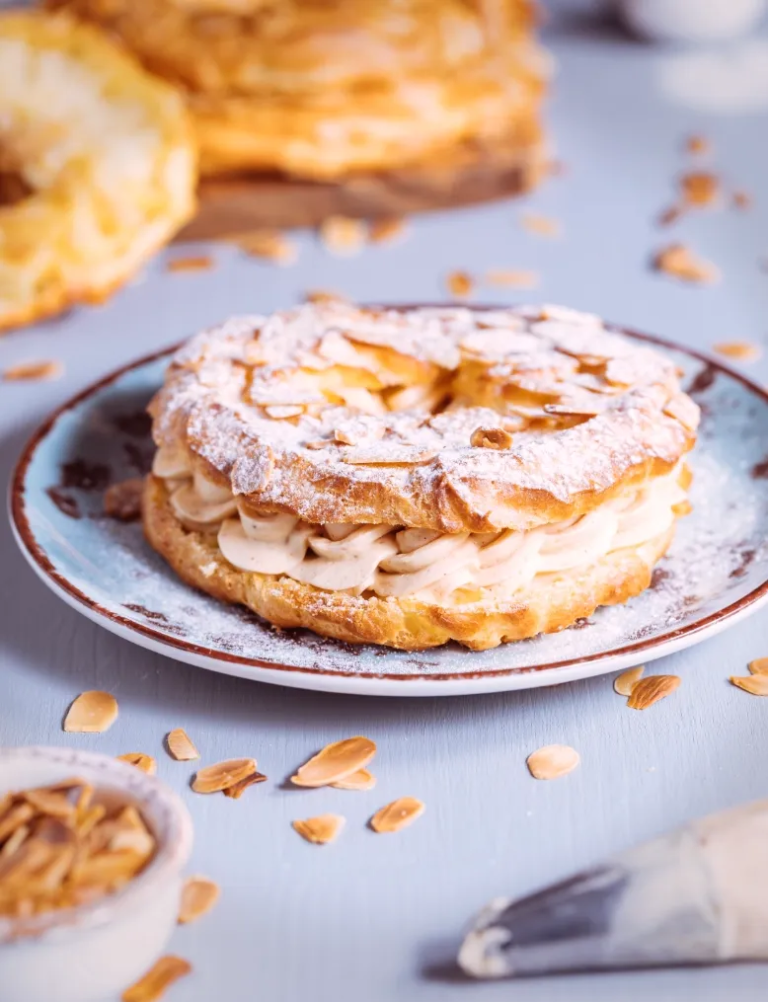
Paris-Brest
 Prep Time 2 hours
  Cook Time 45 minutes
  Total Time 4 hours
  Servings 8
Ingredients
For the choux pastry
- 125 ml water
- 125 ml whole milk
- 110 gr unsalted butter
- 1 tsp caster sugar
- 1/2 tsp salt
- 150 gr plain flour
- 5 egg room temperature
- 1 egg for egg wash
- 50 gr flaked almonds
- icing sugar for dusting
For the praline
- 150 gr hazelnuts blanched
- 150 gr caster sugar
- 4 tbsp water
For the praline mousseline cream
- 500 ml whole milk
- 6 egg yolks
- 100 gr caster sugar
- 50 gr cornflour
- 250 gr unsalted butter room temperature
- 200 gr praline paste from above
Equipment
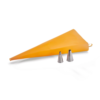
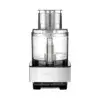

Instructions
1. Draw your template
- Get a 20cm plate and trace a circle on your baking paper. Flip it over so the pencil mark's on the bottom. You'll pipe your choux following this guide. Some people do two rings, one inside the other. I prefer one thick ring, less faff, same result.
2. Make the choux pastry
- Put the water, milk, butter, sugar and salt in a saucepan. Bring to a proper rolling boil, the butter needs to be completely melted. Remove from heat and dump in all the flour at once. Stir vigorously with a wooden spoon until it forms a smooth ball that pulls away from the sides. This takes about 2 minutes of proper arm work.Put the pan back on medium heat for another minute, stirring constantly. You'll see a thin film form on the bottom of the pan. That's what you want, it means the flour's cooked.
3. Add the eggs
- Transfer the dough to your stand mixer with the paddle attachment. Let it cool for 5 minutes, if it's too hot, the eggs will scramble. Beat the eggs in a jug. With the mixer on medium, add the eggs bit by bit. You might not need all of them. Stop when the mixture is glossy and falls from the paddle in a thick ribbon that takes a few seconds to disappear back into the mass. Too runny and your choux won't hold its shape.
4. Pipe the ring
- Transfer to your piping bag. Following your template, pipe a thick ring, about 5cm wide. Then pipe another ring directly on top. If you're feeling fancy, pipe a third ring in the groove where the two meet. Brush with egg wash (carefully, don't deflate it) and sprinkle with flaked almonds.
5. Bake the choux
- Heat your oven to 200°C. Bake for 20 minutes, then reduce to 180°C and bake for another 20-25 minutes until deep golden brown. The most common mistake is underbaking. It should be properly brown and feel light when you pick it up. Turn off the oven, prop the door open with a wooden spoon, and let it cool in there for 30 minutes. This stops it collapsing.
6. Make the praline paste
- While that's cooling, make your praline. Toast the hazelnuts in a dry pan until golden and fragrant, about 5 minutes. Keep them moving so they don't burn. Put the sugar and water in a heavy saucepan and heat without stirring until it turns a deep amber colour. Chuck in the hot hazelnuts, stir once, then immediately pour onto a lined baking sheet. Leave to cool completely, it'll be rock hard.Break it into pieces and blitz in a food processor. First it'll be a powder, then suddenly it'll turn into a smooth, runny paste. This takes ages, at least 10 minutes of processing. Scrape down the sides occasionally. Keep going until it's completely smooth.
7. Make the pastry cream base
- Heat the milk in a saucepan until just steaming. Meanwhile, whisk the egg yolks and sugar until pale, then whisk in the cornflour. Pour the hot milk over the egg mixture, whisking constantly. Return everything to the pan and cook over medium heat, whisking continuously, until it's thick and bubbling. This takes about 3-4 minutes. It needs to properly boil for at least a minute to cook out the cornflour.Transfer to a bowl, press clingfilm directly on the surface, and cool completely. You can speed this up by sitting the bowl in ice water.
8. Finish the mousseline
- Once the pastry cream is completely cold, beat it with the paddle attachment until smooth. With the mixer running, add the butter bit by bit. It might look curdled at some point, keep going, it'll come together. Once all the butter's in, add your praline paste and beat until smooth. It should be thick enough to pipe but still creamy.
9. Assemble
- Cut the choux ring in half horizontally with a serrated knife. Pipe the praline cream generously on the bottom half, use a star nozzle if you want it to look professional. Be generous. Place the top back on and dust with icing sugar.
Notes
- Praline paste keeps for months in a jar in the fridge. Make extra.
- The unfilled choux can be frozen. Refresh in a hot oven for 5 minutes.
- Mousseline is temperature-sensitive. If it splits, it’s usually too cold. Leave it at room temperature for 30 minutes and beat again.
- No food processor? You can buy praline paste from French specialty shops, but homemade is miles better.
- Weather matters. Don’t attempt this on a humid day. The choux will go soggy in minutes.
About this recipe
A tribute to a cycle race in 1891
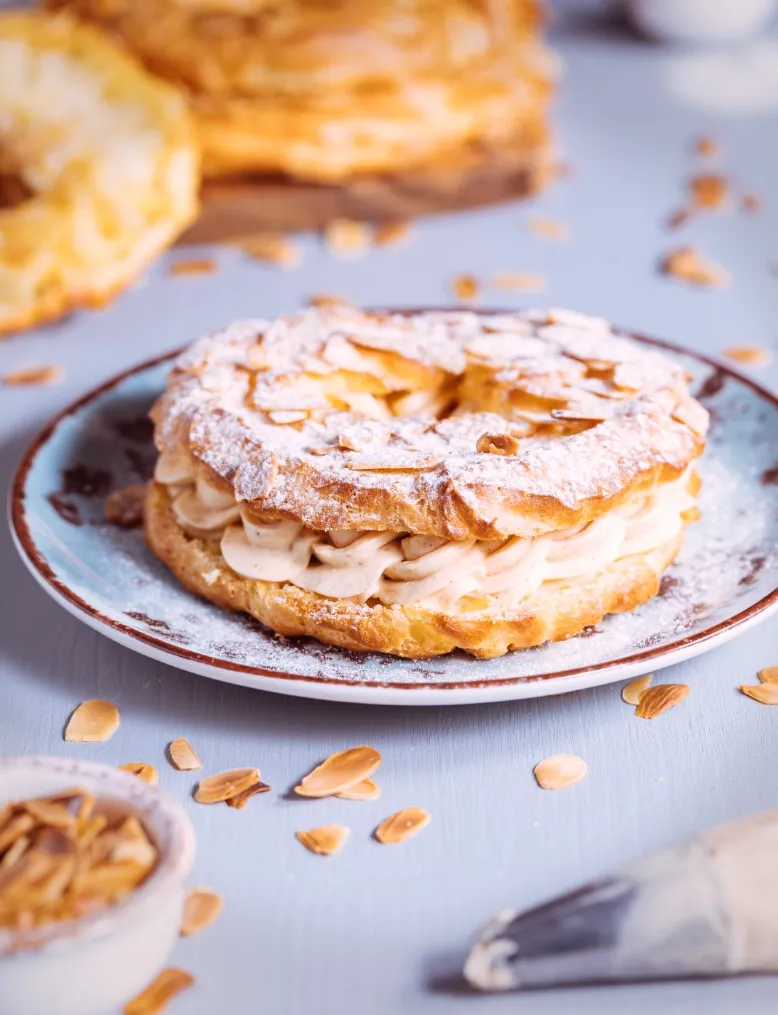
The Paris-Brest is my favourite French pastry. I know that is a strong statement in a country that produces the mille-feuille, the éclair, the Saint-Honoré, and the tarte au citron, but I stand by it. The praline mousseline filling, the choux pastry ring, the toasted almonds on top. Nothing else comes close.
Where the Paris-Brest comes from
This Paris Brest dessert was created in 1910 by Louis Durand, a pâtissier based in Maisons-Laffitte, a town that sat directly on the route of the Paris-Brest-Paris cycling race. The race itself was a 1,200km monster that began in 1891, cycling from Paris to Brest on the Brittany coast and back again. It attracted enormous public interest, and Durand was clever enough to create a pastry that looked like a bicycle wheel to celebrate it. The ring shape is not decorative. It is the wheel.
The Paris-Brest-Paris race still runs today, every four years, a 1,200km endurance event that draws amateur cyclists from around the world. The pastry has outlasted any individual edition of the race and become far more widely known than the event that inspired it. Durand’s marketing instinct in 1910 turned out to be extraordinarily good.
The filling
The original paris brest pastry was filled with praline mousseline, not regular buttercream and not whipped cream. Proper praline mousseline starts with a crème pâtissière base, has butter beaten into it until silky and light, and then has actual caramelised nut paste folded through. The result is rich, nutty, and completely different from any other pastry cream you will encounter.
Some bakeries use whipped cream or standard crème pâtissière instead. This is a cost and time-saving decision, not a culinary one. The praline mousseline is the whole point of this paris brest recipe. Without it you have a choux ring with cream in it, which is fine but not a Paris-Brest. The nutty, caramelised depth of the praline is what makes this brest dessert worth the effort.
The shape
The shape matters. A Paris-Brest is a ring of choux pastry, piped in one continuous circle, baked, split horizontally, and filled. It is not individual choux buns arranged in a circle, which is something else entirely. The ring allows the filling to be distributed evenly and gives you that clean cross-section when you slice it, cream visible all the way around.
The almonds go on top before baking. They toast as the choux cooks and add texture against the soft filling inside.
The right equipment
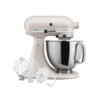
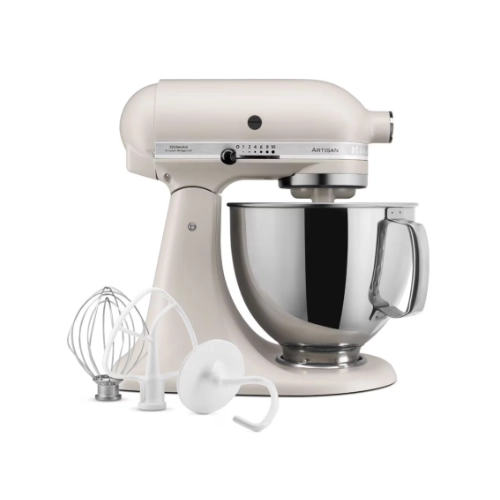
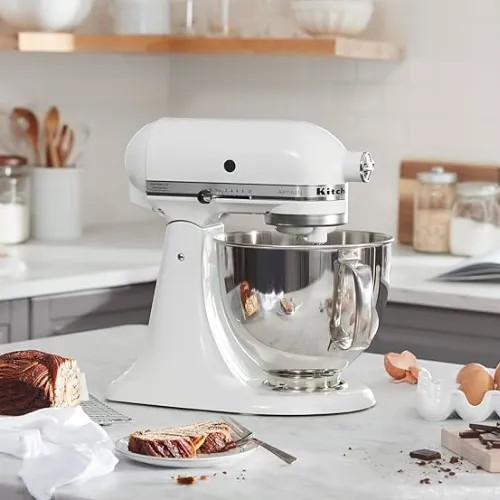
A Paris-Brest demands a stand mixer for the praline mousseline. The butter needs to be beaten into the pastry cream gradually whilst it stays in motion, and doing that by hand is exhausting and produces inconsistent results. The mixer handles the long beating process that develops the silky, light texture the mousseline needs.
I use the KitchenAid stand mixer for this paris brest pastry. The planetary mixing action reaches every part of the bowl, which means the butter incorporates evenly rather than building up on one side. The whisk attachment aerates the mousseline as it beats, giving you a lighter result than a paddle alone would produce. For a pastry cream this important to the finished dish, the mixer is not a luxury. It is what makes the difference between a mousseline that is silky and a mousseline that is dense.
Making it at home
The Paris-Brest is not a quick recipe. The choux needs to be made and baked. The praline needs to be caramelised and processed. The mousseline needs to be assembled carefully. Plan for three hours the first time and less on subsequent attempts once you understand where the time goes.
It is worth every minute. This paris brest recipe produces something that looks spectacular on the table, tastes extraordinary, and is entirely achievable with patience and the right equipment. The fact that it was invented to look like a bicycle wheel and became one of the great French pastries is exactly the kind of outcome the French find entirely natural.
Share your feedback and spread the love!
If you try this recipe, I’d love to hear how it turns out! Leave a ★★★★★ rating and your thoughts in the comments, it helps fellow French foodies discover this recipe too. Snap a photo and tag me @obviously.french on Instagram if you’re sharing your bake or cooking online. Don’t forget to save this recipe to Pinterest so you’ll always have it handy for your next French-inspired meal!
Disclosure: Just so you know, this post contains sponsored content and/or affiliate links, If you make a purchase through these links, I may receive a small commission. Doesn’t cost you anything extra. I only link to things that are actually worth your time. All opinions are my own!